
Colombia's Mining and Energy Planning Unit (UPME) awarded the UPME 03-2024 tender on March 26, 2026 for the installation of synchronous compensators in the National Interconnected System – the first time this grid-stabilization technology has been deployed in the country.
Read moreEcopetrol announced at its March 27 shareholder assembly that construction will begin immediately on the Windpeshi wind farm in La Guajira — between the municipalities of Uribia and Maicao — Colombia's largest wind energy project. The 205 MW facility is targeted for commissioning by late 2027, with a total investment of approximately US$350M across 2025–2027.
Read moreColombia's major electricity holding companies held their annual shareholder assemblies in late March, producing a mix of routine governance decisions and pointed shareholder friction that reflects the sector's broader tensions.
Read moreSome random notes on what we saw in the first quarter of 2026 from a green energy perspective – some longer than others, some more profound than others.
Read moreSpeaking at a high-level intercultural dialogue with Afro-Colombian, Raizal, and Palenquera communities in Barranquilla on March 25, 2026, President Gustavo Petro made his most direct case yet for reconciling the prior consultation process with the expansion of renewable energy – arguing that clean energy development is in the interest of the Caribbean's ethnic and mixed-race communities, not a threat to them.
Read moreISA, Latin America's largest electricity transmission company and an Ecopetrol subsidiary, publicly acknowledged for the first time that it is actively watching Venezuela as a potential investment destination, even as its annual shareholders' assembly in Medellín on March 26, 2026 was clouded by a formal governance complaint from minority shareholders.
Read moreColombia's energy, agricultural, and macroeconomic outlook faces a new headwind: the Ministry of Environment, IDEAM, and the national disaster risk agency UNGRD have all confirmed an 80% probability of El Niño developing and consolidating in the second half of 2026, with a 13% chance of a "super El Niño" — defined as sea surface temperature warming above 2°C — toward year-end.
Read moreThe Ministry of Mines and Energy issued Resolution 40163 on March 27, 2026, authorizing thermal power plants to commercialize imported natural gas on the secondary market — a transitional measure valid for six months designed to unlock underutilized LNG import capacity and broaden gas supply at a moment of acute national shortage.
Read morePresident Gustavo Petro announced on March 25, 2026 that Colombia will withdraw from the international investment arbitration system – the framework under which foreign investors can bring disputes against states before private arbitral tribunals rather than national courts – citing the structural bias he argues such tribunals exhibit in favor of private claimants over sovereign governments.
Read moreEnergy and Mines Minister Edwin Palma represented Colombia at CERAWeek in Houston on March 25, 2026, using one of the global energy sector's most prominent forums to advance the Petro government's framing of the energy transition as a technically grounded, socially responsible process rather than an ideological commitment.
Read moreThe MinEnergia and the Fondo de Energías No Convencionales y Gestión Eficiente de la Energía (FENOGE) announced on March 19, 2026 that the Caribe Cambia Tu Energía program will replace inefficient refrigeration equipment in 12,931 strata 1, 2, and 3 households across Bolívar, Cesar, Córdoba, Sucre, and several Magdalena municipalities, with discounts of up to 40% on energy-efficient replacements.
Read moreThe Petro government issued decrees on March 27, 2026 fixing a 7% salary increase for public servants working in national entities of the executive and judicial branches, with the same adjustment applying to teachers. The increase is retroactive to January 2026.
Read moreThe clearest lesson from Colombian energy companies' 2025 annual results is a structural one: businesses with regulated revenues from electricity transmission and distribution networks held up far better than those exposed to hydrological risk, commodity price cycles, or operational volatility.
Read morePromigas closed 2025 with 292,255 new users connected across its gas and electricity businesses, reaching approximately 7.5 million clients in 1,114 communities across Colombia and Peru.
Read moreWith Colombia's presidential election approaching, the country's energy policy has emerged as one of the sharpest lines of division among the leading candidates – with the opposition right promising an immediate reversal of the Petro-era hydrocarbon moratorium and the ruling coalition's candidate signaling continuity in an energy transition that keeps extractive sectors alive but conditions them on environmental and social limits.
Read moreThe Petro government's Group of State Participations within the Ministry of Finance has proposed reforms to the bylaws of the Electrificadora del Meta (EMSA) that would alter the rules for appointing the company's directors — a move that minority shareholders are publicly resisting on the grounds that it would tilt corporate control toward the national government and undermine the merit-based selection processes built up in recent years.
Read moreResearchers from the Universidad del Norte, in collaboration with the Universidad Nacional de Colombia's Medellín campus, are running what they describe as Latin America's first pilot project for salinity gradient energy — or "blue energy" — at Puerto Mocho, near Bocas de Ceniza, where the Magdalena River meets the Caribbean Sea.
Read moreSolar energy surpassed coal in Colombia's annual electricity generation in 2025, according to data published by the Unidad de Planeación Minero Energética (UPME).
Read moreThe Ministry of Housing, City and Territory released a technical guide on March 19, 2026 consolidating Colombia's regulatory framework for sustainable building, mapping eight categories of available incentives and providing practical case studies to help developers, public entities, and financial actors implement greener construction projects.
Read more
This quarter witnessed important advances in major projects like the Bogotá Metro, the first train on the flagship La Dorada–Chiriguaná corridor and, inevitably, a few setbacks.
Read moreEcopetrol has taken full ownership of the Portón del Sol solar park in La Dorada, Caldas, through a merger by absorption in which the project's separate corporate entity will be dissolved and its assets, liabilities, and equity transferred directly to the state oil company.
Read moreThe Ministry of Mines and Energy formalized the Colombia Solar program on March 19, 2026 through Resolution 40159, establishing the technical, financial, and operational framework for rolling out distributed solar generation to households in strata 1, 2, and 3.
Read moreThree state-owned electricity generators formally committed to a new tariff methodology in a high-level meeting chaired by President Gustavo Petro on March 19, 2026, in a move the government presented as a structural measure to reduce speculation in the spot market and lower costs for Colombian households.
Read moreA new multi-stakeholder coordination platform for Colombia's energy transition was launched in Bogotá on March 19, 2026, backed by international funding and designed to address what its organizers identify as the country's core structural problem: not a lack of initiative, but a lack of coordination among the many actors pursuing it in parallel.
Read more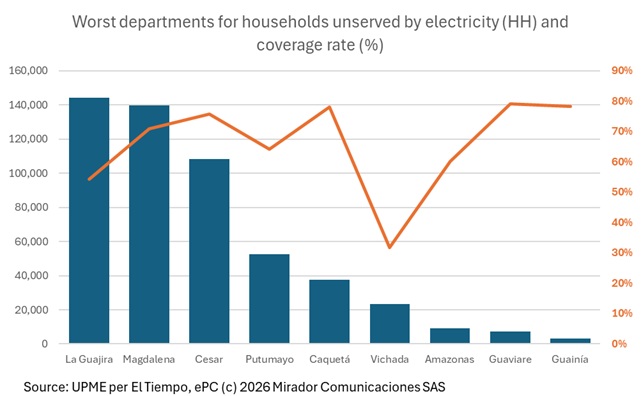
Colombia's Mining and Energy Planning Unit (UPME) released its 2024 Electricity Coverage Index (ICEE), showing that national household electrification reached 93.12% — up 0.45 percentage points from 92.67% in 2023 — as 539,351 new homes were connected during the year.
Read moreEnergy and Mines Minister Edwin Palma met on March 17, 2026 with U.S. Embassy Chargé d'Affaires Jarahn Hillsman and his economic team to review bilateral cooperation and investment opportunities across Colombia's energy sector.
Read moreColombia's gas industry association Naturgas issued a striking warning on March 13, 2026: the country's loss of gas self-sufficiency is producing an accidental reversal of its industrial energy transition, as companies priced out of natural gas migrate toward coal, fuel oil, and other more carbon-intensive alternatives.
Read morePromigas has deployed a continuous intelligent monitoring system at one of its gas infrastructure assets, marking what the Cartagena-based company describes as a strategic step toward carbon neutrality, zero-accident operations, and full digitalization of its asset management processes.
Read more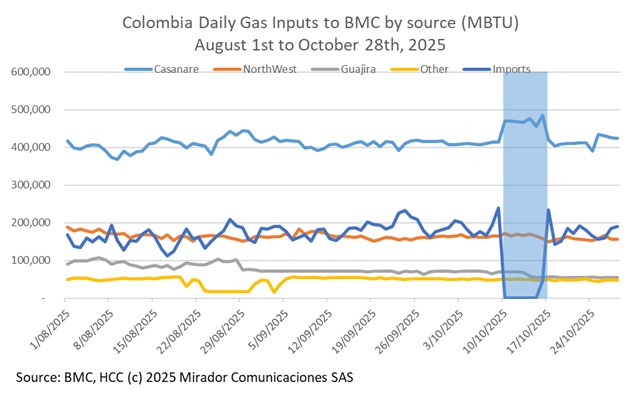
A post-mortem analysis by Asoenergía – the Colombian Association of Large Industrial and Commercial Energy Consumers – of the October 2025 maintenance shutdown of the SPEC LNG regasification terminal in Cartagena has revealed how poor supply planning drove residential gas contract prices to nearly three times their normal level in just a matter of days.
Read moreColombia's energy sector trade associations gathered in Cartagena on March 17, 2026 to issue a coordinated alarm over what they described as the deepest financial and operational crisis to hit the electricity and gas supply chain in recent memory.
Read moreColombia's General Controller issued a broad warning on March 18, 2026 saying that the country faces a genuine risk of energy rationing and tariff increases, presenting the findings of a sectoral study titled Quality Supply and Energy Storage in Colombia 2020-2030 (Abastecimiento con Calidad y Almacenamiento Energético en Colombia 2020–2030) at a public forum.
Read moreEnergy and Mines Minister Edwin Palma used a Controller’s forum on March 18, 2026 to push back against what he characterized as an alarmist narrative around Colombia's energy security, while opening a significant new debate about a structural component of the electricity tariff.
Read moreThe Electrificadora de Santander (ESSA), a 135-year-old EPM Group utility serving Santander department, is entering electricity generation for the first time through a set of utility-scale solar parks of its own — a strategic step that marks a meaningful expansion of its business model beyond its traditional distribution role.
Read moreColombia's Inspector General's Office has formally demanded that the Superintendency of Public Utilities (Superservicios) expand its reporting on the ongoing state intervention of Air-e, the troubled Caribbean electricity distributor, after concluding that an initial report submitted by the regulator was too vague to allow meaningful oversight of the process.
Read moreA Revista Cambio investigation published March 16, 2026 and based on documents now held by the Fiscalía reveals a coherent pattern of financial opacity during Energy Minister Edwin Palma's tenure as special intervening agent at Air-e: large payment agreements covering pre-intervention debts, the systematic restriction of financial information from auditors and successor officials, and the concentration of accounting control within Palma's immediate personal circle.
Read more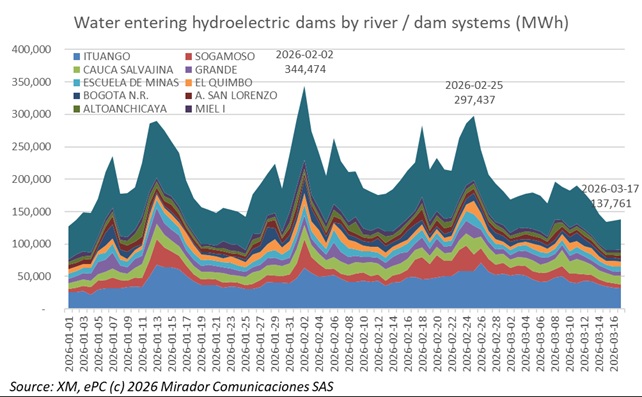
With other issues on their minds, President Gustavo Petro and MinEnergia Edwin Palma have stopped complaining about reservoir levels. We still thought we would update our principal charts concerning water levels in hydro dams, which we hadn’t looked at in six weeks or so.
Read more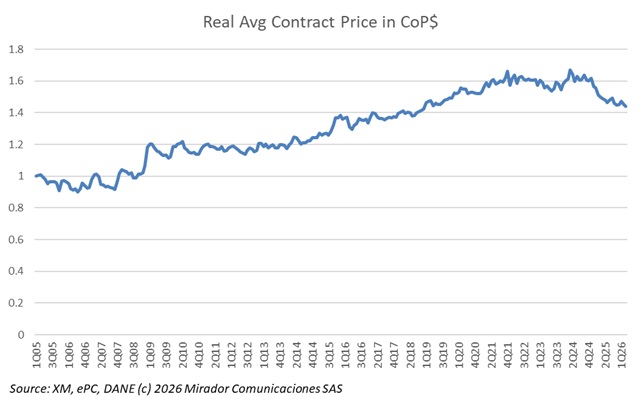
Tariffs once again capture MinEnergia’s attention and, by extension, that of SuperServicios and the CREG. This is a hard argument to make for the average non-economist looking at their bill but, in real terms, prices have been under control since the pandemic.
Read moreEPM has launched a technical cooperation project with the South Korean government focused on developing circular economy solutions for the Hidroituango reservoir, the 78-kilometer impoundment on the Cauca River that houses Colombia's largest hydroelectric plant.
Read moreColombia's Ministry of Mines and Energy has launched a national call for technical cooperation project proposals under its partnership with the International Atomic Energy Agency (IAEA), targeting the 2028–2029 cooperation cycle. The announcement, dated March 11, 2026, builds on two decades of joint work through which nuclear techniques have been applied to radiological safety, cancer treatment, agricultural productivity, and environmental monitoring.
Read morePresident Gustavo Petro's administration is defending the continued tenure of Ricardo Roa and Jorge Carrillo at two of Colombia's most strategically important state enterprises despite escalating legal controversies surrounding both officials,
Read more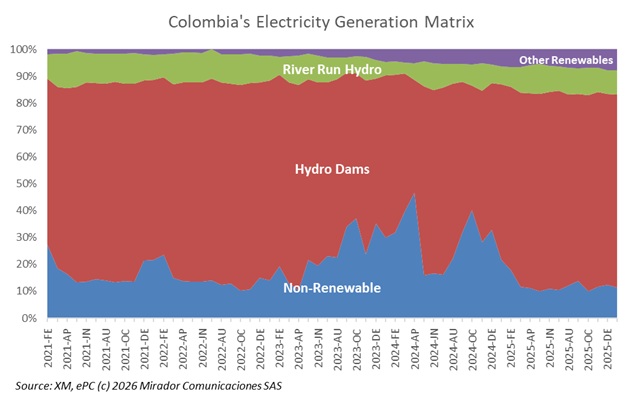
Colombia's Ministry of Environment and Sustainable Development and IDEAM issued an early warning on March 16, 2026 following detection of warming signals in the equatorial Pacific Ocean indicating possible El Niño development during the second half of the year, with potential implications for national water resources and agricultural sectors.
Read moreHidroituango S.A. issued a stark warning about Colombia's electricity sector vulnerability after analysis revealed the Sistema Interconectado Nacional (SIN) experienced net capacity contracted in 2025 despite new generation project additions.
Read moreSmall-scale solar installations are emerging as a practical complement to large renewable energy parks in Colombia's electricity transition, with fifty generators coordinated by Unergy contributing 65,916 MWh to the Sistema Interconectado Nacional between December 2023 and January 2026—equivalent to annual consumption of more than 35,000 Colombian households
Read moreColombia's Ministry of Mines and Energy presented a draft resolution on March 12, 2026 establishing transitional guidelines for differential electricity tariffs targeting the country's most vulnerable families, particularly those in historically underserved rural areas and territories facing operational difficulties.
Read moreColombia's February inflation rate of 5.29% came in below market expectations of 5.5%, driven primarily by energy price deceleration rather than broad-based disinflation.
Read moreThe Colombian government issued a decree suspending electricity billing and collection for properties affected by the economic emergency declaration in eight departments until users recover payment capacity.
Read moreThe Departamento Nacional de Planeación (DNP) conducted a technical tour of three strategic works funded by royalty resources in Santander that generate direct community benefits.
Read moreCopper and rare earth minerals have displaced petroleum as the primary strategic resources in global competition, transforming international relations into what experts call "Diplomacy of the Subsoil."
Read moreColombia's infrastructure sector presents a contrasting landscape for 2026-2027, with transport projects experiencing both advancement and uncertainty.
Read moreGrupo Ecopetrol reached 99% of its 2030 energy efficiency optimization target by 2025, achieving 24.9 petajulios (PJ) of accumulated energy optimization between 2018 and 2025.
Read moreEnel Colombia registered 28,290 electricity theft cases during 2025, affecting service quality for over 300,000 customers and costing the company more than CoP$1.2B to normalize operations.
Read moreLast Sunday, March 8th Colombians went to the polls to vote in presidential primaries and, more importantly perhaps, to vote in congressional contests for the upper and lower houses. What happened and what does it mean?
Read more
Colombia reached 4 gigawatts in clean energy generation, representing 17.09% of the country's total energy matrix, with the launch of the new Parque Solar Atlántico.
Read moreCelsia strengthened profitability in 2025 despite declining revenues, reporting fourth-quarter net profit of CoP$361B, representing 6.6% growth, while net profit attributable to the controlling company reached CoP$206B.
Read moreENEL announced its 2026-2028 plan includes investments of €53B (US$62.5B), representing €10B (US$11.8B) more than the previous plan, with a focus on accelerating growth in stable environments through renewable energy.
Read moreGrupo Energía Bogotá (GEB) recently published its 2025 sustainability report, a 74-page document that covers all aspects of performance from financial to social. We dug into a few chapters and summarized what it had to say.
Read more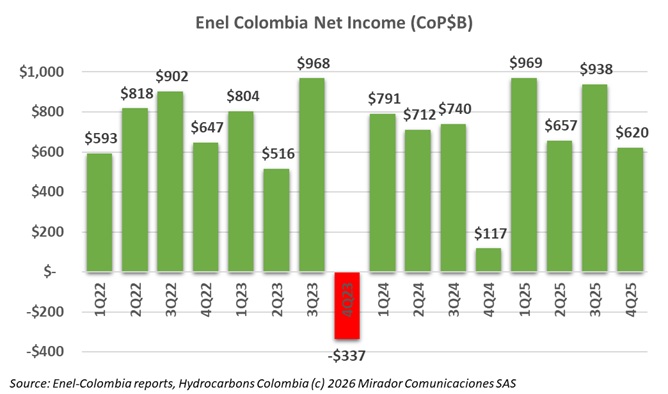
Enel Colombia closed 2025 with net profit of CoP$3.1T, representing 34.9% growth despite operational revenues declining 5.9% to CoP$16T. The company reported consolidated EBITDA of CoP$7.3T, equivalent to 20.7% growth.
Read moreColombian energy company Terpel advanced its energy transformation process by acquiring a large-scale photovoltaic solar plant as part of its corporate strategy to expand beyond traditional liquid fuels and position itself as a comprehensive energy solutions provider in Colombia.
Read moreColombia's Energy and Gas Regulatory Commission published draft Complementary Agreement 001 for public consultation February 27, 2026, marking significant progress toward enabling the first bilateral electrical energy exchange between Colombia and Panama. The draft agreement develops detailed guidelines for cost distribution, interconnection remuneration, and efficient development of the binational project.
Read moreColombian economic think tank ANIF warned that hourly labor costs will surge 34.7% over approximately one year, rising from CoP$7,736 in the first half of 2025 to CoP$10,422 by the second half of 2026.
Read moreColombia's Ministry of Mines and Energy signed a Memorandum of Understanding with the International Atomic Energy Agency (IAEA) establishing a technical cooperation framework for nuclear technology applications oriented toward decarbonizing energy systems and strengthening electrical supply.
Read moreColombia achieved 93.12% national electric coverage in 2024 after connecting 539,351 new homes to the grid, with rural areas registering the year's strongest growth, according to announcements from the Ministry of Mines and Energy and Enel Colombia.
Read moreColombia's accelerating electric vehicle adoption is forcing insurers to recalibrate pricing models and risk assessments as higher repair costs, battery replacement expenses, and infrastructure limitations challenge traditional automotive insurance frameworks.
Read moreEcopetrol commissioned a 43.6 kilowatt-peak (kWp) photovoltaic system at the Institución Etnoeducativa Internado Laachon Mayapo, located in the Mayapo corregimiento of Manaure municipality in La Guajira.
Read moreGrupo Energía Bogotá (GEB) closed 2025 with profit before taxes of CoP$3.20T, yielding net profit of CoP$3.17T after income tax provision of CoP$26.111B. However, the amount available for distribution differs significantly from accounting net profit, as the company applies a distribution model based on actual cash flow generated rather than equity method accounting gains.
Read moreColombia's National Business Council (Consejo Gremial Nacional) rejected the government's use of the economic emergency declaration to introduce structural changes, while supporting urgent measures to address flooding and extreme weather affecting eight departments.
Read moreColombia's Superintendency of Public Services (Superservicios) established a Unified Command Post (PMU) to conduct permanent monitoring of the Caribbean energy market following its intervention in utility company Air-e, which serves over 1.3 million subscribers across the departments of Atlántico, Magdalena, and La Guajira.
Read more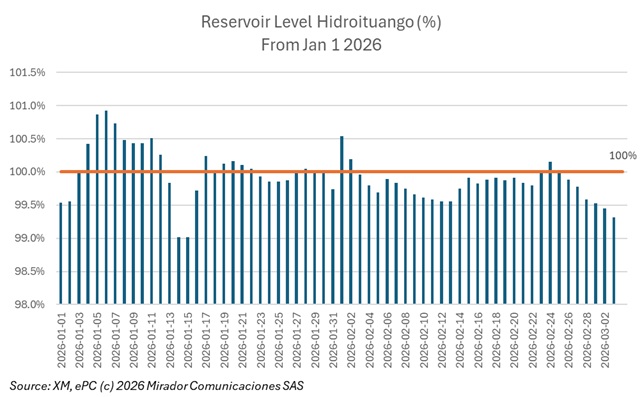
More sunshine in Bogotá the past few days blinds us to the fact that the rains continue creating both engineering and political difficulties for the hydroelectric generators. We look at the ongoing controversies and try to understand what’s happening at Hidroituango, the country’s most important dam.
Read moreISA closed 2025 with revenues of CoP$16T, a slight increase from CoP$15.8T in 2024, with energy businesses contributing 82%, infrastructure 15%, and telecommunications 3%.
Read moreThe government imposed a temporary 2% surcharge on gross revenues of hydroelectric and thermoelectric companies in flood-affected regions, which could generate between CoP$200B and CoP$300B for risk management financing, according to Valora Analitik (February 25, 2026).
Read moreAcolgén raised alarms over economic emergency decrees issued to address Colombia's flooding crisis, warning they could enable government intervention in reservoir operations.
Read moreThe Ministry of Transport, in partnership with Bancóldex and the National Guarantees Fund (FNG), launched a credit line totaling approximately CoP$14.8B to accelerate the replacement of combustion taxis with electric vehicles.
Read moreColombia's Ministry of Mines and Energy will award a geothermal exploration permit for the Cóndor Paipa project located in Paipa municipality, Boyacá department, to Dewhurst Group.
Read moreColombia's Interconexión Eléctrica SA confronts a governance crisis following the State Council's February 26 annulment of Jorge Andrés Carrillo's election as president, triggering immediate leadership changes. Seven potential permanent replacements have been identified.
Read moreAnother public dispute erupted between President Gustavo Petro and Medellín Mayor Federico Gutiérrez over energy tariffs, Hidroituango operations, and flood relief policies. The confrontation began when Gutiérrez criticized the government's decision to reject international aid for Córdoba flooding victims, calling the measure "absurd" and stating authorities "like to see people suffer."
Read moreThe strike at Electrificadora de Santander, an EPM subsidiary, completed eight days Friday with no advances or agreements reached between workers and the company. Despite the labor action, electricity service in Santander has continued uninterrupted.
Read moreHidroituango generated profits for the first time since operations began, delivering over CoP$241 billion in utilities to shareholders after resolving legal controversies with EPM through conciliation agreement approved December 22, 2025, according to Sociedad Hidroituango General Manager Alejandro Arbeláez.
Read moreJanuary 2026 analysis of Caribbean electricity market cost composition revealed generation and transmission components dominate consumer bills, according to Codisgen.
Read moreEcopetrol and ISA announced creation of the "Alliance for Energy Transition in Rural Areas," an initiative aimed at closing energy gaps, improving quality of life in strategic zones, and promoting energy as development driver.
Read moreColombia's National Environmental Licensing Agency (ANLA) warned that water inflow to the Urrá hydroelectric reservoir in Córdoba increased dramatically, rising from 485 cubic meters per second at 5:00 a.m. Saturday February 13th to 823 cubic meters per second by monitoring period conclusion, representing approximately 69% increase within 24 hours.
Read moreColombia's national government delivered clean energy access to over 1,500 people in rural Cauca communities historically excluded from electricity service through a solar electrification intervention representing the Colombia Solar program's commitment to closing infrastructure gaps in conflict-affected regions.
Read moreSix Colombian energy-sector companies earned recognition in S&P Global's 2026 Sustainability Yearbook, demonstrating the sector's environmental, social, and governance performance among over 9,200 companies evaluated globally, with only 848 achieving yearbook membership.
Read moreColombia's atypical early 2026 rainfall elevated reservoir levels above 74%, substantially higher than the typical 40% for this traditionally dry period, prompting President Gustavo Petro's administration to request energy price reductions from generators and compliance with new Comisión de Regulación de Energía y Gas (Creg) regulations modifying reliability charge calculations. However, industry associations maintain price reductions reflect normal market dynamics rather than government intervention.
Read more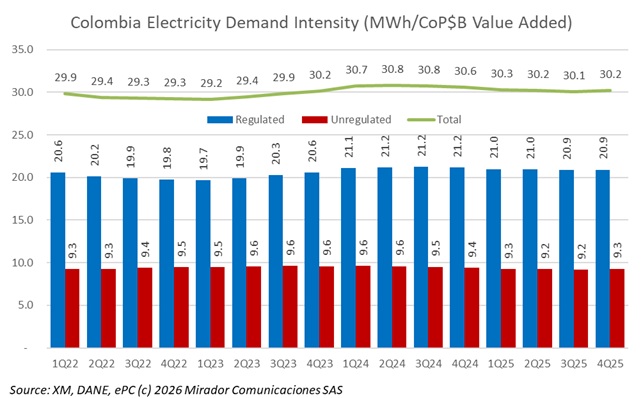
Last September, we wrote an article about power demand intensity with respect to GDP, income elasticity and regulated usage per household. We also produced a crude forecast to 2030 based on this model. But we only had data to 2Q25. Now we have demand and GDP to 4Q25 so we update the charts.
Read more
President Gustavo Petro characterized as an administration milestone the recent Unidad de Planeación Minero-Energética (UPME) report confirming Colombia has surpassed 16% participation of non-conventional clean energies in its national electrical matrix. He’s not exactly correct.
Read moreColombia's national government inaugurated two community solar sports fields in Barranquilla's Adelita de Char and Las Malvinas neighborhoods with CoP$4.894 billion investment, integrating sports infrastructure with distributed renewable energy generation to address electricity cost pressures in vulnerable residential sectors.
Read moreColombia's national government announced the appointment of electrical engineer Víctor Paternina as Vice Minister of Energy, bringing over 18 years of energy sector experience.
Read moreEmpresas Públicas de Medellín (EPM) recently published a primer to address public concerns about water management in the wake of heavy rains and President Gustavo Petro’s unsubstantiated accusations that the hydro plants had caused flooding in Colombia’s northwest.
Read moreColombia's Ministry of Mines and Energy announced support for GECELCA's transformation into solar energy through the creation of new subsidiary GECELCA Solar, marking a decisive advance in the country's energy matrix transformation.
Read moreThe Minister of Mines and Energy, Edwin Palma Egea, appointed Karen Schutt Esmeral as the new expert commissioner of the Energy and Gas Regulatory Commission (CREG) .
Read moreISA Energía completed a strategic project improving operational reliability and energy efficiency at Ecopetrol's Barrancabermeja refinery, one of Colombia's most important assets for natural gas supply to the domestic market.
Read moreEmpresas Públicas de Medellín (EPM) is exploring business opportunities in Venezuela following the political transition, with electricity exports as the primary focus.
Read moreEcopetrol Group announced February 17 the launch of pilot testing to convert a heavy cargo vehicle's combustion system to run on a diesel-hydrogen fuel blend, marking Colombia's first operational hydrogen application in fuel transport.
Read morePresident Gustavo Petro urged Colombia's entire business sector to replace coal, gas, and diesel boilers with solar energy during Monday's Cabinet meeting at Casa de Nariño, announcing that government financing for the transition already exists and has been approved.
Read moreColombia's major hydroelectric operators defended their reservoir management practices following President Gustavo Petro's accusations that Urrá and Hidroituango caused severe Córdoba flooding, with responses highlighting both technical explanations and governance contradictions, according to reports from Valora Analitik, EPM, and Portafolio.
Read moreColombia's General Controller (Contraloría General de la República) flagged a presumed loss of CoP$86.054 billion in two Ecopetrol contracts following a 2024 audit, raising fresh concerns about oversight and project management at the state oil company, La República reported on January 19, 2026.
Read more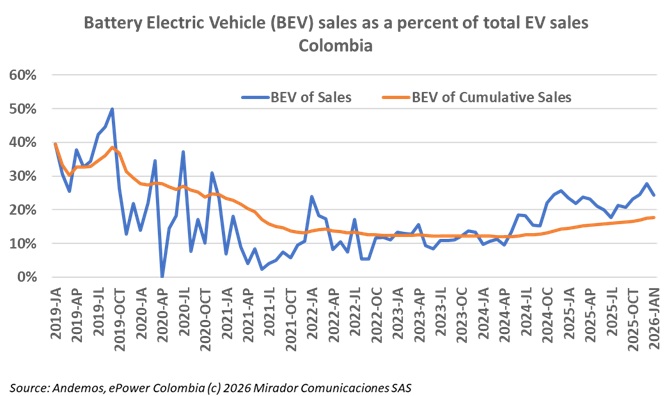
Colombia's electric and hybrid vehicle market surged to record levels in January 2026, with low-emission vehicles capturing approximately one-third of total auto sales during the month, according to RUNT registry data presented by Fenalco and Andi.
Read moreLatin America's electric vehicle market surged to 632,992 electrified units sold in 2025—up 47.5% annually—but a dramatic charging infrastructure divide separates market leaders from fast-growing competitors like Colombia, according to data from Colombia's automotive dealers association (Aconauto) and the Latin American and Caribbean Energy Organization (OLADE).
Read moreEnlaza, a subsidiary of Grupo Energía Bogotá (GEB), completed the Alférez-San Marcos transmission line as part of the 500-kilovolt Southwestern Reinforcement project, strengthening electricity transmission capacity in Valle del Cauca and Nariño regions.
Read more
The International Energy Agency's December 2025 update on the COP28 Tripling Renewable Capacity Pledge provides a comprehensive assessment of global renewable energy ambitions for 2030, with noteworthy findings for the Americas region encompassing Latin America. While Colombia is not specifically mentioned in the report, the analysis offers important insights into renewable energy trends across North America, Central America, South America, and the Caribbean that are directly relevant to understanding Latin America's position in the global energy transition.
Read more