Colombia's government has set December 31st as the deadline to remove any risk of a blackout and issued its first concrete measure, a decree on thermal plant fuel.
Read moreA total power outage lasting four hours would expose about CoP$460.8B of economic value across Colombia's seven Caribbean departments, according to an estimate by the think tank Fundesarrollo.
Read moreColombia's utilities regulator will watch hydro and thermal plants, company finances and grid assets for signs of trouble during El Niño.
Read morePresident Abelardo De la Espriella met Caribbean governors, mayors and power-sector officials on the night of October 1 to start a roadmap for El Niño and the risk to energy supply.
Read moreA repeat of Colombia's 1992 power rationing would cost about CoP$30.7T, and a columnist argues that unpaid Caribbean power debt has made the system more fragile than it looks.
Read more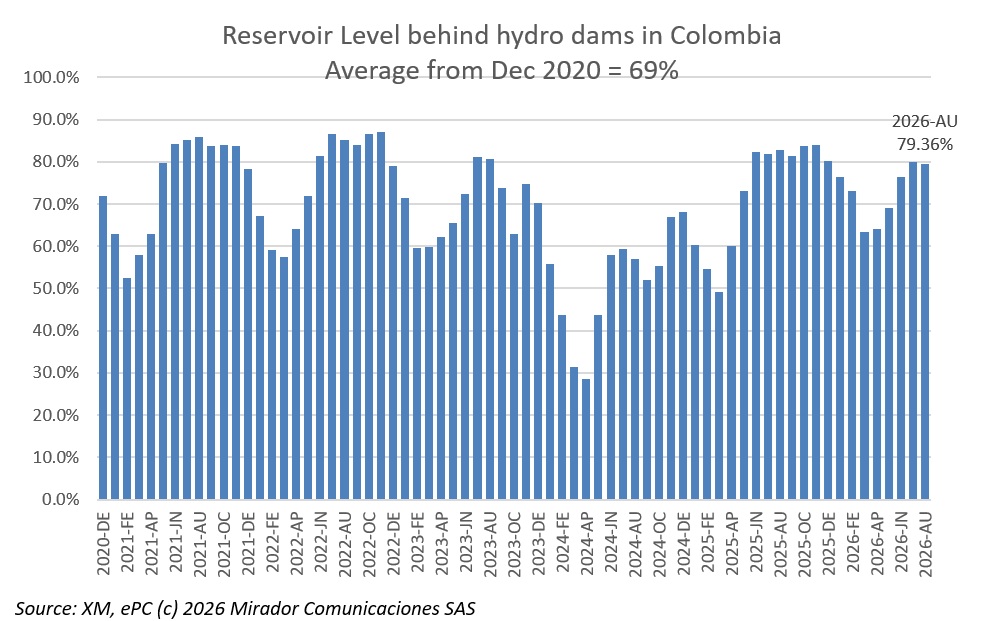
The Petro government said we need to have reservoirs at 80%. MinEnergia Arboleda, who ran XM under Petro, now says we should be at 90%. The graph shows that, at the end of August, we were not quite at 80% yet.
Read moreSenator Gonzalo Baute has formally asked the Energy and Gas Regulatory Commission (CREG) to explain whether it considered the Caribbean's climate when designing its national energy-saving program.
Read moreColombia's government reached an agreement with Enel Colombia and AES Colombia to reschedule major maintenance at two of the country's largest hydroelectric plants -- El Guavio and Chivor II -- so the work doesn't overlap during the peak-demand months of the 2026-2027 El Niño.
Read morePresident Abelardo de la Espriella issued Presidential Directive No. 3, ordering five ministries and the national disaster-risk agency UNGRD to jointly develop a coordinated response roadmap for the El Niño phenomenon expected to intensify through 2026-2027.
Read moreColombia's environmental authorities have approved raising Hidroituango's reservoir level from 408 to 420 meters above sea level, a 12-meter increase that unlocks meaningful extra storage just as El Niño tightens the hydrological outlook.
Read moreColombia's biofuels sector avoided an estimated 15.5 million tons of greenhouse gas emissions and roughly 3,400 tons of particulate matter between 2022 and 2026.
Read moreCamilo Sánchez, president of Andesco, laid out a stark picture of Colombia's supply-demand imbalance heading into the peak of El Niño.
Read moreColombia's gas-import lifeline came under direct strain this week when a mechanical failure forced SPEC LNG's floating regasification unit in Cartagena to cut capacity from 475 to 400 mmcfd, just hours after authorities had flagged the risk of running the plant too hard.
Read moreVice President José Manuel Restrepo acknowledged at Acolgen's 18th Annual Energy Congress that Colombia's electricity system faces a complex situation, inherited as a blackout risk from the prior administration.
Read moreAcolgen president Natalia Gutiérrez told the association's Annual Energy Congress that Colombia faces two distinct problems: "we have a short-term need. A structural problem."
Read moreCiti analyst Johanna Chua said equatorial Pacific warming has crossed the threshold defining the most intense El Niño episodes on record, with sea-surface anomalies near 3°C through September 14th.
Read moreAndeg president Alejandro Castañeda endorsed CREG's energy-savings program but called for adjustments accounting for the Caribbean's heat.
Read moreVice President José Manuel Restrepo told Bogotá's Acolgen Congress that only 1.9% of expected new generation capacity came online in 2025 -- the fifth consecutive year of that shortfall -- directly tying Colombia's stalled electricity buildout to its broader economic ambitions.
Read more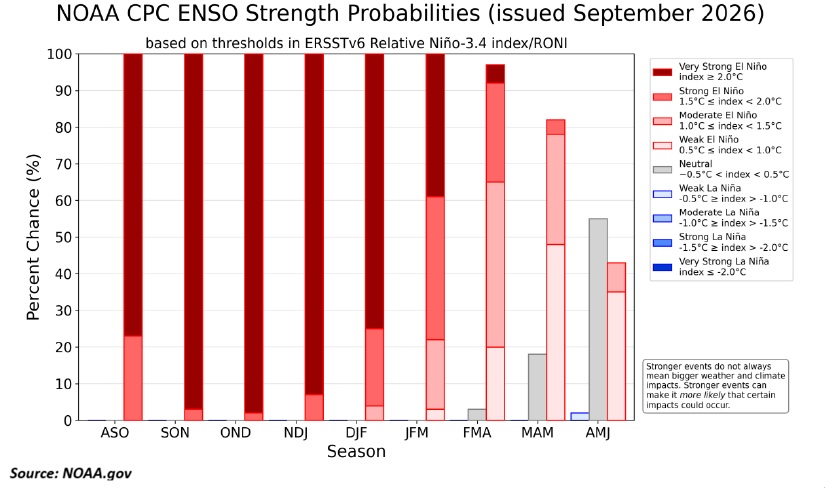
Citi says the Pacific has crossed the threshold defining the most intense El Niño episodes on record, with equatorial sea-surface anomalies near 3°C as of September 14th,levels that put the region "firmly in Súper El Niño territory," per analyst Johanna Chua.
Read moreColombia's firm-energy deficit – projected at 7.76% of demand for 2026-2027 – combined with severely delayed generation expansion (just 1,027 of the 4,475 MW expected for 2026 had entered operation as of September 10, only 23% of target) is reviving comparisons to 1992's year-long blackout, which forced a complete restructuring of the electricity sector.
Read moreColombia enters this El Niño with less water reaching reservoirs than in 2015-2016 or 2023-2024: since June, rivers have delivered only three of every four liters of normal inflow, while IDEAM puts the odds at 81% that the event crosses the threshold for a "very strong" Niño.
Read moreXM, Colombia's grid operator and an ISA subsidiary, warned in its latest bulletin that the gap between the system's firm (secure) energy and projected demand will reach 7.76% for 2026-2027 and remain at 7.6% for 2027-2028, up sharply from 5.43% in 2025-2026.
Read moreCREG's Resolución 101 120 (later amended by Resolución 101 126), in effect since September 1, sets an individual monthly consumption target for each regulated user based on their trailing 12-month average. Users who cut consumption more than 10% below that target earn a bill credit; those who exceed it by more than 10% pay a surcharge, only on the excess consumption, not the whole bill, scaled at 30% for strata 1-3, 50% for strata 4-6, and 70% for commercial and industrial users.
Read moreANIF projects a strong-to-very-strong El Niño could add roughly 0.70 percentage points (70 basis points) to Colombia's inflation, with a severe "Súper Niño" scenario potentially pushing total annual inflation as high as 7.3%.
Read more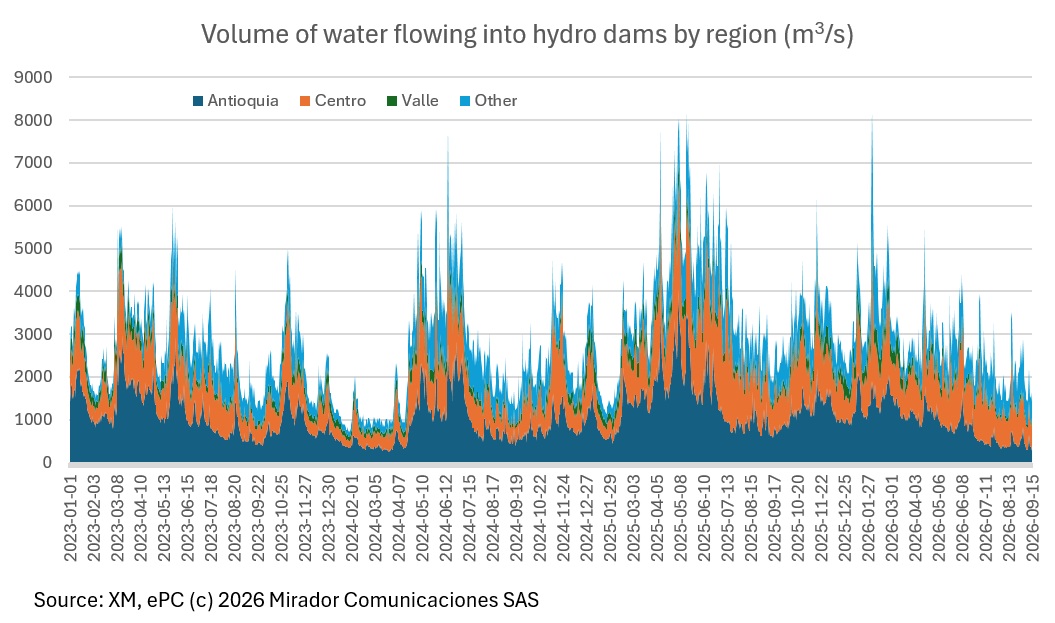
El Niño is here. The lead graph shows the amount of water flowing into Colombia’s hydroelectric dams and it doesn’t take sophisticated statistical analysis (or ChatGPT) to realize that inflows are in decline and have been since probably March.
Read moreEnvironment Minister Fabio Arjona detailed his ministry's measures to shore up the electricity system against El Niño during a September 9 congressional debate on the energy sector, the same session where Minister Arboleda warned tariffs must rise.
Read moreEPM implemented internal water and energy-saving measures across its main headquarters, other company facilities, and its natural gas and electricity service stations, adjusting lighting, air conditioning, digital displays, escalators, and internal spaces.
Read moreA single ChatGPT query consumes roughly 0.34 watt-hours of electricity or "about what an oven uses in a little over a second," according to OpenAI CEO Sam Altman, plus 0.32 milliliters of water, or "about a fifteenth of a teaspoon."
Read moreThe Comisión de Regulación de Energía y Gas (CREG) activated its reliability-sustainment mechanism under Resolución CREG 101 127 de 2026, following technical recommendations from XM's National Dispatch Center and the National Operations Council.
Read moreAs Colombia heads into El Niño in earnest, a number of voices, especially former MinEnergia’s have called for an incentive program to promote the “right behaviors”: encourage those who use energy wisely and, frankly, punish those who waste it. Inevitably perhaps, the CREG’s plan provoked criticism from the Caribbean.
Read moreAndeg president Alejandro Castañeda said Colombia's firm-energy cushion has been fully consumed: the 2023-2024 El Niño was survived with a 2% firm-energy surplus, but the country now faces a 2.5% deficit heading into this Niño.
Read moreColombia's Agencia Nacional de Licencias Ambientales (ANLA) granted environmental approval for the transmission interconnection linking the Ariguaní photovoltaic park (200 MWac) to the La Loma 500kV substation, spanning the municipalities of El Paso and Chiriguaná in Cesar.
Read moreXM's interim general manager Juan Carlos Morales said Colombia's electricity system remains far from the conditions that produced the 1992 blackout, even as the sector faces real El Niño-driven challenges.
Read moreIn today’s lead story, XM's interim general manager Juan Carlos Morales said Colombia's electricity system remains far from the conditions that produced the 1992 blackout, though he didn't explain what specifically makes today's system more resilient. He was direct, instead, that "current uncertainty exceeds recent years'
Read moreSergio Arturo Piñeros Botero was sworn in August 13 as director of the Agencia Nacional de Licencias Ambientales (ANLA), the agency responsible for licensing hydrocarbons, electricity, and other infrastructure projects nationwide, succeeding Irene Vélez Torres.
Read moreColombia has designated 998,576 hectares of rural land as Areas Protected for the Production of Food (APPA) as of July, created under the Petro government's Agriculture Ministry to safeguard land for food production and security.
Read moreXM interim general manager Juan Carlos Morales laid out the electricity system's core vulnerability heading into El Niño: expected peak demand could exceed 265 GWh on some days, against roughly 118 GWh of thermal firm-energy obligations and around 20 GWh of daily solar – leaving hydro to cover the remaining 120-140 GWh, with no assurance about how long the dry period will last.
Read moreDeputy Minister of Energy Armando José Cuello said technical teams across the Ministry of Mines and Energy, CREG, and the Environment and Finance ministries are reviewing every available option to keep Colombia's electricity system stable through El Niño, though he stopped short of saying blackout risk is fully off the table.
Read more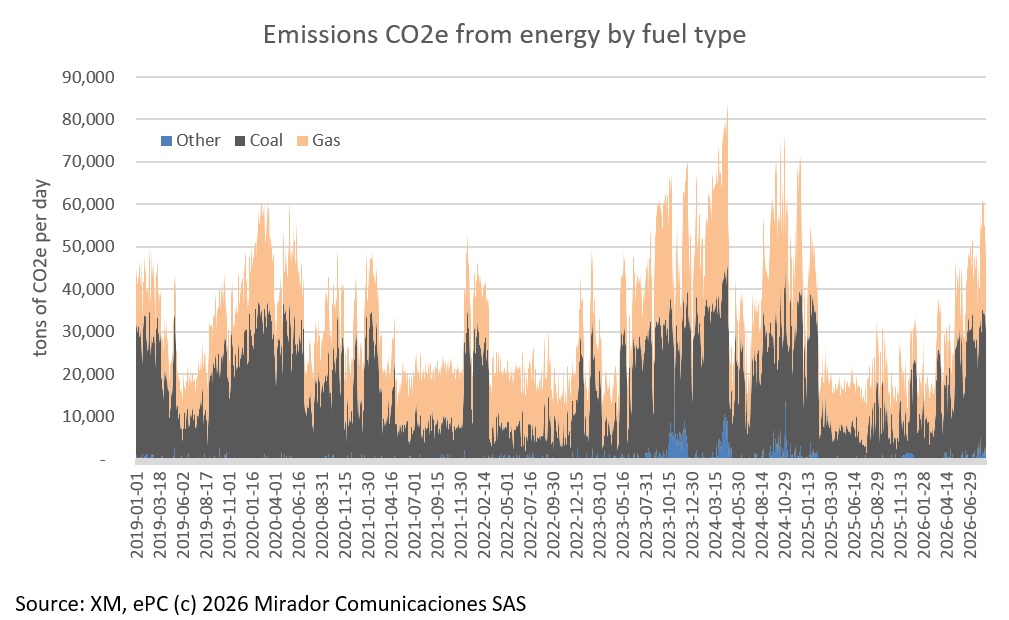
For some time, I had wanted to look at CO2e emissions from energy over the past eight years. With malice aforethought, I wanted to show were higher – or at least the same – when the “Illuminati” were running the show than during the previous administration. See graph.
Read more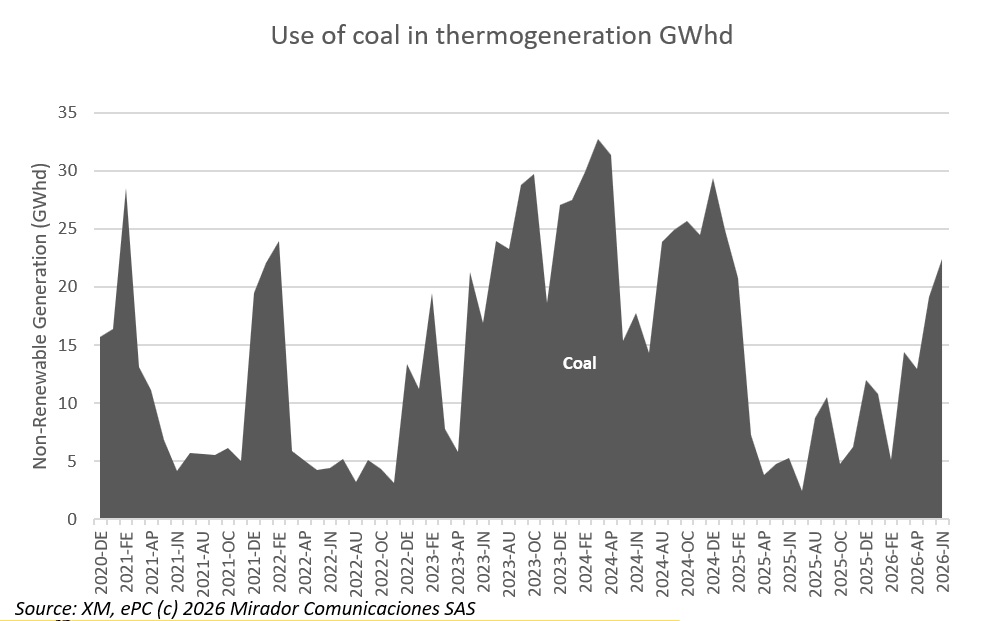
Colombia's electricity sector is navigating one of its most critical stretches since the 1992 blackout – tight supply-demand margins, delayed generation and transmission projects, gas supply strain, generator debt, and subsidy payment delays – with intervened utility Air-e's financial collapse now widely described as a systemic risk rather than a regional problem.
Read moreColombia's Ministry of Environment and Sustainable Development swore in its new leadership team on August 13, including Sergio Arturo Piñeros Botero as director of the Agencia Nacional de Licencias Ambientales (ANLA), the agency responsible for environmental licensing of major electricity infrastructure, from transmission lines to solar and wind farm development.
Read moreColombia's El Niño phenomenon is expected to intensify in October and November, prompting think tanks and analysts to call for early-warning mechanisms to avoid any resort to energy rationing.
Read moreThe Ministry of Mines and Energy provided a full update on electricity restoration following the August 10 earthquake and its aftershocks, which knocked out power to more than 1.5 million users – concentrated in Chocó, Valle del Cauca, Risaralda, Caldas, Quindío, Cauca, and Nariño – and disconnected roughly 1,700 MW of demand, equivalent to 18% of national consumption at the time.
Read moreAir-e's intervening agent, Jaime Mesa Buitrago, detailed new tiered electricity tariffs at a Consejo Nacional de Operación de Gas (CNO Gas) meeting in Barranquilla led by then Minister Edwin Palma, under which consumers who reduce usage can earn discounts of up to 40%, while those exceeding set thresholds will pay progressively more.
Read moreColombia's August 10th magnitude-7.4 earthquake knocked out roughly 18% of national electricity demand, with the heaviest impact concentrated in Chocó, Valle del Cauca, Quindío, Caldas, and Risaralda, according to preliminary information from MinEnergia María Nohemí Arboleda and system operator XM.
Read moreMaría Nohemí Arboleda, sworn in as Colombia's new Minister of Mines and Energy under President Abelardo De la Espriella, summarized the state of the sector bluntly in her first hours in office: "the situation is critical, but not lost."
Read moreThe Household Public Services User League (Liga Nacional de Usuarios de los Servicios Públicos Domiciliarios) pushed back against former Minister Edwin Palma's plan to penalize energy waste during the current drought.
Read moreThe Global Environment Facility (GEF) Council announced the selection of Diego Mesa Puyo, Colombia's former Minister of Energy and Mines, as the fund family's next CEO and Chairperson, for an initial four-year term aligned with the GEF-9 funding period.
Read moreFormer Minister of Mines and Energy Amylkar Acosta argues in this El Heraldo opinion column that the risk of simultaneous electricity and natural gas rationing in Colombia is real, not alarmism, though whether it materializes depends on rainfall, thermal-fuel availability, and how quickly contingency measures are adopted.
Read moreThe Comisión de Regulación de Energía y Gas (CREG) formally approved a measure offering discounts of up to 40% on electricity bills for households that cut consumption by up to 30%, with surcharges applied to users who exceed reference consumption levels.
Read more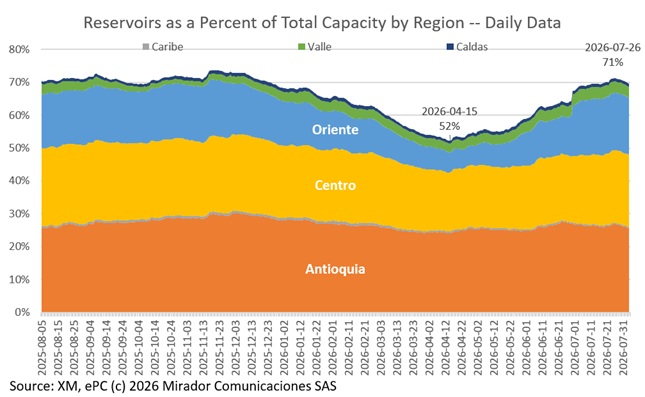
Colombia's hydroelectric reservoirs closed July above 80% of capacity nationally, according to XM data -- the level the system operator considers the minimum threshold needed to withstand a drought, and the highest reading recorded so far in 2026.
Read moreA fast-developing El Niño episode -- potentially among the six most intense since 1870 -- has Deutsche Bank warning of inflationary pressure, economic disruption, and possible monetary policy effects across Latin America, with Colombia identified as the region's most exposed economy.
Read moreEmpresas Públicas de Medellín issued a broad appeal tied to El Niño risk this week, notable less for its urgency than for its scope: rather than the single-service warnings that have dominated recent coverage, EPM is flagging conservation needs across water, electricity, and gas simultaneously – a reflection of just how much of Colombia's utility infrastructure runs through the company.
Read moreColombia's Constitutional Court reviewed three decrees issued under the Economic Emergency declared by Decreto 150 de 2026 in response to the extreme weather event of early 2026, upholding most measures while striking some provisions and conditioning others to the actually affected areas.
Read moreColombia's electricity system has crossed a threshold its operator XM had been warning about for years: available firm energy is no longer sufficient to cover projected demand under extreme drought scenarios, and the shortfalls are projected to persist across three consecutive reliability charge periods.
Read moreWith fewer than two weeks left in his administration, President Gustavo Petro declared a national disaster for the El Niño phenomenon on July 23rd – Colombia's first such declaration linked explicitly to an electricity supply emergency – and simultaneously ordered a CoP$4T budget reallocation to the National Disaster Risk Management Unit (UNGRD), bringing its total El Niño resources to CoP$8T.
Read moreA comprehensive El Heraldo analysis published July 26th, based on interviews with six sector leaders, delivers the most structured account yet of the structural failures that have placed Colombia in its most vulnerable energy position since the 1992 blackout.
Read moreThe clearest articulation yet of why El Niño is simultaneously a gas crisis and an electricity crisis came from Tomás González in a recent interview with El Tiempo, in which the former Mines and Energy Minister mapped the convergence of pressures the de la Espriella government will face from day one.
Read more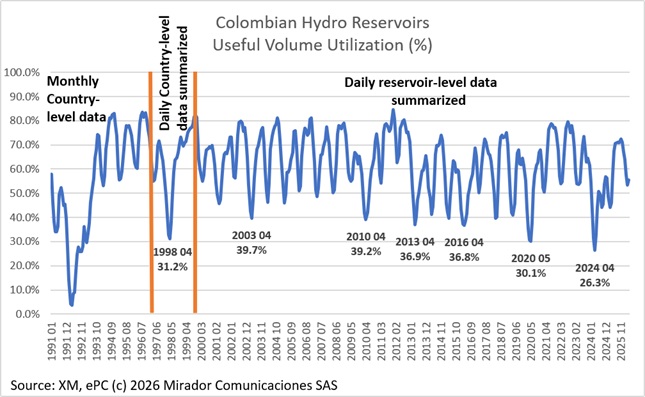
The Ministry of Mines and Energy used the final session of Colombia's National Risk Management Council on July 10th to deliver its most unambiguous public warning yet about the coming climate event: the approaching El Niño could be the most severe episode recorded in the last three decades.
Read moreTwo El Tiempo investigations, eleven days apart, trace the arc of Colombia's hydroelectric maintenance crisis from internal CND recommendation to formal ministerial alert.
Read moreEcopetrol's July 9th El Niño contingency plan reveals a company that has quietly become a material contributor to Colombia's electricity system resilience – not as a customer of the grid but as an self-generator whose 1,863 MWp of installed capacity can operate independently of the national interconnected system and thereby reduce pressure on shared reservoir levels.
Read moreAs Colombia faces its most demanding El Niño season in years, a common thought has emerged in public debate: the idea that the country should simply turn on its entire thermal generation fleet to protect reservoir levels.
Read moreColombia's Ministry of Environment and Sustainable Development issued Resolution 0808 on June 30th, establishing for the first time the environmental terms of reference that developers must follow when preparing Environmental Impact Studies for offshore wind energy projects.
Read moreColombia's Ministry of Transport published a draft resolution on July 7th establishing the country's first comprehensive national regulatory framework for light electric personal urban mobility vehicles – covering electric scooters, skateboards, monowheels, and electric bicycles – as a second public comment round under Law 2486 of 2025.
Read moreColombia's incoming government faces a climate scenario that has hardened since earlier in 2026.
Read more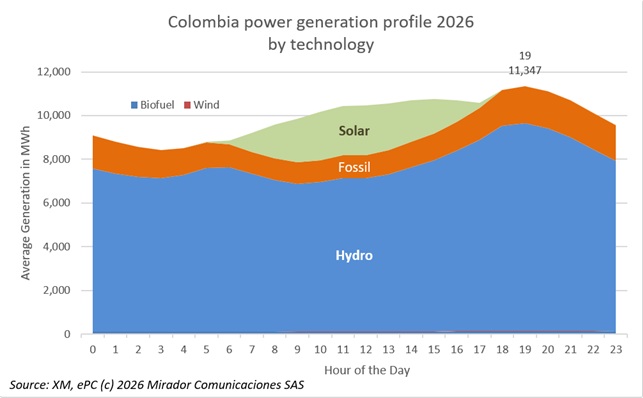
Alejandro Arbeláez, general manager of Sociedad Hidroituango, used a July 5th interview with Valora Analitik to deliver the most operationally specific public warning yet about Colombia's blackout risk -- and to put two concrete proposals on the table for the incoming de la Espriella government: activate more thermal plants immediately, and advance the clock by one hour to optimize use of natural daylight.
Read moreThe most underreported dimension of Colombia's El Niño crisis is not the reservoir levels: it is the simultaneous convergence of scheduled maintenance at the country's largest generation plants with the precise period when the system most needs them available.
Read moreThe Caribbean electricity crisis became the first substantive policy commitment of the de la Espriella presidency even before his August 7th inauguration.
Read moreAcolgen president Natalia Gutiérrez used a Semana interview published June 24 to deliver the electricity generators' industry association's most direct warning yet to the incoming government: the El Niño response agenda is not a transition-period discussion: it begins on inauguration day.
Read moreThe Superintendency of Public Services issued Circular Externa 20261000000624 on June 30, ordering all electricity, gas, water, sewerage, and waste collection companies in Colombia to activate their contingency plans without delay ahead of an El Niño event that IDEAM projects will intensify significantly from September onward, with the Andean and Caribbean regions most exposed.
Read moreEl Niño was officially confirmed on June 11, three months ahead of the expected timeline, and NOAA's projections point to a potentially severe episode, possibly the worst since 1950.
Read moreColombia's Ministry of Mines and Energy has designated Karen Schutt -- currently an expert commissioner at CREG and a former deputy energy minister -- as technical manager of the Sectoral Committee created under Resolution 40269 of 2026 to coordinate the government's response to El Niño and oversee strategic infrastructure milestones, including the scheduled maintenance at the SPEC regasification terminal in Cartagena.
Read moreColombia's energy and gas regulator CREG has issued Resolution 101 114 of 2026, establishing a permanent regulatory framework for activating additional generation capacity and demand flexibility tools whenever the National Interconnected System (SIN) faces critical hydrology conditions.
Read more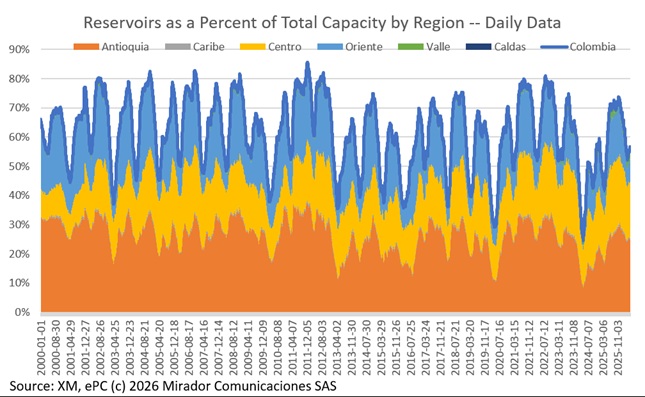
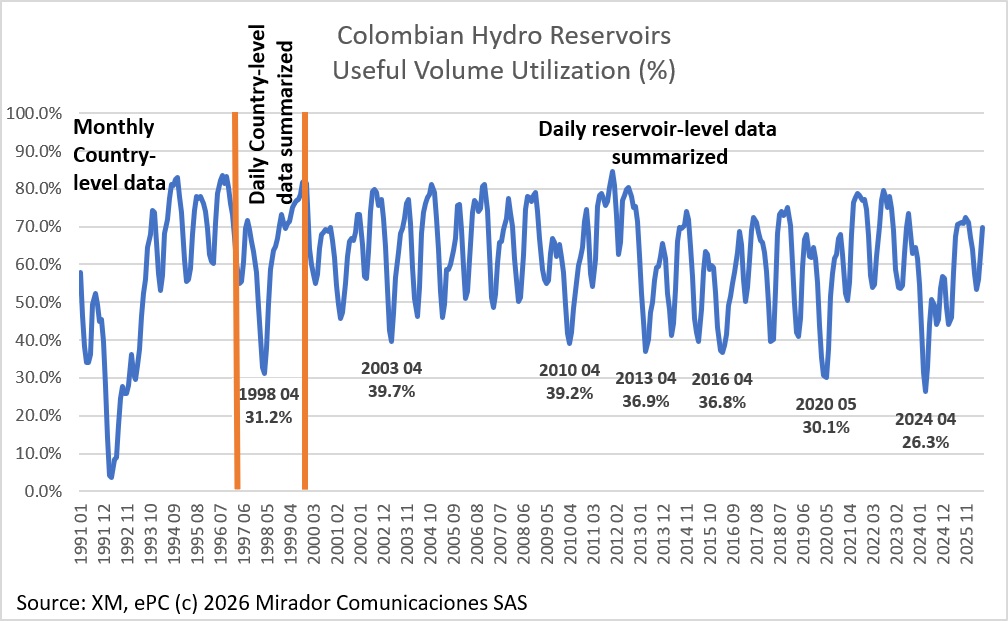
Colombia's El Niño weather event has arrived, and the country enters the dry season with reservoir levels already running roughly 10 percentage points below where they should be. XM, the electricity market operator and ISA subsidiary, warned as of June 17 that under scenarios resembling the driest episodes in the historical record, aggregate reservoir levels could descend to approximately 30% of useful capacity by the time the phenomenon peaks – far below the 80%-plus level that XM considers the minimum adequate entry point into the dry season.
Read moreThe Colombian Institute of Petroleum and Energy Transition (ICPET), Ecopetrol's research arm, has launched an expanded operating model centered on decarbonization, circular economy applications, and nature-based solutions, deepening the institute's pivot toward energy transition technologies.
Read moreColombia's Ministry of Mines and Energy has issued Resolution 40267 of 2026, establishing the supply management framework to govern natural gas distribution during the scheduled maintenance of the SPEC regasification terminal in Cartagena, set for July 30 to August 3.
Read more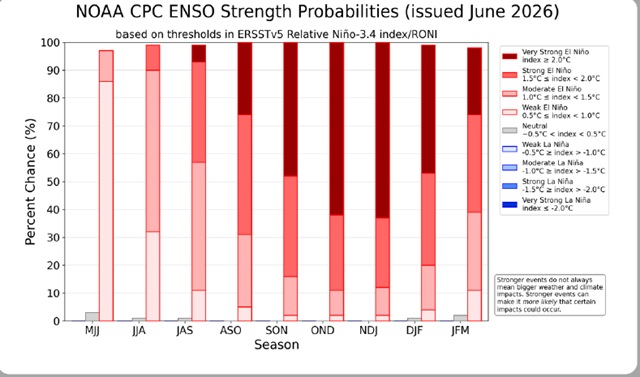
“El Nino has developed in the tropical Pacific,” says the latest report from the National Oceanographic and Atmospheric Administration (NOAA) and the forecasters expect it to “strengthen”.
Read moreThe Ministry of Mines and Energy announced on June 12 the creation of a Special Committee for the coordination and monitoring of El Niño response measures across the energy and mining sector, formalizing an institutional structure to manage the climatic risk the government has been tracking through 36 prior sessions of its CACSSE energy security committee.
Read moreFormer Minister of Mines and Energy Amylkar Acosta published a four-point demand-management plan on June 8, arguing that Colombia is already operating under conditions of "maximum hydrological and energy stress" even before El Niño has fully hit and that voluntary government appeals to save electricity are insufficient to manage what is coming.
Read moreWith El Niño already in a probability of 96% by year-end, Barranquilla's district administration has launched a two-track response combining immediate household demand-management guidance with longer-term urban climate adaptation investments.
Read moreWith climate models now placing the probability of a strong or very strong El Niño closing out 2026 at 96%, Colombia's association of capital cities, Asocapitales, has launched a coordinated national preparedness initiative that brings together the national disaster risk management agency (UNGRD), IDEAM, the Colombian Red Cross, and several ministries.
Read moreColombia's Inspector General used a June 1 Asocapitales meeting on El Niño preparedness to deliver a pointed institutional message: the approaching climatic phenomenon cannot be managed as a water supply problem alone.
Read moreColombia's Ministry of Environment issued a circular to all autonomous regional corporations, urban environmental authorities, and local governments on May 28, setting out ten operational directives for managing the El Niño phenomenon expected to consolidate in the second half of 2026 and potentially extend into early 2027.
Read moreJuan Ricardo Ortega, president of Grupo Energía Bogotá, told W Radio's 6AM program on May 28 that electricity tariffs in Colombia face an upward trajectory over the coming months, driven by three interlocking cost pressures that are coinciding at a moment of unusual vulnerability for the national energy system.
Read more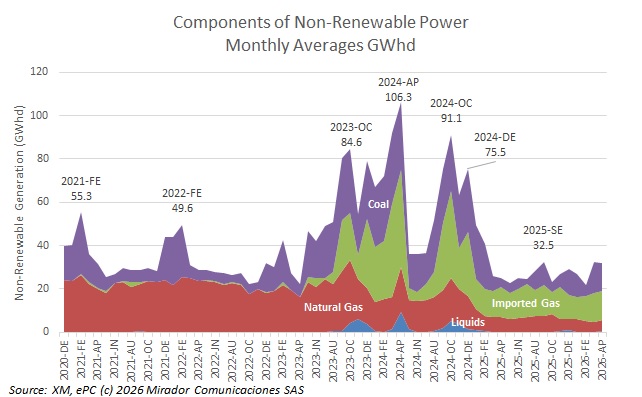
Colombia's thermal generation sector has been burning significantly more fuel since mid-May, with XM data showing coal consumption at thermal plants rising 47.9% between January and May 2026 -- from 132.7 to 196.3 GBTUd -- and gas consumption rising 65.1%, from 122.2 to 201.7 GBTUd.
Read moreThe Consejo Gremial Nacional issued an urgent public appeal on May 29 to the government, the Ministry of Mines and Energy, and CREG to act immediately on what it described as a real and imminent risk of both electricity and gas supply failure. Industry sources speaking anonymously to Portafolio were starker still: "we need a miracle to save ourselves from the blackout."
Read moreColombia's 23 monitored hydroelectric reservoirs closed May at 66.38% of capacity -- a 2.35 percentage-point improvement over April's 64.03% but still well short of the 80% analysts consider the minimum safe level for withstanding a prolonged dry period.
Read moreColombia's National Environmental Licensing Authority (ANLA) issued a public clarification on May 28 pushing back against media reports that implied the Hidroituango hydroelectric project required new regulatory approvals to raise its reservoir to 420 meters above sea level.
Read moreColombia's cement and concrete industry is navigating a convergence of energy-cost pressures, gas supply uncertainty, and growing international decarbonization requirements that together are redefining the economics of one of the country's most infrastructure-critical sectors.
Read moreThe economic price tag on a potential rationing scenario is the most important thing El País's May 25 expert survey adds to a story we have already well documented elsewhere, including today.
Read moreAndesco, Colombia's public utilities industry body, issued its starkest public warning to date on May 21, laying out five interconnected risk factors it says could drive the country into electricity rationing -- and giving the government a three-to-four month window to act before the dry season becomes unmanageable.
Read moreColombia faces an imminent risk of electricity rationing and sharp tariff increases as El Niño bears down on a power system weakened by four years of poor decisions.
Read more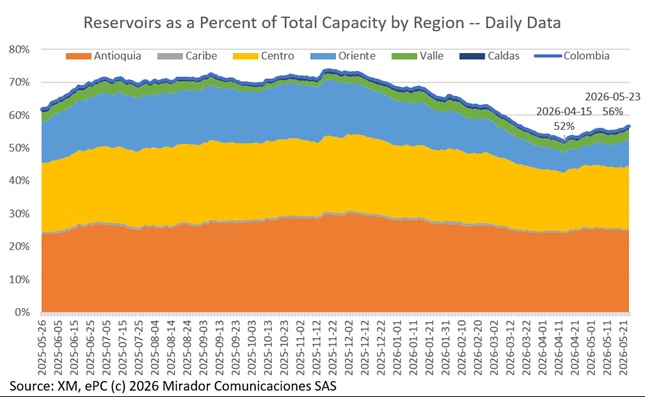
Energy services platform Klik has published an analysis warning that Colombia's electricity grid faces a compounded stress test in the second half of 2026: the coincidence of El Niño, a structural firm-energy deficit, and the surge in demand that accompanies every Colombia match at the World Cup.
Read morePresident Gustavo Petro escalated Colombia's official response to the approaching El Niño on May 22, announcing a package of energy and food security measures via his X account and warning that constitutional tools remain on the table if normal administrative channels prove too slow.
Read moreThe Ministry of Environment and Sustainable Development has granted conditional environmental clearance for the exploration phase of the Nereidas geothermal project, located in the Macizo Volcánico del Ruiz in Caldas department.
Read moreThree industry voices converged in the third week of May to paint a consistent and sobering picture of Colombia's energy exposure as El Niño approaches: the sector is entering the dry season with a negative firm-energy balance, insufficient gas, a crippled Caribbean distributor, and a new generation pipeline that has chronically underdelivered.
Read moreEnergy Minister Edwin Palma has sent a formal circular to the Comisión de Regulación de Energía y Gas (CREG) acknowledging what he calls an "imminent risk" of electricity rationing across Colombia -- a significant reversal from his own public statements made just days earlier, when he told an audience in Atlántico that a blackout was not going to happen.
Read moreColombia's Ministry of Mines and Energy has activated a preparedness roadmap containing 50 specific actions to protect the electricity and gas systems ahead of El Niño 2026--2027, presenting the plan during a session of the Advisory Commission on Energy Situation Monitoring (Cacsse) on May 12.
Read more