Air-e, the state-intervened distributor serving Colombia's Caribbean coast, is running an energy-saving awareness campaign in Atlántico, Magdalena and La Guajira as consumers worry about surcharges tied to higher electricity use.
Read moreLandfill biogas is being pitched as a modest complement to Colombia's power supply as El Niño tightens the system, and Barranquilla hosts the country's largest plant.
Read moreColombia's government has set December 31st as the deadline to remove any risk of a blackout and issued its first concrete measure, a decree on thermal plant fuel.
Read moreThe first electricity bills with penalties under Colombia's El Niño savings scheme have reached Caribbean households, drawing protests from consumer groups, ombudsmen and lawmakers who say the program ignores the region's heat.
Read moreA total power outage lasting four hours would expose about CoP$460.8B of economic value across Colombia's seven Caribbean departments, according to an estimate by the think tank Fundesarrollo.
Read more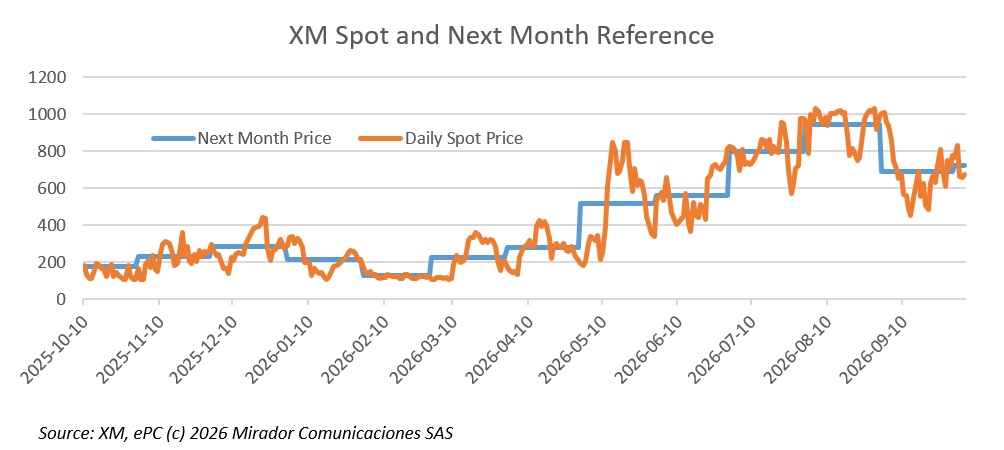
Colombia's spot power price averaged CoP$946.6 per kWh in August, up 278.2% from CoP$250.3 a year earlier and 18.7% from July.
Read moreWithout thermal generation, Colombia's power system has no real protection in a drought, argues an El Heraldo opinion column.
Read moreColombia has formally suspended electricity sales to Ecuador, pausing a trade that earned CoP$530.7B between January 2025 and August 2026.
Read moreColombia's energy establishment is split over the right fix for a worsening firm-energy deficit: hold more reliability auctions to bring in new capacity or focus on getting already-awarded projects built.
Read moreColombia's government will not hold any energy-reliability auctions in 2026, pushing the process into 2027 instead.
Read moreFacing a fiscal deficit CARF projects could reach 10% of GDP by the close of 2027 and net debt around 67.3% of GDP, former Finance Minister Mauricio Cárdenas told Blu Radio that selling Ecopetrol's majority stake in ISA to Colombia's pension funds would be a smart move.
Read moreCamilo Sánchez, president of Andesco, laid out a stark picture of Colombia's supply-demand imbalance heading into the peak of El Niño.
Read moreVice President José Manuel Restrepo acknowledged at Acolgen's 18th Annual Energy Congress that Colombia's electricity system faces a complex situation, inherited as a blackout risk from the prior administration.
Read moreAcolgen president Natalia Gutiérrez told the association's Annual Energy Congress that Colombia faces two distinct problems: "we have a short-term need. A structural problem."
Read more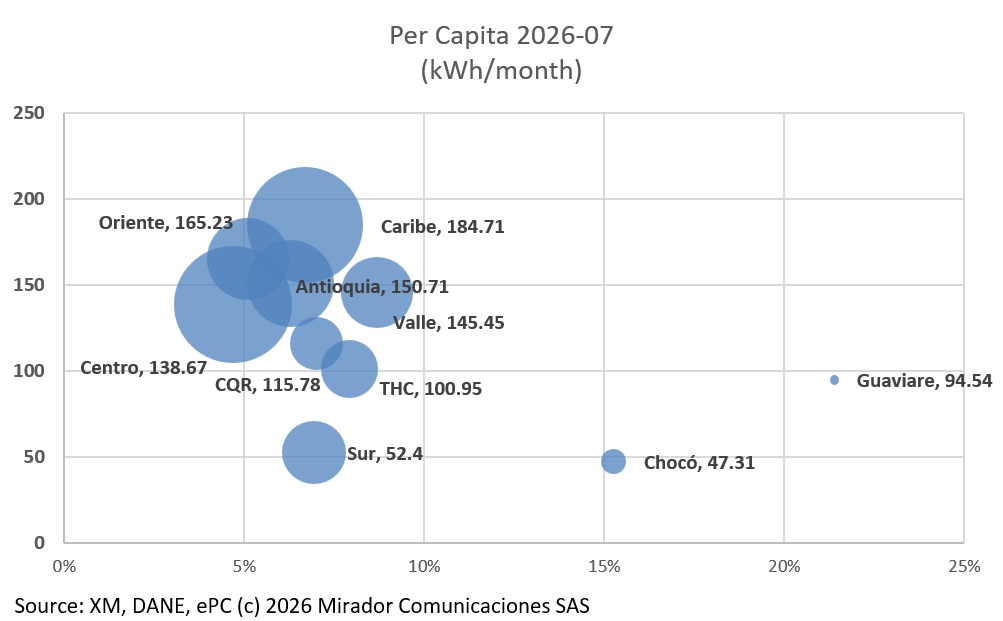
We’ve written a lot lately about the Caribbean coast’s resistance to the CREG’s tariff plan, designed to encourage more frugal use of electricity during El Niño. We thought we’d look at some of the numbers.
Read moreColombia's electricity regulators are preparing three sequential energy auctions to strengthen system capacity and close the projected gap between supply and demand.
Read moreColombia's firm-energy deficit – projected at 7.76% of demand for 2026-2027 – combined with severely delayed generation expansion (just 1,027 of the 4,475 MW expected for 2026 had entered operation as of September 10, only 23% of target) is reviving comparisons to 1992's year-long blackout, which forced a complete restructuring of the electricity sector.
Read moreA fire at the San Mateo electrical substation in Cúcuta left approximately 135,000 users without power for more than three hours on the night of September 16th.
Read moreColombia enters this El Niño with less water reaching reservoirs than in 2015-2016 or 2023-2024: since June, rivers have delivered only three of every four liters of normal inflow, while IDEAM puts the odds at 81% that the event crosses the threshold for a "very strong" Niño.
Read moreXM's interim general manager Juan Carlos Morales revealed at the utility's Eighth Forum in Cartagena that the August 10 earthquake pushed the National Grid (Sistema Interconectado Nacional) far closer to a full collapse than previously disclosed.
Read moreAndeg president Alejandro Castañeda said Colombia's firm-energy cushion has been fully consumed: the 2023-2024 El Niño was survived with a 2% firm-energy surplus, but the country now faces a 2.5% deficit heading into this Niño.
Read moreVice President José Manuel Restrepo proposed developing new electricity generation capacity in Colombia's Alto Caribe corridor as a precondition for the country to compete for datacenter investment in Latin America, positioning energy as the third of five pillars in a growth agenda aiming for 6% annual economic expansion.
Read moreInspector General Gregorio Eljach Pacheco installed a permanent technical roundtable on "paz energética" at his office this week, bringing together the government, regional authorities, sector agents, and control bodies to move from diagnosing Colombia's energy crisis toward folding solutions into the new 2026-2030 National Development Plan.
Read moreXM interim general manager Juan Carlos Morales laid out the electricity system's core vulnerability heading into El Niño: expected peak demand could exceed 265 GWh on some days, against roughly 118 GWh of thermal firm-energy obligations and around 20 GWh of daily solar – leaving hydro to cover the remaining 120-140 GWh, with no assurance about how long the dry period will last.
Read moreDeputy Minister of Energy Armando José Cuello said technical teams across the Ministry of Mines and Energy, CREG, and the Environment and Finance ministries are reviewing every available option to keep Colombia's electricity system stable through El Niño, though he stopped short of saying blackout risk is fully off the table.
Read more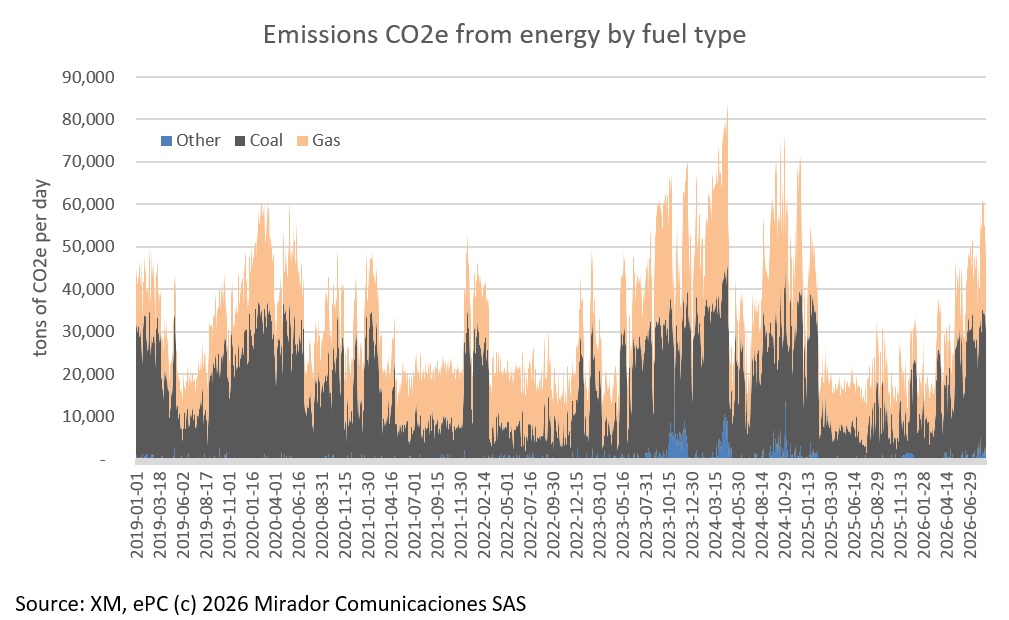
For some time, I had wanted to look at CO2e emissions from energy over the past eight years. With malice aforethought, I wanted to show were higher – or at least the same – when the “Illuminati” were running the show than during the previous administration. See graph.
Read more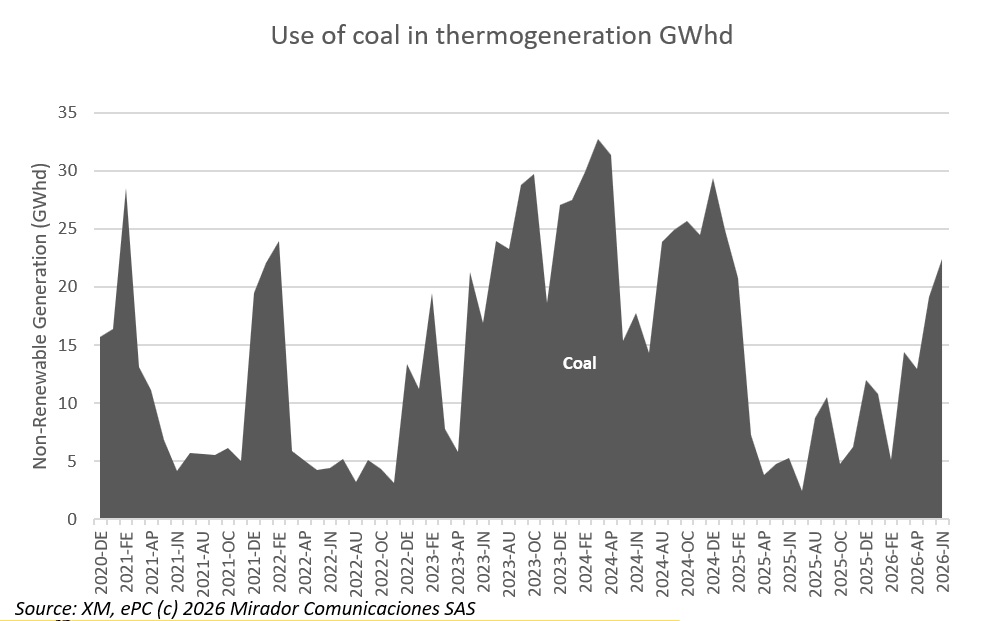
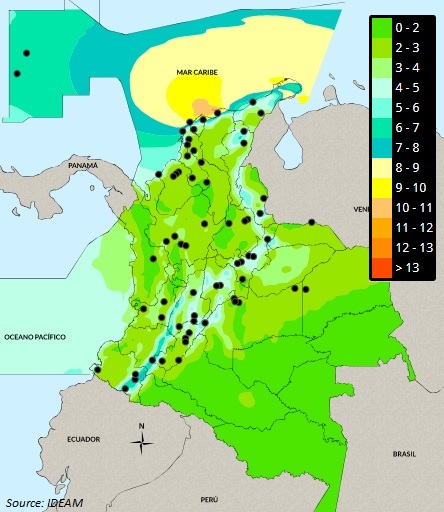
Barranquilla's district government signed a joint declaration with Copenhagen Infrastructure Partners (CIP) validating progress on "Winds of Barranquilla," (Vientos de Barranquilla) which will become Colombia's first offshore wind farm, positioned in Caribbean waters off the city's coast.
Read moreCREG executive director Adriana Jiménez said the sector's central challenge is coordinating simultaneous technological transitions across generation, grids, storage, and end users into a sustainable, integrated system, rather than regulating each shift separately.
Read more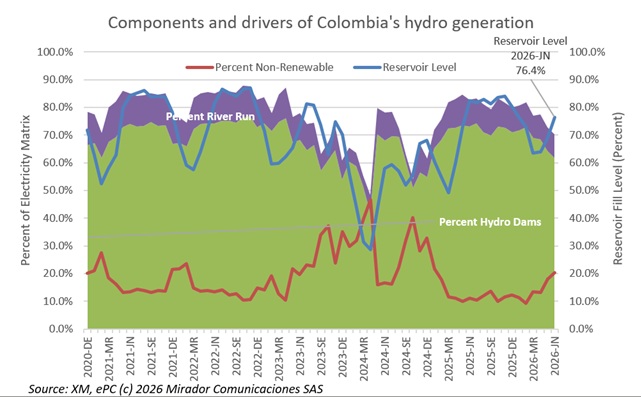
XM’s June report provides yet more graphic evidence that despite the rhetoric and ex-President Gustavo Petro’s visceral hatred of the thermogenerating industry, the matrix did indeed shift to protect the reservoirs. We also look at demand growth over the past four years.
Read moreThe previous government announced Colombia's most recent Reliability Charge auction, held May 22nd as a success – 15 new generation projects plus an existing plant's expansion, an estimated CoP$16T in investment, and 4,069.7 MW of new capacity assigned to meet demand for December 2029-November 2030. But …
Read moreThe Ministry of Mines and Energy provided a full update on electricity restoration following the August 10 earthquake and its aftershocks, which knocked out power to more than 1.5 million users – concentrated in Chocó, Valle del Cauca, Risaralda, Caldas, Quindío, Cauca, and Nariño – and disconnected roughly 1,700 MW of demand, equivalent to 18% of national consumption at the time.
Read moreColombia's electricity sector needs CoP$10-13T in annual generation investment to close firm-energy deficits, with grid infrastructure requiring a similar sum to keep pace with demand growth, figures that could rise further if Colombia pursues broader economy-wide electrification and its 2050 emissions targets, according to Raúl Lancheros, Acolgen's director of sectoral affairs and regulation.
Read moreColombia's August 10th magnitude-7.4 earthquake knocked out roughly 18% of national electricity demand, with the heaviest impact concentrated in Chocó, Valle del Cauca, Quindío, Caldas, and Risaralda, according to preliminary information from MinEnergia María Nohemí Arboleda and system operator XM.
Read moreThe Ministry of Mines and Energy closed its Clean Energy Contracting Auction with what it framed as a turning point for the country's power system: the first long-term contracting mechanism to incorporate battery energy storage systems (BESS) alongside solar generation, multiplying the country's contracted storage capacity by a factor of ten.
Read moreEmpresas Públicas de Medellín issued a broad appeal tied to El Niño risk this week, notable less for its urgency than for its scope: rather than the single-service warnings that have dominated recent coverage, EPM is flagging conservation needs across water, electricity, and gas simultaneously – a reflection of just how much of Colombia's utility infrastructure runs through the company.
Read moreColombia's National Interconnected System came through the five-day SPEC regasification maintenance window without disruption to grid reliability, and the terminal itself confirmed a clean finish.
Read more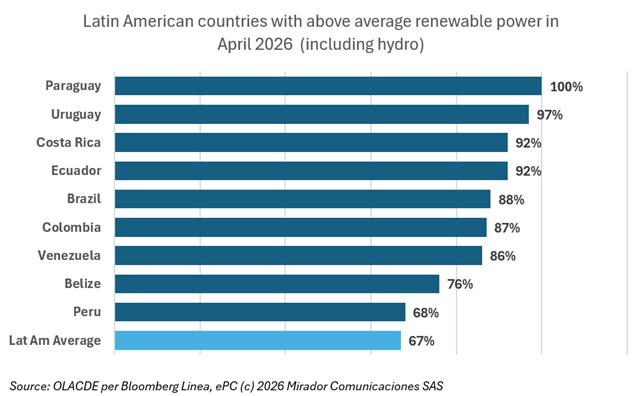
Nine of the 27 member countries tracked by the Organización Latinoamericana y Caribeña de Energía (Olacde) posted renewable (including hydro) shares above the regional average in April, as the region's overall electricity output climbed 4.5% year-on-year to 164 TWh.
Read moreGrupo Energía Bogotá president Juan Ricardo Ortega delivered his most detailed public assessment yet of Colombia's transmission crisis through two Valora Analitik pieces in consecutive days -- a letter to president-elect De la Espriella and a direct interview. Read together, they form a comprehensive indictment of four years of energy infrastructure paralysis and a precise warning about what comes next if it continues.
Read moreDelivered at the inauguration of a solar project in Manaure, La Guajira, Minister Edwin Palma's July 23rd call for telework and study-from-home schemes represents the most direct government intervention yet on the demand side of Colombia's El Niño preparedness.
Read moreColombia's two most important La Guajira clean energy infrastructure announcements of the transition period arrived together on July 24: the Colectora 500 kV transmission line -- the dedicated highway for Guajira wind energy -- reaching 90% overall construction completion, and a draft regulatory resolution designed to prevent the wind projects that will connect to it from being cancelled due to the planning mismatches that have dogged Colombia's renewable buildout.
Read moreThe outgoing Petro government issued two related but distinct resolutions in the final weeks of its mandate that together address the structural problems most frequently cited for Colombia's electricity supply crisis: the chronic disconnect between generation and transmission project planning, and the grid's vulnerability to high-impact disruptions from extreme weather, equipment failure, and cyberattack.
Read moreColombia's electricity system has crossed a threshold its operator XM had been warning about for years: available firm energy is no longer sufficient to cover projected demand under extreme drought scenarios, and the shortfalls are projected to persist across three consecutive reliability charge periods.
Read moreWith fewer than two weeks left in his administration, President Gustavo Petro declared a national disaster for the El Niño phenomenon on July 23rd – Colombia's first such declaration linked explicitly to an electricity supply emergency – and simultaneously ordered a CoP$4T budget reallocation to the National Disaster Risk Management Unit (UNGRD), bringing its total El Niño resources to CoP$8T.
Read moreA comprehensive El Heraldo analysis published July 26th, based on interviews with six sector leaders, delivers the most structured account yet of the structural failures that have placed Colombia in its most vulnerable energy position since the 1992 blackout.
Read moreColombia's electricity system enters its most exposed five-day window of 2026 on Thursday, when SPEC shuts for scheduled maintenance through August 3rd .
Read more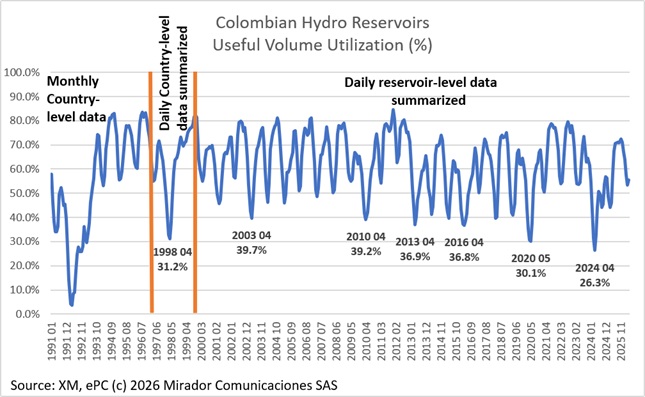
The Ministry of Mines and Energy used the final session of Colombia's National Risk Management Council on July 10th to deliver its most unambiguous public warning yet about the coming climate event: the approaching El Niño could be the most severe episode recorded in the last three decades.
Read moreTwo El Tiempo investigations, eleven days apart, trace the arc of Colombia's hydroelectric maintenance crisis from internal CND recommendation to formal ministerial alert.
Read morePresident Gustavo Petro requested and received the resignation of Mines and Energy Minister Edwin Palma on July 17th, placing ANH president Pablo Yesid Fajardo in temporary charge of the ministry with just over three weeks left in the government.
Read moreThe day after Abelardo de la Espriella's June 21 election victory, Colombia's energy and mining sector moved quickly from congratulating the incoming president to handing him the bill.
Read moreAs Colombia faces its most demanding El Niño season in years, a common thought has emerged in public debate: the idea that the country should simply turn on its entire thermal generation fleet to protect reservoir levels.
Read more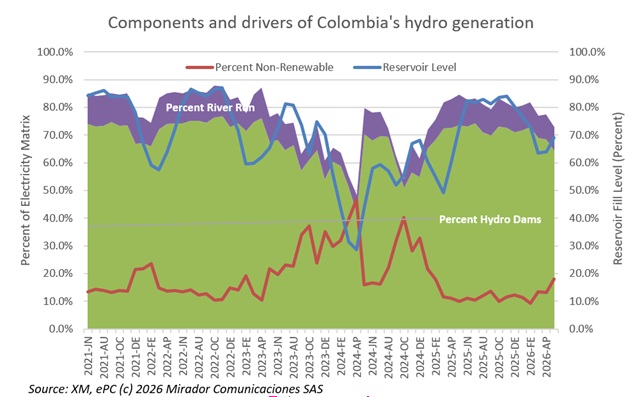
Colombia's reservoir system entered July in better shape than May but still short of where XM needs it to be and the improvement is almost certainly temporary.
Read moreVice president-elect José Manuel Restrepo made the economic cost of Colombia's energy crisis concrete on July 12th, posting on X after a meeting with sector leaders convened by El Tiempo that a blackout under current El Niño conditions would cost the country approximately CoP$204B per hour of lost supply.
Read moreColombia's electricity service quality improved measurably in 2025, with 74.6% of municipalities meeting the regulatory standard for interruption duration per user and 80.1% meeting the frequency standard, a meaningful step forward from 2024.
Read moreColombia's incoming government faces a climate scenario that has hardened since earlier in 2026.
Read moreA legal proceeding before the Administrative Tribunal of Cundinamarca has emerged as the sector's best near-term hope for unlocking the resources needed to keep Colombia's thermal generation fleet fueled through El Niño and Natalia Gutiérrez, president of the Consejo Gremial Nacional, used a detailed X thread on July 2 to call on the Tribunal to act urgently.
Read moreTwo earthquakes measuring magnitudes 7.2 and 7.5 that struck northern Venezuela in late June killed more than 3,800 people and caused widespread infrastructure damage -- but left the country's upstream oil production essentially unscathed.
Read more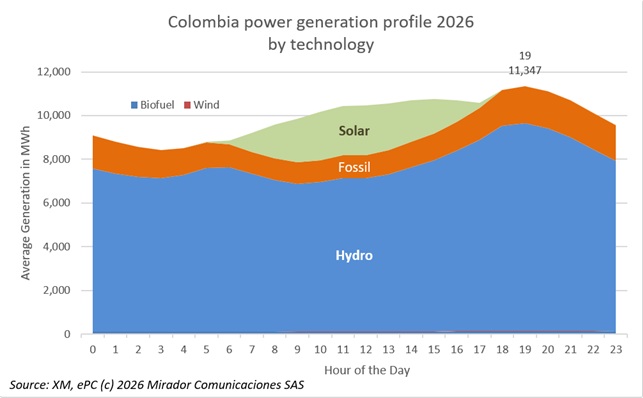
Alejandro Arbeláez, general manager of Sociedad Hidroituango, used a July 5th interview with Valora Analitik to deliver the most operationally specific public warning yet about Colombia's blackout risk -- and to put two concrete proposals on the table for the incoming de la Espriella government: activate more thermal plants immediately, and advance the clock by one hour to optimize use of natural daylight.
Read morePuerta de Oro, Colombia's largest solar park, entered commercial operations on July 6th, an arrival that Valora Analitik noted comes at a strategically significant moment, with El Niño conditions confirmed and the national grid under pressure to build non-hydraulic generation capacity.
Read moreThe most underreported dimension of Colombia's El Niño crisis is not the reservoir levels: it is the simultaneous convergence of scheduled maintenance at the country's largest generation plants with the precise period when the system most needs them available.
Read moreThe Caribbean electricity crisis became the first substantive policy commitment of the de la Espriella presidency even before his August 7th inauguration.
Read moreThe Superintendency of Public Services signed a Agreed Management Program (PGA) with Empresa de Energía Eléctrica de Vichada – Electrovichada – placing the isolated department's electricity provider under a structured corrective and preventive framework after regulatory inspections found a combination of technical, operational, and financial deficiencies serious enough to threaten service continuity.
Read more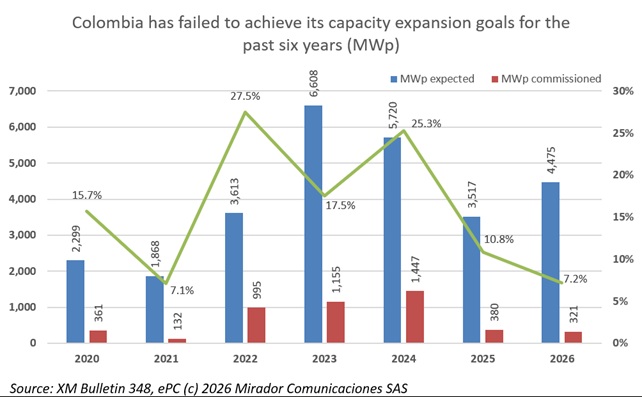
Colombia enters its seventh consecutive year of failing to commission the electricity generation capacity its own planning agency projected, according to XM data reported by Valora Analitik on June 27 -- and the timing could not be worse, with El Niño now confirmed and potentially extending into the first quarter of 2027.
Read moreJuan Ricardo Ortega, president of Grupo Energía Bogotá (GEB), issued one of the sharpest public warnings yet about Colombia's transmission infrastructure crisis in a conversation with ACIPET reported by Valora Analitik on June 26, framing Bogotá's energy restriction risk not as a future scenario but as a present reality already cutting off new industrial demand.
Read moreLatin America's renewable energy endowment gives it a structural advantage in the global competition for artificial intelligence infrastructure investment, according to Steven Carlini, head of Data Centers and AI at French energy technology company Schneider Electric.
Read moreXM's Bulletin 348, published June 27, delivered the starkest available measure of Colombia's renewable energy buildout failure: of the 4,475 MW expected to enter the national interconnected system during 2026, only 321 MW -- just 7.2% of the annual target -- had actually connected as of the report date.
Read moreColombia's energy and gas regulator CREG put a proposed demand-reduction incentive program out for public consultation on June 23, framing it explicitly as a pre-emptive El Niño measure following IDEAM's June 11 confirmation that El Niño conditions have arrived in the equatorial Pacific and are expected to intensify through the second half of 2026.
Read more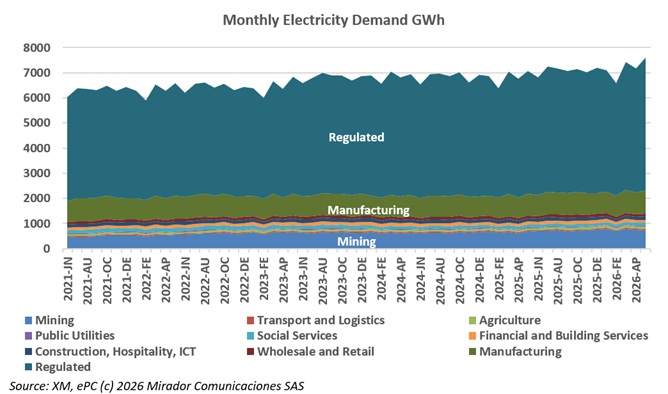
Colombia's electricity system is running a firm energy deficit that will widen every year through 2029, according to data from XM, the national electricity market operator, reported by Valora Analitik on June 22.
Read moreVenezuela has signed a memorandum of understanding with GE Vernova – the energy technology company responsible for generating approximately 25% of global electricity, spun off from General Electric – to develop projects aimed at improving the country's chronically deficient power supply.
Read more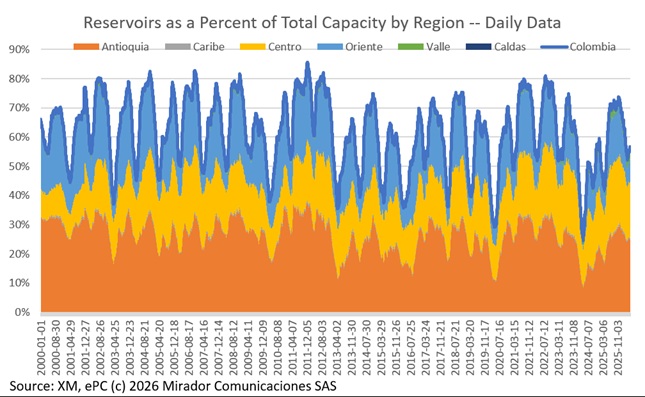
Colombia's El Niño weather event has arrived, and the country enters the dry season with reservoir levels already running roughly 10 percentage points below where they should be. XM, the electricity market operator and ISA subsidiary, warned as of June 17 that under scenarios resembling the driest episodes in the historical record, aggregate reservoir levels could descend to approximately 30% of useful capacity by the time the phenomenon peaks – far below the 80%-plus level that XM considers the minimum adequate entry point into the dry season.
Read moreThe Ministry of Mines and Energy issued three press releases in the week of June 10--12 announcing a cluster of renewable energy deliveries and a high-profile project reactivation, presenting them collectively as evidence that the government's just energy transition is reaching remote and historically marginalized territories.
Read moreColombia's electricity generation buildout has fallen catastrophically behind schedule just as demand is hitting historic peaks, according to a detailed analysis by Valora Analitik drawing on data from grid operator XM, an ISA subsidiary.
Read moreFitch Ratings has warned that Colombia's electricity system will face heightened reliability pressure in the second half of 2026, with tightening supply-demand margins raising the risk of rationing if El Niño conditions materialize as projected.
Read more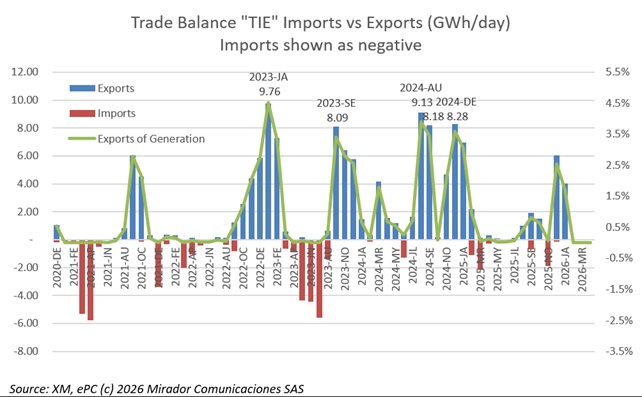
A diplomatic and commercial spat between Colombia and Ecuador spilled into the energy arena in late May, when President Gustavo Petro used his X account to signal that Colombia would be willing to resume electricity exports to its southern neighbor -- conditionally.
Read more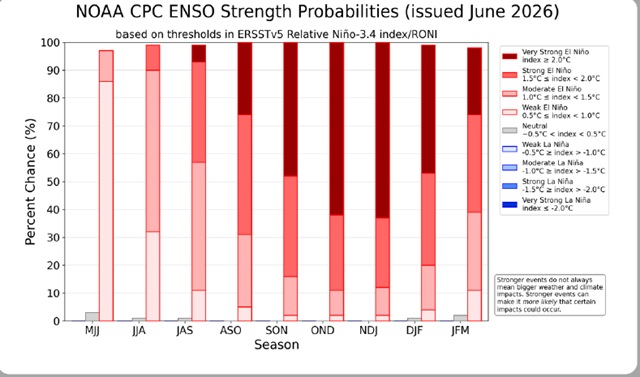
“El Nino has developed in the tropical Pacific,” says the latest report from the National Oceanographic and Atmospheric Administration (NOAA) and the forecasters expect it to “strengthen”.
Read moreColombia's Senate approved the so-called Ley Nuclear in its fourth and final legislative debate on June 11, sending the bill to the president for signature.
Read moreArgentine energy company Impsa is in advanced negotiations with Venezuelan state utility Corpoelec to revive a long-stalled hydroelectric contract that could add up to 672 MWp of generating capacity to Venezuela's chronically underpowered grid.
Read moreThe May 22 reliability charge auction (OEF) awarded firm energy obligations to 15 new projects totaling 4,069 MW of capacity and 143 GWh per day, enough for the government to declare success, but not enough for industry bodies to agree with it.
Read moreWith climate models now placing the probability of a strong or very strong El Niño closing out 2026 at 96%, Colombia's association of capital cities, Asocapitales, has launched a coordinated national preparedness initiative that brings together the national disaster risk management agency (UNGRD), IDEAM, the Colombian Red Cross, and several ministries.
Read moreThe municipality of Galapa, in Atlántico department, has been subject to rolling power cuts for several weeks caused by overloading of the circuit serving the town, triggering community protests and blockades on the Cordialidad highway.
Read moreWith the June 21 presidential runoff looming, Colombia's energy sector is watching the electoral cycle with unusual intensity. Not because either candidate's platform is unclear, but because analysts say the first hundred days of the new administration will send market signals that reverberate for years.
Read moreGalapa, a municipality in Atlántico department, has become the first town in the department to face open, acknowledged electricity rationing by the government-intervened distributor Air-e and the editorial board of El Heraldo is not mincing words about what comes next.
Read moreWhen the Superintendencia de Servicios Públicos intervened Air-e in September 2024, the Caribbean distributor's debt stood at approximately CoP$530B. By April 30, 2026 -- twenty months and five administrators later -- it had reached CoP$2.3T, an increase of more than 350%.
Read more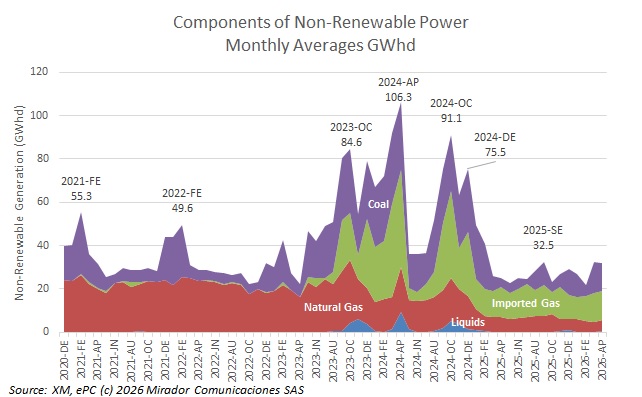
Colombia's thermal generation sector has been burning significantly more fuel since mid-May, with XM data showing coal consumption at thermal plants rising 47.9% between January and May 2026 -- from 132.7 to 196.3 GBTUd -- and gas consumption rising 65.1%, from 122.2 to 201.7 GBTUd.
Read moreNencol 5, the 2,240 MWp gas-fired thermal plant awarded a firm energy obligation in the May 22 reliability charge auction, is nominally the most consequential single result of that process -- representing 55% of the 4,069.7 MWp of new capacity assigned and 4.5% of all firm energy committed. However, El Tiempo's investigation into the project and the man behind it raises serious doubts about whether any of that will materialize.
Read moreSimón Gaviria, writing in El Heraldo, argues that Colombia's energy debate is stuck in the wrong century.
Read moreThe Petro administration issued Decree 0526 on May 21, amending Decree 1073 of 2015 and fundamentally broadening the mandate of the Fondo de Energía Social (FOES) -- the fund that has historically financed electricity bill discounts for stratum 1 and 2 households.
Read moreColombia's 23 monitored hydroelectric reservoirs closed May at 66.38% of capacity -- a 2.35 percentage-point improvement over April's 64.03% but still well short of the 80% analysts consider the minimum safe level for withstanding a prolonged dry period.
Read moreThe Petro administration declared the May 22 reliability charge auction a resounding success, claiming it exceeded projected demand by 8%. Industry analysts, the power generators industry association Andeg, and the auction's most controversial winner all spent the following week telling a different story.
Read moreAlejandro Castañeda, president of the power generators industry association Andeg, declared on May 27 that Colombia faces a high probability of a blackout in March and April of next year, the product of three simultaneous failures: an undersized reliability charge auction, the financial collapse of Caribbean distributor Air-e, and the approaching El Niño phenomenon.
Read moreThe economic price tag on a potential rationing scenario is the most important thing El País's May 25 expert survey adds to a story we have already well documented elsewhere, including today.
Read moreAndesco, Colombia's public utilities industry body, issued its starkest public warning to date on May 21, laying out five interconnected risk factors it says could drive the country into electricity rationing -- and giving the government a three-to-four month window to act before the dry season becomes unmanageable.
Read more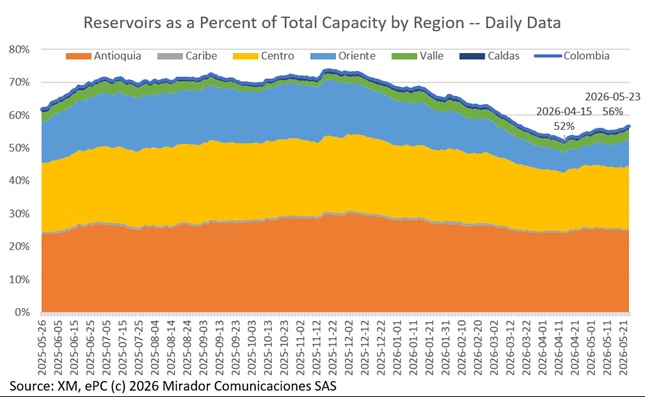
Energy services platform Klik has published an analysis warning that Colombia's electricity grid faces a compounded stress test in the second half of 2026: the coincidence of El Niño, a structural firm-energy deficit, and the surge in demand that accompanies every Colombia match at the World Cup.
Read moreThe CREG's 2029-2030 firm energy obligation auction – the result that secured 4,069 MW and CoP$16T in investment – has a pronounced regional dimension that received little attention in national coverage.
Read moreColombia's electricity system regulator CREG closed its latest expansion auction on May 22--23, securing 4,069.7 MW of firm energy capacity and 15 new generation projects for the December 2029--November 2030 obligation period, with total committed investment exceeding CoP$16T.
Read moreThree industry voices converged in the third week of May to paint a consistent and sobering picture of Colombia's energy exposure as El Niño approaches: the sector is entering the dry season with a negative firm-energy balance, insufficient gas, a crippled Caribbean distributor, and a new generation pipeline that has chronically underdelivered.
Read more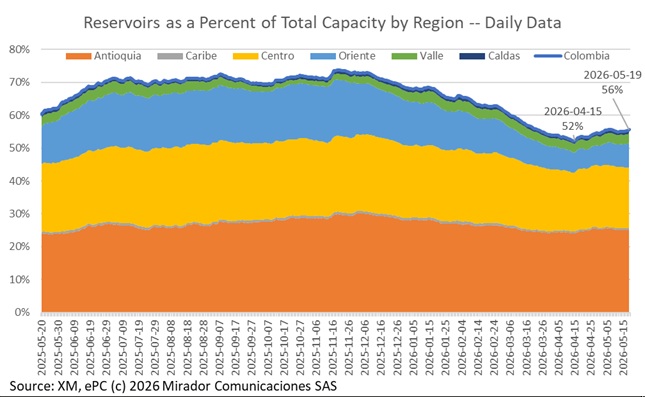
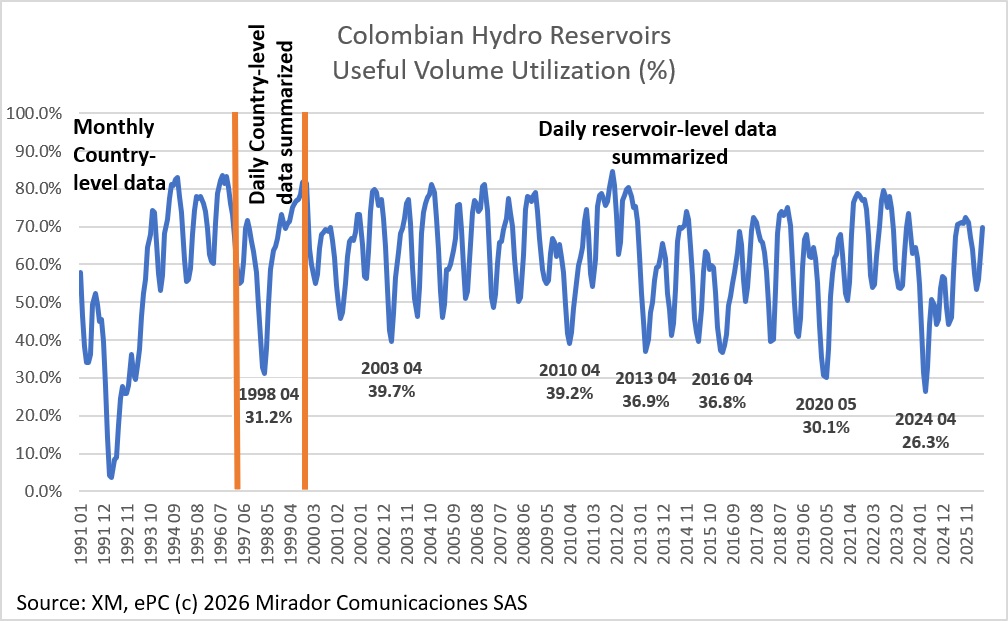
Several articles recently have noted the coming El Niño, perhaps “Super” El Niño and the need to ensure the hydro reservoirs are at their highest possible level.
Read moreColombia's Ministry of Mines and Energy published a draft resolution for public comment on May 7 proposing changes to the policy governing capacity allocation on the National Power Grid (Sistema Interconectado Nacional or SIN) – a measure framed by Minister Edwin Palma as aimed at freeing up connection slots occupied by stalled projects so that new generation, including clean energy and storage, can move faster.
Read moreColombia's only LNG import terminal, the Cartagena regasification plant, is scheduled to go offline for five days of preventive maintenance from July 30 to August 3, 2026 – deliberately brought forward from its customary October / November slot to ensure the infrastructure is fully available during the most demanding phase of the El Niño weather phenomenon forecast for the second half of the year.
Read more