
Enel's Atlántico solar park, rated at 256 MWp DC, has entered commercial operation in the municipalities of Sabanalarga and Usiacurí.
Read moreBanco de Occidente has joined the financing of Parque Solar Puertos de Santander, a solar project of about 250 MWp in Cimitarra, Santander, with up to CoP$200B committed.
Read moreXM, the system operator, estimates that Colombia's power system could enter the 2026-27 dry season with a gap of up to 7,669 GWh between firm energy and projected demand, or 8.3% of expected needs.
Read moreAdriana Jiménez, director of the energy and gas regulator CREG, says its short-term priority is responding to El Niño, with wholesale-market modernization, supply expansion and the reliability charge as medium- and long-term work.
Read more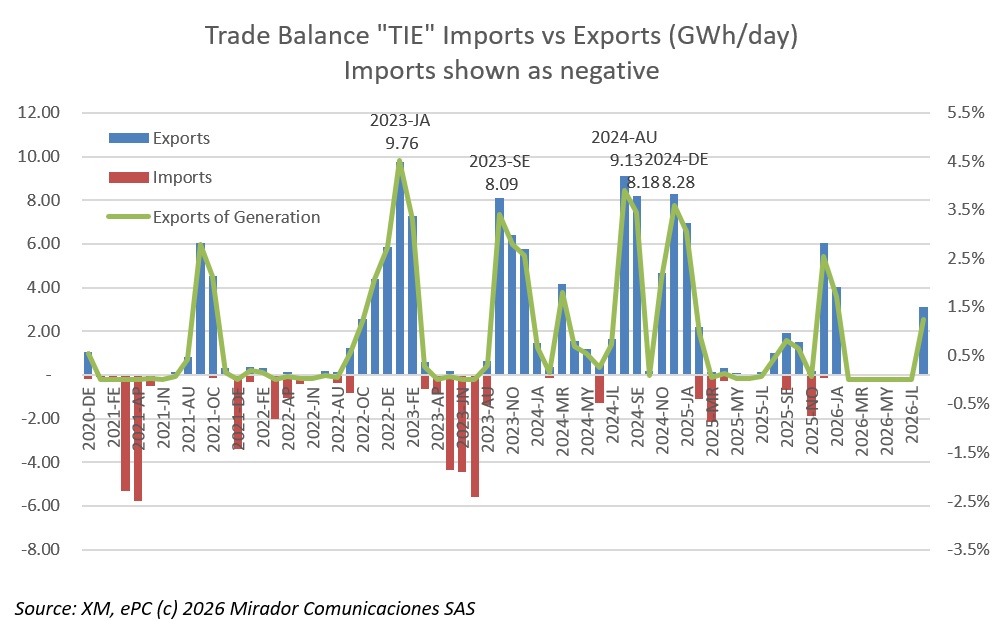
Colombia will resume electricity exports to Ecuador, which is in one of its worst dry seasons, with industrial power cuts and its key reservoir near critical levels.
Read moreThe main El Niño risk for Colombia's power system may be adequacy and grid reliability, not tariffs, according to a study by the Observatorio del Caribe Colombiano, while generators ask for decisions to avoid rationing.
Read moreAir-e, the state-intervened distributor, and RAP Caribe, the Caribbean planning region, say they are advancing a roadmap to stabilize and improve electricity service across the region.
Read moreDark clouds gather over Bogotá with sufficient frequency that friends who know I write about energy issues ask if, in fact, we have anything to worry about. We do.
Read moreColombia's thermal plants have fallen short of the output target set to conserve reservoir water ahead of El Niño, and their trade association says the regulator's own rule is the main reason.
Read moreXM, the wholesale electricity market operator, has warned that Colombia could be unable to cover full electricity demand in April 2027 without urgent measures, just as one columnist argues that a record El Niño is still being underestimated.
Read moreSix years after Air-e and Afinia replaced Electricaribe, the Caribbean still has no lasting solution to its electricity problems, with debts to generators, high losses and tariffs residents struggle to pay all unresolved.
Read moreColombia has a new vice minister of energy: Alex Fabián Cañas takes over from Armando Cuello, who has resigned.
Read more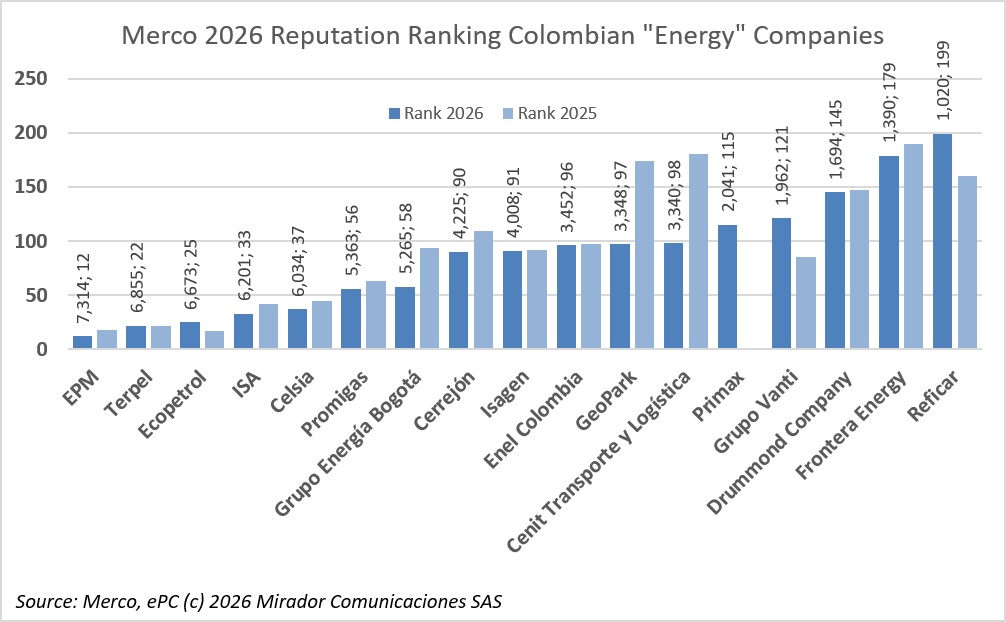
EPM is the highest-ranked energy company in Merco's 2026 Colombia reputation ranking, at 12th, while Ecopetrol fell eight places to 25th.
Read morePresident Abelardo de la Espriella has issued a directive that reshapes how Colombia handles prior consultation with ethnic communities, replacing three earlier presidential directives.
Read moreVice President José Manuel Restrepo says the government will work to unblock energy projects in La Guajira that could bring in about US$2.5B of investment.
Read moreBarranquilla used an energy session at an Organization of American States competitiveness forum to present its renewable plans to investors, led by an offshore wind project of 350 MW that could reach 700 MW.
Read more