
Javier Campillo, who served as Colombia’s Deputy Minister of Energy under President Gustavo Petro until late January, recently shared his concerns regarding proposed regulatory changes in the electricity market.
Read moreIn his first public appearance, Edwin Palma, Colombia’s new Minister of Mines and Energy (MinEnerigia), strongly addressed recent warnings about potential blackouts in the country. He criticized what he sees as a politically motivated narrative surrounding the financial difficulties in the electricity sector.
Read moreColombia’s energy transition continues to gain momentum, and the Caribbean region is joining the movement with a new initiative: Nebula, a mini solar farm designed to provide clean energy to over 1,100 households.
Read moreAfinia, the public utility company serving Colombia’s Caribbean region, raised urgent concerns over an impending blackout due to the government’s unpaid energy subsidies.
Read moreThe growing gap between energy supply and demand in Colombia has raised alarms among industry experts.
Read moreColombia faces increasing concerns about its electricity supply as demand continues to grow while the expansion of energy generation struggles to keep pace.
Read moreThe global energy sector is undergoing a profound transformation, driven by the rise of renewable energy. This shift is fueled by the pursuit of sustainability, digitalization, electric mobility, and emerging business models. Companies like Erco are at the forefront of this change.
Read moreElectricity prices in Colombia have surged 58.8% over the last five years, prompting the national government to implement measures aimed at reducing costs.
Read more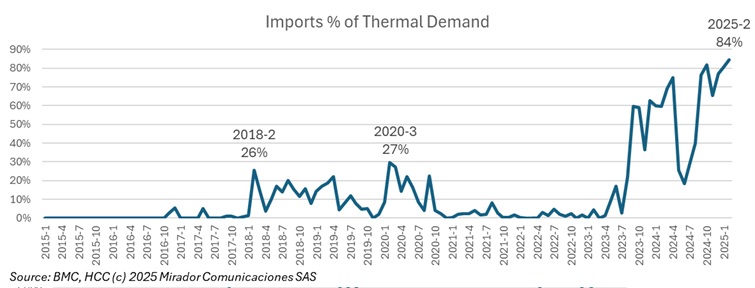
Colombia's inflation rose slightly in February, reaching an annual rate of 5.28%, according to data released by DANE.
Read moreAir-e, the electricity distribution company in Colombia’s Caribbean region, has announced a significant debt relief measure for over 195,000 users in Atlántico, Magdalena, and La Guajira.
Read moreConcerns over Colombia’s ongoing energy and gas crisis continue to grow as rising tariffs impact millions of users nationwide.
Read moreThe auditor of ISA, Andrés Camilo Morales, has formally requested the company to address a shareholder's complaint regarding a lack of access to key information ahead of the 2025 General Assembly, scheduled for later this month.
Read moreThe Mayor of Medellín, Federico Gutiérrez, announced that the Tenth Civil Circuit Court ordered the seizure of the Colombian government's accounts due to outstanding debts owed to Empresas Públicas de Medellín (EPM) and its subsidiaries.
Read moreColombia’s new Minister of Mines and Energy (MinEnergia), Edwin Palma, is planning several internal changes within the ministry to align with the goals set by both himself and President Gustavo Petro.
Read moreThe operator of Colombia’s National Interconnected System (SIN) and Administrator of the Wholesale Energy Market (MEM), XM, has revealed new details about the implementation of the CREG 101 066 of 2024 and 101 069 of 2025 resolutions, designed to reduce energy tariffs in the country.
Read moreLast month we wrote that we had expected to see geothermal play an important role in Colombia’s energy matrix but it wasn’t happening. Since that article we found some more material, some Colombian but mostly global. Many of the challenges are not unique to here.
Read moreThe global energy transition is a critical priority, and women's role in achieving this goal cannot be overlooked.
Read moreEcopetrol (NYSE: EC) and the British Embassy in Colombia announced the creation of the Chevening – Ecopetrol Scholarships for a Just Energy Transition in Colombia.
Read moreLess than a year after the Colombian government intervened in energy provider Air-e, electricity tariffs in the Caribbean region have shown a downward trend, according to a recent report from the Energy and Gas Regulatory Commission (CREG).
Read moreThe municipality of Ariguaní, Magdalena, is facing a severe energy and potable water crisis.
Read moreThe government of President Gustavo Petro expressed strong support for unconventional renewable energy sources, particularly solar and wind projects. However, some of its recent policies are raising concerns among industry players, who warn that these measures could deter investment and hinder the development of such initiatives in Colombia.
Read moreColombian President Gustavo Petro met with Minister of Mines and Energy (MinEnergia), Edwin Palma Egea, and expert commissioners from the Energy and Gas Regulatory Commission (CREG) at the Casa de Nariño to discuss measures to reduce electricity tariffs.
Read moreEPM implemented preventive measures to combat illegal mining activities near the Porce III hydroelectric plant.
Read moreDiana Bustamante Rueda has officially assumed the role of intervenor for Air-e, replacing Edwin Palma. The appointment was formalized before Yanod Márquez, Superintendent of Public Utilities.
Read moreThe Inspector General’s office issued a document as part of its efforts to ensure an energy transition that balances energy sovereignty with the environmental, social, and economic impacts of energy projects in Colombia.
Read moreThe Energy and Gas Regulation Commission (CREG) participated in the forum "Smart Metering Systems: Their Role in the Energy Transition and User Empowerment," organized by the Colombian Association of Electric Power Distributors (ASOCODIS). The event brought together key sector stakeholders to analyze the role of these technologies in the provision of public utility services.
Read moreGiven the complexity of the energy situation in the Caribbean, multiple solutions have been proposed to address the problems and positively impact on the final costs paid by consumers. One of the most talked-about proposals has been the creation of a new alternative energy company.
Read moreBanco Popular and Promigas signed a strategic alliance to install solar energy systems in 13 of the bank’s offices across Colombia, starting in April 2025.
Read moreEdwin Palma, Colombia’s newly appointed Minister of Mines and Energy (MinEnergia), has officially begun the transition process with outgoing minister Andrés Camacho.
Read moreResidents of Ariguaní, a municipality in the central region of Magdalena, held a team of workers from Afinia hostage for several hours. Their purpose was to prevent the company from cutting off power to three delinquent water plants. If the power had been cut, so would have been water services to the town.
Read moreThe Urrá Hydroelectric Plant has announced the restoration and paving of an 8.2-kilometer road connecting Tierralta to its operations center, addressing what the company calls a "historic debt" to the municipality.
Read moreEPM announced executive changes as part of its organizational restructuring to differentiate the management of its businesses in Medellín and Antioquia from its national and international subsidiaries.
Read moreSevere drought conditions that affected multiple countries across Latin America and the Caribbean throughout 2024, especially in the latter half of the year, played a significant role in driving up energy inflation in the region.
Read moreThe Unconventional Energy and Efficient Energy Management Fund (FENOGE), under the leadership of the Ministry of Mines and Energy (MinEnergia), and with the support of the Pereira Mayor’s Office, delivered 38 Educational Energy Communities in Risaralda.
Read moreSolar energy has gained significant traction in Colombia as a sustainable and cost-effective solution to reduce electricity bills while minimizing environmental impact.
Read more
We can debate strategic issues like why Colombia should accelerate energy transition while sitting on enormous coal reserves or tactical issues like whether the Levelized Cost of Energy is lower for solar or gas thermal. But we cannot debate that Mother Nature is harder to predict than a thermal plant.
Read more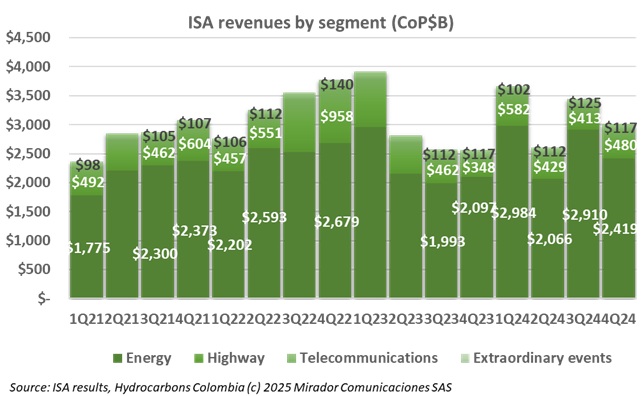
ISA (Interconexión Eléctrica S.A.) closed 2024 with a strong financial performance.
Read moreEcopetrol (NYSE: EC) made a formal bid to acquire the Windpeshi wind farm from Enel Colombia, marking a potential shift into the wind energy sector.
Read moreThe recent departure of Andrés Camacho from the Ministry of Mines and Energy (MinEnergia) marks another shift in the government of Gustavo Petro. His resignation, accepted on February 9, comes amid ongoing tensions between the administration and the energy sector.
Read moreAfter 18 months in office, Andrés Camacho is stepping down as Colombia’s Minister of Mines and Energy (MinEnergia), leaving behind a mixed legacy in the energy sector.
Read moreThe Caribbean coast is at the center of Colombia’s energy transition with the first offshore wind round.
Read moreBarranquilla is taking a bold step towards sustainability with the launch of its first large-scale solar park in the Juan Mina district.
Read moreEnel Colombia continues to lead the country’s energy transition, not only by developing large-scale solar projects like El Paso, La Loma, Fundación, and Guayepo I & II, but also by fostering local initiatives.
Read moreOur eye was caught by a Presidencia news release saying 10% of the energy Colombians consume was already solar. We were pretty sure that was “inaccurate” to be polite so we checked. It isn’t. But the fault mostly lies with Presidencia’s press team because the body of the press release is not as much of an “inaccuracy”, again to be polite.
Read moreColombia’s outgoing Minister of Mines and Energy (MinEnergia), Andrés Camacho, reflected on his tenure and future political aspirations following President Gustavo Petro’s acceptance of his resignation.
Read moreGrupo Diana launched Colombia’s first renewable energy self-generation project using biomass: a rice husk-based thermoelectric plant at the Arroz Diana production facility in Yopal, Casanare.
Read moreFor nearly seven decades, the Empresa de Energía de Boyacá (EBSA) has been at the forefront of transforming the department of Boyacá, ensuring access to reliable and high-quality electricity.
Read more
Bogotá’s mayor says water rationing in the city will end in April, less than two months away. We look at the data and wonder why?
Read moreColombian airline Satena is taking a significant step toward sustainability by implementing a solar-powered engine cooling system, optimizing aircraft maintenance while reducing its carbon footprint.
Read moreEcuador’s government has unveiled an ambitious plan to add approximately 8,000 megawatts (MW) of electricity generation between 2025 and 2030.
Read moreAuthorities confirmed the destruction of equipment used for illegal mining in the municipalities of Anorí and Amalfi, in the Nordeste region of Antioquia.
Read moreThe strong and constant winds, along with high solar radiation, make Colombia’s Caribbean coast an ideal energy powerhouse capable of supplying not only Colombia but also exporting electricity to neighboring countries such as Ecuador, Panama, and Venezuela.
Read moreThe Casa de Nariño is set to unveil eight new ministers who will accompany President Gustavo Petro through the remainder of his term.
Read moreFollowing the resignation of Carlos Raúl Yepes as EPM's designated member on the board of Interconexión Eléctrica S.A. (ISA), candidates are beginning to appear.
Read moreI recently came across an article from a US business school analyzing whether farmers there should raise corn or install solar panels. That got me thinking about Colombia’s rural solar opportunity which President Gustavo Petro thinks could make the country an energy exporter.
Read more
The Colombian energy market experienced a decline in wholesale electricity prices in January 2025, according to a report released by XM.
Read moreThe Jeques solar park, acquired by the French multinational GreenYellow Colombia, has been officially inaugurated in Cucunubá, Cundinamarca.
Read moreRicardo José Arango officially took over as the General Manager of Afinia, a subsidiary of Grupo EPM.
Read moreMiguel Uribe, senator from the opposition party Centro Democrático, announced a control debate targeting key members of President Gustavo Petro’s administration over what he describes as an impending energy crisis in Colombia.
Read moreThe Colombian Ministry of Mines and Energy (MinEnergia) reaffirmed the "secure supply of energy" for all Colombian.
Read moreOne of the biggest concerns in Colombia’s energy sector is the future of the Caribbean Coast’s electricity distributors, Air-e and Afinia. Both companies are facing severe financial difficulties, with Air-e being placed under government intervention by the Superintendence of Public Services for liquidation, while Afinia’s owner, Empresas Públicas de Medellín (EPM), has asked the government to acquire it.
Read moreAs soon as Colombia’s gas tariff crisis erupted, the Energy and Gas Regulatory Commission (CREG) issued Resolution 102 015, aimed at providing flexibility in contracts between producers and marketers starting in June 2025.
Read moreEnel Colombia continues to fulfill its promise of bringing electricity to the most remote corners of the region with its "Cundinamarca al 100%" program.
Read more
Ecuadorian President Daniel Noboa recently claimed that Ecuador is selling electricity to Colombia, but officials from both countries seem to disagree.
Read moreColombia’s Minister of Mines and Energy (MinEnergia), Andrés Camacho, dismissed concerns over potential power shortages in the country, contradicting recent warnings from various industry groups.
Read moreThrough Resolution CREG 070 of 2025, the Energy and Gas Regulatory Commission (CREG) introduced a new framework that will allow large energy consumers to share their electrical infrastructure with distribution companies.
Read moreThe 14th edition of Colombia Genera, the flagship event of the National Business Association of Colombia (ANDI), will take place in Cartagena on March 19-20, 2025.
Read moreGrupo Energía Bogotá (GEB) and its subsidiary, Transportadora de Gas Internacional (TGI), have been recognized in the Sustainability Yearbook 2025 by S&P Global for their outstanding performance in environmental, social, economic, and governance management.
Read moreEcopetrol (NYSE: EC) has been recognized as one of the world's most sustainable companies, earning a place in the 2025 S&P Global Sustainability Yearbook.
Read moreThe Board of Directors of Afinia, a subsidiary of Grupo EPM in the Caribbean region, appointed a new general manager.
Read moreThe appointment of Jorge Carrillo as president of ISA continues to spark controversy within the company, leading to the resignation of a key member of its Board of Directors last week.
Read moreRecently, Colombia’s Minister of Mines and Energy (MinEnergia), Omar Andrés Camacho, highlighted the national government’s progress in promoting renewable energy in the department of La Guajira, a key region due to its wind and solar radiation resources. However, the reality may not be as promising as the government portrays.
Read moreClimate change and the energy transition have become central priorities for the current Colombian government. However, translating these ambitious goals from theory into practice is proving to be far from simple.
Read moreEcopetrol (NYSE: EC) announced progress in the construction of the La Iguana Solar Farm, a renewable energy project located in Yondó, Antioquia.
Read more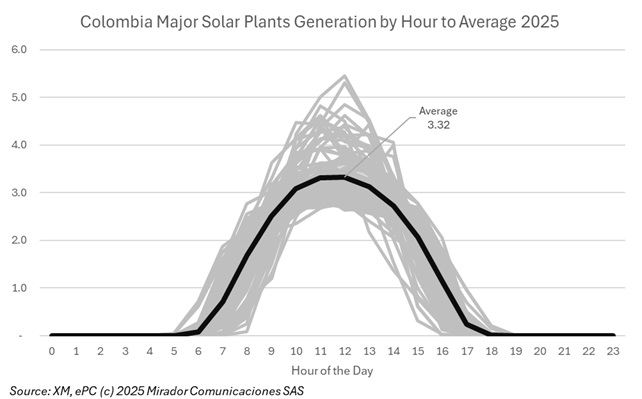
The Petro government has put virtually all its “eggs” in a solar basket, relying almost exclusively on rooftop or community solar for growth. These have indeed grown in quantity but very little or none translates into additional capacity for the grid.
Read more
The National Authority of Environmental Licenses (ANLA) has officially granted an environmental license to the ‘El Copey’ solar park project.
Read morePostobón, in partnership with its transportation company Edinsa and Grupo Bancolombia’s subsidiary Renting Colombia, has successfully piloted a sustainable mobility project using hydrogen technology in freight trucks.
Read moreAs part of its ongoing energy transition, the Colombian government is set to auction seven areas for geothermal energy projects in 2025.
Read moreAir-e, the electricity provider under government intervention, launched a strategic initiative aimed at reducing estimated energy consumption charges for users in Atlántico, Magdalena, and La Guajira.
Read more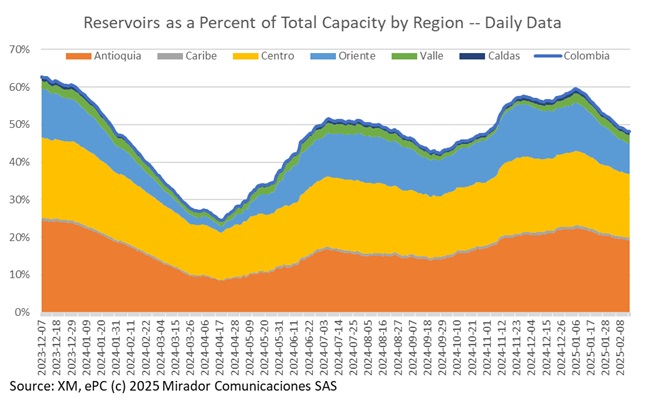
In Bogotá it rains every afternoon, heavily. In the hydro dam reservoirs it is not raining or at least not enough to compensate for the XM’s use of hydroelectric power. Porce III only operating at 40% does not help with power generation.
Read moreThe Porce III hydroelectric plant in northern Antioquia is facing significant threats due to unauthorized mining activities that have compromised its infrastructure and increased the risk of environmental hazards.
Read moreThe Inspector and Comptroller General formally requested that the Minister of Mines and Energy (MinEnergia), Andrés Camacho, provide detailed accounts regarding the delayed energy subsidies for households in strata 1, 2, and 3.
Read moreThe Inspector General’s Office called upon governors, city and municipal mayors, and decentralized entities to take immediate and medium-term actions to mitigate risks in energy service provision. The governors responded with a letter addressed to other entities.
Read more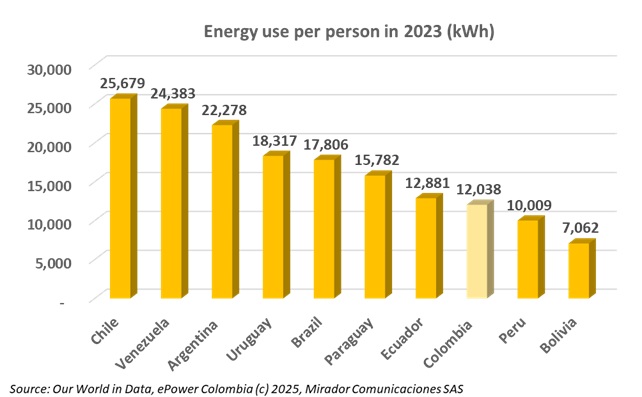
Energy consumption per capita is a key indicator of a country's level of development, industrialization, and quality of life. In this metric, Colombia ranks among the lowest both globally and in Latin America.
Read moreAs the electric vehicle (EV) market continues to grow, sustainability is becoming a key driver in the automotive sector.
Read moreIn a significant but somewhat overlooked development, Ecopetrol (NYSE: EC) is preparing a multimillion-dollar investment that could reshape its future by integrating artificial intelligence (AI) and digital connectivity into its core business.
Read moreColombia’s business sector is on edge after the Superintendence of Industry and Commerce (SIC) carried out a surprise inspection to industry associations.
Read more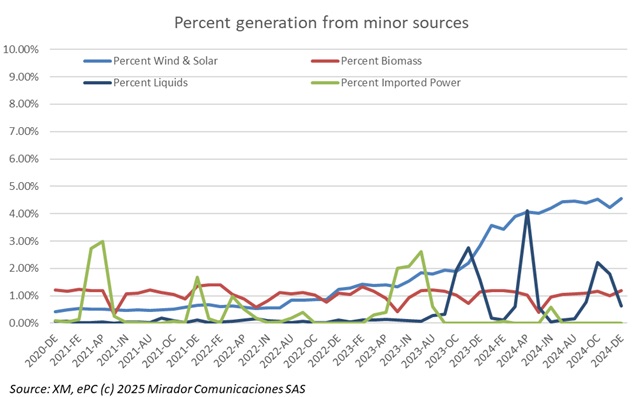
The agricultural sector emerged as one of the key drivers of Colombia’s economy in 2024. By the third quarter, it was the fastest-growing sector, expanding at an annual rate of 10.7%. After coffee, which had an exceptional year, permanent crops such as sugarcane showed the highest growth.
Read moreColombia is making strides in renewable energy, but progress remains uneven.
Read moreEdwin Palma, the special interventor agent for Air-e, announced that the company has successfully secured energy supply for 2025 in the departments of La Guajira, Magdalena, and Atlántico through direct contracts with power generation companies.
Read moreFitch Ratings removed the negative watch from EPM and its local bond issuances, affirming their AAA rating with a stable outlook.
Read moreColombia's energy crisis prompts urgent discussions among government officials, industry leaders, and regulatory bodies.
Read moreColombian energy industry associations urged Minister of Mines and Energy (MinEnergia), Andrés Camacho, to demonstrate greater willingness to engage in dialogue and find solutions to the sector’s pressing issues.
Read moreAs part of Colombia’s energy transition, the private sector in the Atlantic Coast is playing a strategic role by implementing solar panels in production centers to reduce energy costs by up to 80%.
Read moreLast week, The Economist’s weekly environmental newsletter The Climate Issue, talked about regions where deserts meet oceans as “creating the ideal conditions for generating renewable electricity”. Colombia has one of those.
Read moreThe recent announcement by President Gustavo Petro regarding the payment of energy subsidies amounting to nearly one trillion pesos has provided some relief to Colombia’s energy sector. However, according to José Camilo Manzur, President of Asocodis (Colombian Association of Electric Energy Distributors), this measure does not fully resolve the severe financial crisis faced by the sector.
Read moreThe President of the National Association of Generating Companies (Andeg), Alejandro Castañeda, criticized the Colombian government for its lack of coordination with the private energy sector.
Read moreAir-e outlined a strategic roadmap to enhance service quality, improve user experience, strengthen infrastructure, ensure fair tariffs, and secure long-term sustainability. These elements form the foundation of a specialized consultancy the company plans to hire to implement a comprehensive business solution.
Read moreAs the world transitions toward cleaner energy solutions, solar panels have gained popularity due to their ability to generate electricity in a sustainable, renewable, and cost-effective manner.
Read more