
The Constitutional Court's provisional suspension of the economic emergency decree could worsen the energy crisis facing Caribbean departments due to Air-e's precarious financial situation, according to government officials.
Read moreColombia's industrial natural gas demand reached its lowest level in a decade during December 2025, triggering increased consumption of more polluting fuels as companies abandon gas for coal, diesel, fuel oil, and liquefied petroleum gas.
Read moreActing Environment Minister Irene Vélez Torres led a dialogue with 40 Colombian ambassadors and diplomatic mission representatives to advance preparations for the First Conference for Transition Beyond Fossil Fuels.
Read moreThe Ministry of Mines and Energy issued a draft resolution for public comment regulating the Colombia Solar program, transforming traditional electricity subsidies into solar self-generation for households in strata 1, 2, and 3 of the National Interconnected System.
Read moreColombia's Constitutional Court suspended President Gustavo Petro's economic emergency decree, halting tax measures targeting petroleum, mining, and other sectors. However, Decree 044 – imposing new levies on electricity generators to finance Air-e – remains in force and is scheduled to take effect February 2, creating legal uncertainty and industry alarm.
Read moreOn January 26, 2026, Ecuador increased Colombian oil transport costs through the Sistema de Oleoducto Transecuatoriano (SOTE) by 900%, from US$3 to US$30 per barrel, triggering Colombia's suspension of electricity exports.
Read moreThe Centro Nacional de Consultoría (CNC) presidential poll conducted January 15-21, 2026 among 2,202 people in 56 municipalities reveals Iván Cepeda maintaining his frontrunner position with 28.2% voter intention, while competition intensifies for second place ahead of Colombia's May 2026 elections.
Read moreThe resignation of Nelson Javier Vásquez Torres as Air-e's special intervention agent has intensified concerns about the electricity crisis affecting over 1.3 million users across 57 municipalities in Atlántico, Magdalena and La Guajira.
Read more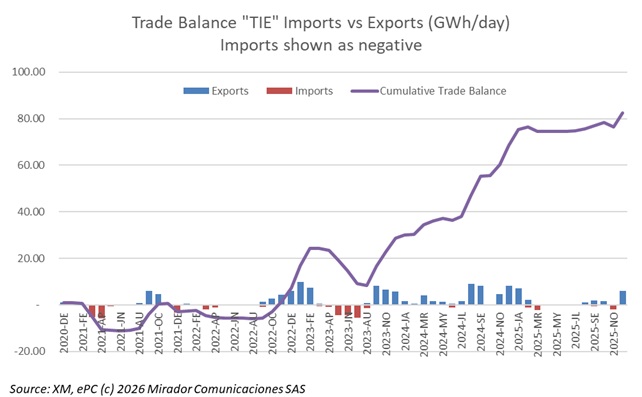
Ecuador's Ministry of Environment and Energy asserted that the national electrical system has sufficient capacity to meet daily energy demand with domestic generation, even facing potential limitations on imports from Colombia.
Read moreColombia's energy panorama for 2026 is expected to be one of the most challenging of the last decade, with rising prices and a narrow margin between generation and demand driving projected growth of 20-40% in the energy efficiency technology market.
Read moreEcopetrol and Frontera Energy marked World Clean Energy Day with the inauguration of the new Quifa Solar Farm, incorporating 18MWp in the first quarter of 2026 and advancing Colombia's energy transition.
Read moreBrazil leads Latin America in billionaire wealth concentration with 66 billionaires controlling US$253.2B, followed by Mexico (over US$200B), Chile, Colombia, and Argentina, according to an Oxfam report presented at the World Economic Forum in Davos. Meanwhile the CIDA says Colombia is the most unequal society in the region.
Read more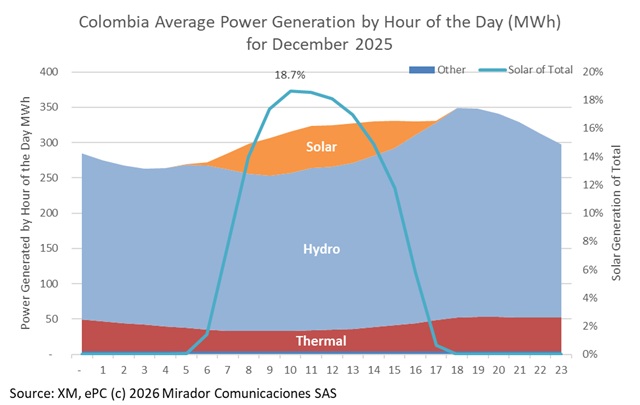
Colombia's solar energy sector demonstrated significant expansion in December 2025, with solar parks contributing 7.17% of total renewable electricity generation, according to XM data, as reported by El Tiempo. This represents a 17.49% increase compared to November 2025, underscoring the country's advancing clean energy transition.
Read moreColombia's Ministry of Mines and Energy launched the second phase of the 'Caribe, Cambia tu Energía' program in Suan, Atlántico, targeting 20,000 households across the Caribbean region with appliance replacement initiatives aimed at reducing electricity consumption and lowering utility bills.
Read moreColombia's foreign direct investment (FDI) landscape in 2025 demonstrated resilience amid global economic headwinds, with renewable energy emerging as the dominant sector and the United States maintaining its position as the primary capital source.
Read moreOpinion polls on Colombians’ choices for president come fast and furious these days. For now there are two, perhaps three clear front runners. What if anything can we say about energy policy under each of them?
Read moreEmerging markets face critical challenges attracting energy investment despite holding world-class renewable resources and representing the bulk of future energy demand.
Read moreThe World Economic Forum's Transitioning Industrial Clusters (TIC) initiative has partnered with Colombia's largest port-based industrial area to advance low-carbon growth frameworks. The Cartagena Industrial Cluster represents a key example of how regional collaboration can drive energy transition in emerging economies.
Read moreColombia's Energy and Gas Regulatory Commission (CREG) resumed operating with its complete team of six expert commissioners after nearly three years of unprecedented vacancies, following the recent swearing-in of Ángela Álvarez and Adriana Jiménez before Mines and Energy Minister Edwin Palma.
Read moreEPM announced the successful rehabilitation of the Sonsón hydroelectric plant in eastern Antioquia, restoring 18.5 megawatts (MW) of clean energy capacity to Colombia's National Interconnected System (SIN) following a CoP$24B investment.
Read moreThe Petro government created two new levies for energy generators under Legislative Decree 044 of 2026, which "adopts measures to ensure the provision of residential electricity public service" while acknowledging a liquidity crisis in the sector.
Read moreColombia's energy sector erupted in protest after the government issued Decree 044 of 2026 under economic emergency powers, imposing two new levies on power generators to address the liquidity crisis affecting intervened companies like Air-e.
Read moreIn a Guarumo-Ecoanalítica poll (Jan 14-22, 4,245 respondents): Iván Cepeda of Pacto Histórico leads with 33.6% support, followed by conservative attorney Abelardo De la Espriella at 18.2%, and Centro Democrático's Paloma Valencia at 6.9%.
Read moreISA Energía Peru, a subsidiary of Colombian state-controlled long-distance electrical transmission company, announced commercial operation of the San Gabriel connection project, representing the highest-altitude electrical infrastructure in the company's history.
Read more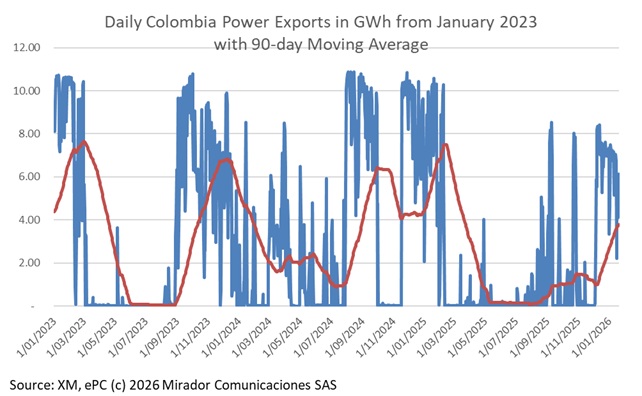
Colombia's Ministry of Mines and Energy issued a resolution suspending International Electricity Transactions (TIE) with Ecuador, responding to tariff measures announced by Ecuadorian President Daniel Noboa while prioritizing domestic energy security amid climate variability concerns. The decision affects electricity flows representing 8-10% of Ecuador's consumption, according to government data.
Read moreColombia's Environment and Sustainable Development Ministry has opened a public consultation to define the roadmap for implementing the Escazú Agreement, aiming to strengthen environmental democracy and guarantee rights to information, public participation, and environmental justice.
Read moreISA president Jorge Carrillo revealed the Ecopetrol subsidiary is preparing to bid on two new infrastructure projects in Chile, deepening its presence in a sector that generates 18% of company revenues.
Read moreA new GAD3 poll revealed by Noticias RCN shows Iván Cepeda (Pacto Histórico) leading Colombia's presidential race with 30% voter intention, followed by Abelardo de la Espriella (Defensores de la Patria) at 22%, and Paloma Valencia (Centro Democrático) at 3%. The survey of 1,207 respondents carries a 2.83% margin of error.
Read moreColombia's Ministry of Mines and Energy issued a resolution convoking the country's first long-term electricity contracting mechanism, enabling contracts up to 15 years duration to secure energy supply, diversify the electrical matrix, and advance energy transition in compliance with Decree 1091 of 2025.
Read moreBusiness associations and chambers of commerce from Colombia's Caribbean coast endorsed the Ministry of Mines and Energy's proposed CoP$8 per kWh increase electricity tariffs, warning of systemic risk threatening the national electrical grid due to intervened distributor Air-e's mounting debts.
Read moreClean technologies (cleantech) are transforming environmental approaches but face significant obstacles beyond technical innovation, including financing gaps, limited demand, and scalability constraints that require coordinated solutions to achieve sustainable energy transition.
Read more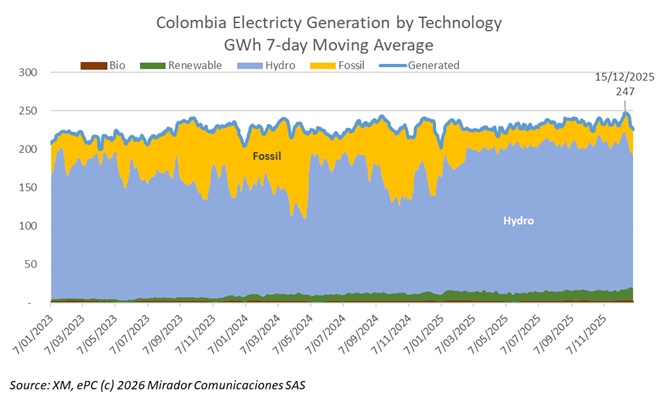
Last week I wrote about reservoir levels but didn’t include generation statistics (because we hadn’t updated our detailed databases) and yesterday we wrote about monthly generation statistics but had nothing to say about demand (because XM hasn’t updated its monthly demand figures).
Read more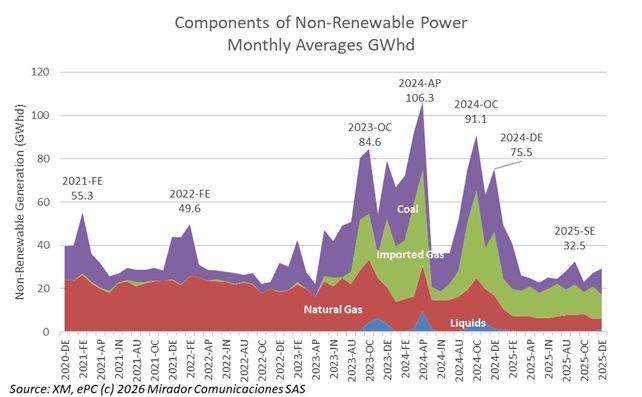
Power market manager XM reported that reservoir levels went down in December. Power generation was up but not from hydro. Instead, the increase came from solar (no surprise) and coal (surprise!)
Read moreLatin America and the Caribbean expect 3.7% growth in installed electricity generation capacity during 2025, reaching 562,000 MW total, driven primarily by renewable energy expansion. The growth stems from new wind and solar facilities plus natural gas thermal plants gradually displacing fossil fuel-based generation.
Read moreGrupo Energía Bogotá's (GEB) subsidiary Enlaza inaugurated the Bonda 220 kV transmission project, key infrastructure designed to strengthen the National Transmission System, improve electrical service reliability, and facilitate integration of renewable energy projects in Colombia's Caribbean region
Read moreColombia's Ministry of Mines and Energy announced the launch of "Caribe Conectado: Urgent Works for Reliable and Competitive Electric Service," a US$1.7B infrastructure program designed to strengthen the Caribbean region's electrical grid and enable integration of up to 6 gigawatts (GW) of renewable energy capacity.
Read moreThe Ministry of Mines and Energy issued a draft decree modifying Decree 1073 of 2015 to strengthen natural gas supply and establish an enabling framework for biogas and biomethane integration into Colombia's energy system.
Read moreColombia's Producer Price Index (IPP) registered an annual decline of 2.63% in December 2025 compared to the same month in 2024, according to La República citing DANE data. The IPP measures price changes at the producer level before goods reach consumers, serving as "an early signal of what may happen later with inflation."
Read moreThe Ministry of Mines and Energy allocated CoP$15.176B for electrical grid normalization in neighborhoods across Ciénaga, Sitionuevo, and El Piñón municipalities in Magdalena department, benefiting over 3,500 residents who faced precarious energy service conditions for years.
Read moreAn Arbitration Tribunal approved an agreement between EPM and Sociedad Hidroeléctrica Ituango, ending arbitration proceedings initiated in 2020
Read more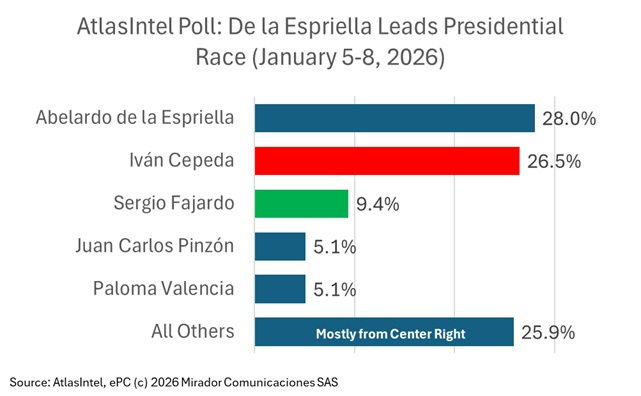
An AtlasIntel poll (sponsored by Revista Semana) conducted January 5-8, 2026, reveals Abelardo de la Espriella leading Colombia's presidential race with 28% voter intention, narrowly ahead of Iván Cepeda at 26.5%. The survey of 4,520 participants carries a 1% margin of error for general results and 3% for party consultations, with 95% confidence level.
Read moreLatin America's electric mobility sector recorded significant growth through October 2025, with 673,811 light electric vehicles in circulation, though representing only 0.5% of the total regional light vehicle fleet. The sector expanded dramatically, growing 851% between 2022 and 2025 – nearly tenfold.
Read moreColombian energy company Terpel announced its strategic focus on three business lines for 2026—solar energy, electromobility, and lubricants—to compensate for impacts from divestments in Ecuador and Peru.
Read moreColombia's Ministry of Mines and Energy published a study examining energy distribution areas and potential alternatives to maximize efficiency and operability. These distribution areas define tariff rules across territories, meaning two users with identical energy consumption can pay different amounts depending on their location.
Read more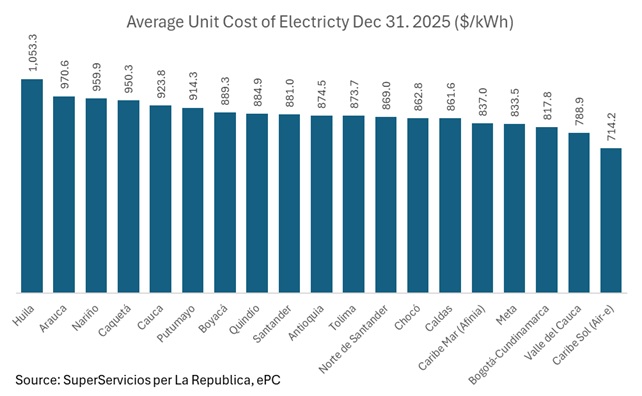
Huila and Arauca lead Colombia's departments with the most expensive electricity rates, a situation that could worsen with the Ministry of Mines and Energy's draft decree proposing a temporary CoP$8/kWh surcharge for National Interconnected System (SIN) users.
Read moreColombia's Ministry of Mines and Energy initiated pilot tests evaluating low-emission hydrogen injection in heavy-duty trucks as part of the national clean energy transition strategy. We check the maths…
Read moreColombia confronts unexpected changes to its energy strategy following political upheaval in Venezuela, where Nicolás Maduro was imprisoned and Delcy Rodríguez sworn in as president, with the United States seeking involvement in the neighboring country's affairs.
Read moreEcopetrol received the "Gold Standard" recognition for the third consecutive year for its advances in methane emissions management, detailed measurement plan implementation, reporting quality and transparency, and establishment of reduction targets. The recognition is granted by the Oil and Gas Methane Partnership (OGMP 2.0), an initiative led by the United Nations Environment Programme.
Read moreThe Fund for Non-Conventional Energies and Efficient Energy Management (Fenoge), in partnership with the International Organization for Migration (IOM), concluded the EN-Comunidad initiative by delivering five technical studies for energy system evaluation and characterization, plus 50 structured projects promoting energy solutions across 43 Colombian territories, including Bogotá.
Read morePresident Gustavo Petro announced the national government's willingness to allocate COP$1.5 trillion for purchasing an electric fleet for Bogotá's TransMilenio system, opposing the proposed COP$350 fare increase that would raise the ticket price to COP$3,550.
Read moreColombia's Ministry of Mines and Energy is preparing a significant adjustment to its proposed COP$8 per kilowatt-hour surcharge designed to address Air-e's COP$2.5T debt accumulated through November 2025.
Read more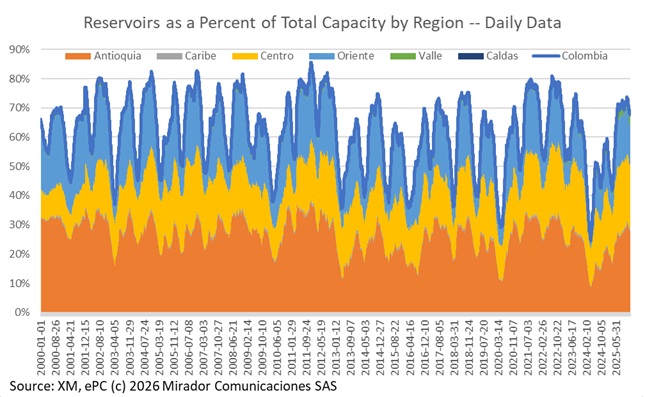
Coming back from a month in Canada where the weather was, well, typical for this time of year, I have been disappointed (to say the least) to find the weather in Bogotá was only marginally better. OK. An exaggeration. But then we found an article suggesting the eastern part of the country was in drought. Which child has come to visit?
Read moreColombia's next president will inherit an energy sector on red alert—not from ideological debate but from accumulated tensions manifesting as supply problems, financial blackout risks, misguided energy transition, and insufficient progress reducing energy poverty. After three decades of relative stability, the system faces simultaneous crisis factors.
Read moreThe Colombian government, through the Ministry of Mines and Energy, presented a draft decree modifying Decree 1073 of 2015 to adopt public policy measures promoting natural gas supply and enabling development and integration of biogas and biomethane as complementary energy sources. The initiative advances President Gustavo Petro's Just Energy Transition agenda.
Read moreColombia's Ministry of Mines and Energy announced sustained electricity tariff reductions resulting from government measures to correct accelerated increases inherited at the beginning of President Gustavo Petro's administration.
Read moreThousands of Colombian families are adopting solar panels as both environmental and financial strategies to reduce electricity costs and increase home values.
Read morePresident Gustavo Petro announced the Colombian government will provide COP$52 million to taxi owners who replace gasoline, diesel, or gas vehicles with electric ones, as part of a comprehensive fleet modernization program targeting 54,000 taxis by 2036.
Read moreColombia's national government, through the Ministry of Mines and Energy and Ministry of Defense, deployed a comprehensive emergency plan guaranteeing fuel supply and electrical service continuity in Mitú, Vaupés, and Puerto Inírida, Guainía, following historic low river levels in the Guaviare and Unilla rivers that disrupted regular transport to Non-Interconnected Zones.
Read moreISA (Interconexión Eléctrica S.A.) commenced operations of Brazil's first project employing Flexible AC Transmission Systems (FACTS) technology, addressing urgent industrial demand in São Paulo state while structural infrastructure works are executed.
Read moreLa Guajira, possessing Colombia's greatest wind energy potential, has become central to the government's National Energy Plan 2050, yet the renewable energy boom has sparked new conflicts over Wayúu territorial protection. Columnist Fabrina Acosta Contreras examines how Wayúu women are assuming crucial leadership roles defending their ancestral lands against what they perceive as green colonialism.
Read moreNicolás Maduro's detention and U.S. involvement in Venezuela have upended President Gustavo Petro's energy strategy for Colombia, which centered on electrical interconnection with Venezuela rather than continued gas imports from the United States.
Read morePresident Gustavo Petro's surprise 23% minimum wage increase for 2026 forced Colombian financial analysts to hastily revise their macroeconomic projections on New Year's Eve, with expectations shifting dramatically for inflation, GDP, dollar exchange rates, and unemployment.
Read moreElectric mobility is consolidating in Colombia as a visible alternative within the automotive sector, with charging point installation accompanying the growth of electric vehicles.
Read moreColombia's Ministry of Minas y Energía published a draft resolution proposing a controversial COP$8 per kilowatt-hour surcharge on all users nationwide to address Air-e's COP$2-3 trillion debt, sparking fierce debate about who should bear the burden of the Caribbean energy distributor's financial collapse.
Read more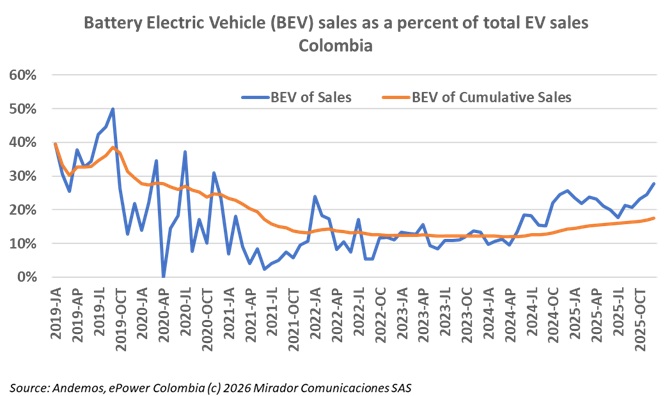
Colombia's sustainable mobility sector achieved historic milestones in 2025, according to the latest ANDI and Fenalco report.
Read moreThe Colombia Solar program was officially launched in Barranquilla on Monday, December 30, following the signing of an interadministrative agreement between Energy Minister Edwin Palma and Gecelca's acting president Erick Wehdeking.
Read moreThe Ministry of Minas y Energía, together with the National Planning Department and Ministry of Finance and Public Credit, subscribed ordinary future commitments recently approved by the Superior Council of Fiscal Policy (CONFIS) and the entity's contracting committee.
Read moreThe Energy and Gas Regulatory Commission (CREG) announced that expert commissioner Ángela Álvarez was sworn in on Friday, January 2, 2026, joining the entity's technical team.
Read moreFollowing the failed tax reform that sought COP$16.3T, President Gustavo Petro's government issued an economic emergency decree attempting tax modifications to obtain budget resources. The executive justified the measure citing systemic risk in the energy sector.
Read moreIndira Portocarrero assumed leadership of Colombia's Mining-Energy Planning Unit (UPME), becoming the first woman to hold this position. The entity, attached to the Ministry of Mines and Energy, plays a key role in planning Colombia's energy policy.
Read moreFitch Ratings downgraded multiple Colombian energy companies following the country's sovereign rating reduction, with Ecopetrol, Grupo Energía Bogotá (GEB), and Enel Colombia among those affected. The rating actions reflect these companies' close ties to the Colombian state and its deteriorating credit profile.
Read moreIt is January and time to both look back at what we predicted for 2025 and look forward to what might happen in 2026. Spoiler alert: elections and weather will play a big role.
Read moreFinanciera de Desarrollo Nacional (FDN) announced the financial closing of Parque Solar Terra Site I, located in Copey municipality in Sierra Nevada de Santa Marta.
Read moreTerpel Sunex, a subsidiary of Organización Terpel founded in 2021, is advancing Colombia's energy transition by developing large-scale solar generation projects. The company positions itself as a strategic partner for businesses seeking sustainability and positive environmental impact through clean energy solutions.
Read moreEcopetrol's Board of Directors approved investment resource allocation for the Windpeshi wind project, located in the municipalities of Uribia and Maicao, La Guajira.
Read moreColombia's energy sector faces a convergent triple crisis as 2026 approaches, with analysts warning that inadequate generation capacity expansion, declining gas production requiring costly imports, and Caribbean operators' financial collapse threaten national energy security and potential rationing.
Read morePresident Gustavo Petro categorically rejected industry warnings about potential power outages in Colombia, asserting the country possesses sufficient resources to guarantee service to households and industries.
Read moreColombia's National Environmental Licensing Authority (ANLA) issued a sharp rebuke to Natalia Gutiérrez, president of the Colombian Association of Power Generators (Acolgen), demanding rectification of statements alleging delays in environmental licensing for renewable energy projects in La Guajira.
Read moreBogotá confronts a growing fiscal challenge as the explosive growth in hybrid and electric vehicle registrations threatens to erode a critical revenue source—the gasoline surcharge that funds mass transit systems and infrastructure projects.
Read moreColombia's Caribbean region has become the epicenter of the country's electrical problems, concentrating 91.66% of zones classified as "electrically subnormal" across the entire nation.
Read moreColombia faces a critical energy capacity deficit threatening potential rationing as early as 2026-2027, as surging demand outpaces generation capacity expansion.
Read moreSucre's government and the Korean Institute for Advancement of Technology (KIAT) signed the Handover document for the Implementation Project of Electrical Self-Generation System for Rural Housing, marking one of Colombia's most significant rural energy access initiatives.
Read moreColombia's Energy and Gas Regulatory Commission (CREG) promotes regulatory frameworks to integrate hydrogen into the national energy system as part of the country's energy transition strategy, according to CREG Commissioner Fanny Guerrero.
Read moreThe National Association of Power Generators (ANDEG) president Alejandro Castañeda identified multiple Petro administration decisions as damaging Colombia's electricity sector, particularly modifications to the reliability charge mechanism that altered generator risk profiles, made auctions unattractive to new participants, and changed established market rules.
Read moreColombia's energy and public services sectors face severe institutional weaknesses due to prolonged leadership vacancies at key regulatory bodies, according to Corficolombiana.
Read moreEcopetrol announced successful completion of pilot tests producing green hydrogen to power Bogotá's Integrated Public Transport System (SITP), marking a significant milestone in Colombia's clean energy transition.
Read moreAir-e successfully concluded the ENNOVA 2025 Open Innovation Challenge, an initiative promoting sustainable energy and community solutions across Atlántico and Magdalena departments.
Read moreColombia's Energy and Gas Regulatory Commission (CREG) confirmed progress on the long-discussed electrical interconnection with Panama during the first half of 2026, according to CREG Director Antonio Jiménez.
Read moreDespite warnings about Colombia's "silent rationing" and energy supply constraints, Celsia is advancing an ambitious renewable energy expansion strategy focused on hydroelectric projects and solar farms as the country grapples with natural gas shortages and growing electricity demand.
Read moreAdministrative procedures and regulatory approvals consume approximately 50% of total development time for energy projects in Colombia, representing a critical bottleneck delaying urgently needed generation capacity additions.
Read moreColombia officially launched its National Hydrogen Policy, establishing a comprehensive framework to position the country as a regional leader in green and blue hydrogen production while creating new clean industries and accelerating energy transition.
Read more
After three decades of neglect, Colombia is experiencing an ambitious railway revival under President Gustavo Petro's administration.
Read moreCelsia CEO Ricardo Sierra warned that Colombia is already experiencing a "silent rationing" of electricity, characterized by connection denials and supply restrictions that don't yet constitute formal nationwide rationing but signal serious underlying problems.
Read moreDecember 6, 2025: Air-e and Afinia, the two electricity distribution companies serving Colombia's Caribbean coast, announced a collaborative effort to address the region's persistent energy challenges through a common agenda focused on structural solutions.
Read moreColombia's Constitutional Court validated Decree 1275 of 2024, which recognizes indigenous peoples as environmental authorities within their territories, but established specific conditions for its application. The decree, signed by President Gustavo Petro and issued by the Ministry of Environment, responds to a demand from ancestral communities spanning more than three decades.
Read moreThe national government increased the import tariff on electric buses from 0% to 10% through Decree 2159 of 2024, published in the Official Gazette and effective from publication date.
Read moreOn December 3, 2025, EPM confirmed a strategic agreement with Erco Energía S.A.S. and a European investor to develop a new solar project of approximately 400 MWp, representing an investment of up to US$400 million. The ambitious initiative seeks to strengthen Colombia's energy matrix amid the growing gap between supply and demand.
Read moreColombia has already entered a phase of energy rationing, according to Natalia Gutiérrez, president of the Colombian Association of Electric Energy Generators (Acolgen), during her intervention at the 'Country Perspectives 2026' forum organized by Revista CAMBIO.
Read moreEcopetrol inaugurated the La Iguana Solar Farm in Yondó, Antioquia, marking a significant milestone in its renewable energy strategy. The facility features 26 MWp of installed capacity with 42,840 solar panels distributed across 26 hectares, generating an estimated 42.2 GWh annually.
Read moreOn December 5, 2025, the Ministry of Mines and Energy announced the creation of Gecelca Solar, marking a historic shift from coal-fired thermal generation to clean energy production.
Read more