
Colombia's average wholesale spot price reached CoP$562.1/kWh in June 2026, up 395.7% from CoP$113.4/kWh in June 2025 and 8.9% from May, driven by increased thermal generation's share of the mix.
Read moreThe Household Public Services User League (Liga Nacional de Usuarios de los Servicios Públicos Domiciliarios) pushed back against former Minister Edwin Palma's plan to penalize energy waste during the current drought.
Read moreThe Superintendencia de Industria y Comercio (SIC) formally charged Enel Colombia, AES Colombia, and Celsia Colombia, finding preliminary evidence suggesting conduct that may have affected free economic competition in the Mercado de Energía Mayorista (MEM).
Read moreThe Comisión de Regulación de Energía y Gas (CREG) formally approved a measure offering discounts of up to 40% on electricity bills for households that cut consumption by up to 30%, with surcharges applied to users who exceed reference consumption levels.
Read more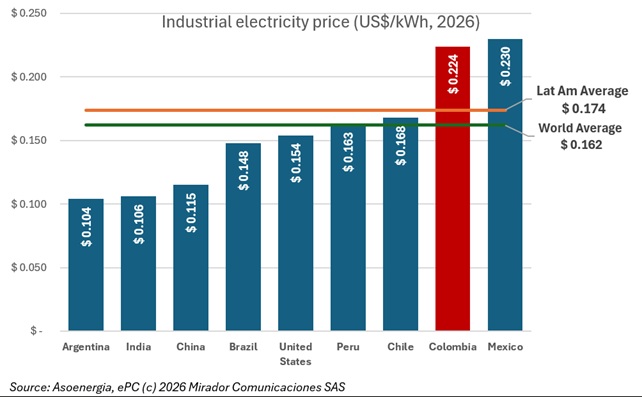
Colombia's industrial sector is paying the second-highest electricity tariff in Latin America, according to data from Asoenergía, the association representing Colombia's large industrial energy consumers.
Read moreColombia's energy and gas regulator CREG sent a delegation to Cartagena on July 6th for a two-day technical visit to Afinia and Grupo EPM, combining boardroom briefings with on-the-ground field tours through some of the city's most challenging electricity service zones.
Read moreUnder pressure from users and local media over rising electricity bills, Air-e – currently under government intervention through the Superintendency of Public Services – issued a public statement on June 24 explaining that the June tariff increase was driven by market conditions beyond its control rather than by any unilateral decision of the intervened company.
Read moreLong-time readers will know that tariff-setting is an ongoing problem for Colombian regulators and politicians. Turns out the European Union has the same issues.
Read moreColombia's residential electricity prices moved against the broader trend in May 2026: DANE data show a month-on-month variation of -1.93% for the electricity category, even as headline inflation climbed to 5.84%.
Read moreAn ANIF report cited by Valora Analitik on May 22 puts hard historical numbers behind what Colombia's electricity sector is bracing for: every significant El Niño event of the past two decades has produced sharp spikes in residential electricity bills, driven by the system's structural dependence on hydroelectric generation (around 62% of effective installed capacity) and the much higher cost of the thermal backup that fills the gap when reservoirs run low.
Read moreJuan Ricardo Ortega, president of Grupo Energía Bogotá, told W Radio's 6AM program on May 28 that electricity tariffs in Colombia face an upward trajectory over the coming months, driven by three interlocking cost pressures that are coinciding at a moment of unusual vulnerability for the national energy system.
Read moreColombia's central bank is sounding a clear warning about the inflationary consequences of an El Niño event that forecasters expect to arrive in the second half of 2026, intensifying toward a peak in September and potentially setting temperature records.
Read moreColombia's electricity users face a two-track tariff threat in the second half of 2026: the anticipated arrival of El Niño, which will shift generation toward costlier thermal fuels, and a government-mandated surcharge designed to bail out debt-laden Caribbean distributor Air-e.
Read moreColombia's energy regulator CREG published draft Resolution 701 122 of 2026 for public comment on April 10, proposing a significant upgrade to the Sistema Centralizado de Información de Convocatorias Públicas (SICEP), the platform through which approximately half of all energy purchased in Colombia is contracted via public tender.
Read moreColombia's Superintendency of Public Services (Superservicios) used the National Congress on Energy Transition, held at Universidad del Norte in Barranquilla, to deliver one of its sharpest assessments yet of the Caribbean region's chronic electricity crisis – arguing that the problem is structural and cannot be solved by changing operators or launching yet another financial rescue plan. We provide a long commentary on his statements.
Read moreThe Ministry of Mines and Energy has issued Resolution 40208, opening a long-term electricity contracting auction that will award 15-year supply contracts beginning January 2030, with a separate tranche starting 2035.
Read morePresident Gustavo Petro used X to attribute the historically high electricity tariffs in Colombia's Caribbean region to decisions taken under the governments of Álvaro Uribe Vélez and Iván Duque Márquez, renewing a long-running political dispute over the collapse of the former regional distributor Electricaribe and its aftermath.
Read more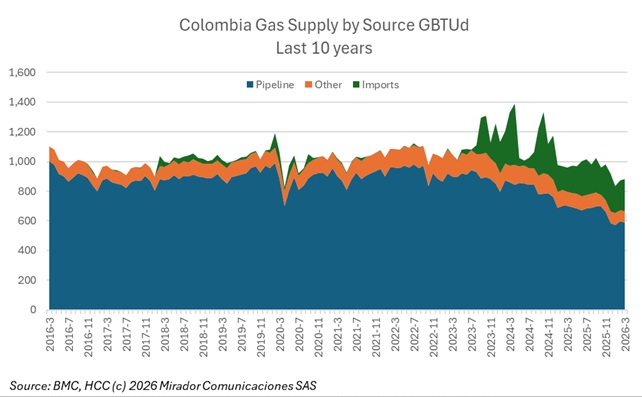
Luz Stella Murgas, president of Naturgas, used a wide-ranging El Tiempo interview published April 13 to deliver a specific and urgent message to Colombia's energy establishment: without new LNG import infrastructure entering service by the end of 2026 or early 2027 at the latest, the country will lack the gas supply needed to run its thermoelectric fleet during the El Niño dry season now forecast to begin in September.
Read moreEnergy Minister Edwin Palma used a social media exchange with Acolgen president Natalia Gutiérrez to reopen the government's long-running challenge to Colombia's standby fee mechanism, putting a cumulative price tag on the instrument and questioning whether it has delivered on its promise ahead of the El Niño dry season.
Read moreColombia's March 2026 inflation reading came in at 5.56%, marking the second consecutive monthly increase since February, but the energy components of the basket told a contrasting story of deceleration rather than acceleration.
Read moreThree state-owned electricity generators formally committed to a new tariff methodology in a high-level meeting chaired by President Gustavo Petro on March 19, 2026, in a move the government presented as a structural measure to reduce speculation in the spot market and lower costs for Colombian households.
Read more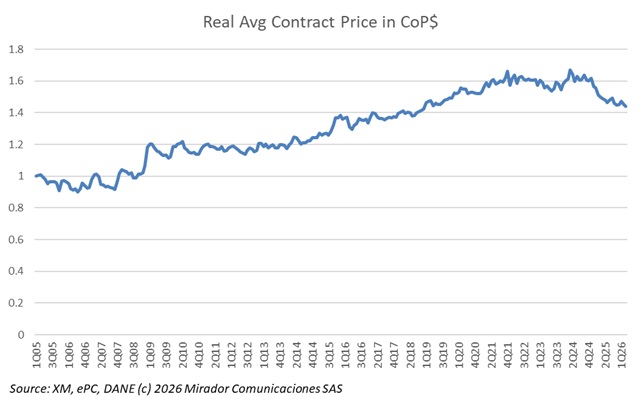
Tariffs once again capture MinEnergia’s attention and, by extension, that of SuperServicios and the CREG. This is a hard argument to make for the average non-economist looking at their bill but, in real terms, prices have been under control since the pandemic.
Read moreColombia's Ministry of Mines and Energy presented a draft resolution on March 12, 2026 establishing transitional guidelines for differential electricity tariffs targeting the country's most vulnerable families, particularly those in historically underserved rural areas and territories facing operational difficulties.
Read moreColombia's February inflation rate of 5.29% came in below market expectations of 5.5%, driven primarily by energy price deceleration rather than broad-based disinflation.
Read moreThe Colombian government issued a decree suspending electricity billing and collection for properties affected by the economic emergency declaration in eight departments until users recover payment capacity.
Read moreColombian economic think tank ANIF warned that hourly labor costs will surge 34.7% over approximately one year, rising from CoP$7,736 in the first half of 2025 to CoP$10,422 by the second half of 2026.
Read moreAnother public dispute erupted between President Gustavo Petro and Medellín Mayor Federico Gutiérrez over energy tariffs, Hidroituango operations, and flood relief policies. The confrontation began when Gutiérrez criticized the government's decision to reject international aid for Córdoba flooding victims, calling the measure "absurd" and stating authorities "like to see people suffer."
Read moreJanuary 2026 analysis of Caribbean electricity market cost composition revealed generation and transmission components dominate consumer bills, according to Codisgen.
Read moreColombia's atypical early 2026 rainfall elevated reservoir levels above 74%, substantially higher than the typical 40% for this traditionally dry period, prompting President Gustavo Petro's administration to request energy price reductions from generators and compliance with new Comisión de Regulación de Energía y Gas (Creg) regulations modifying reliability charge calculations. However, industry associations maintain price reductions reflect normal market dynamics rather than government intervention.
Read moreColombia's wholesale electricity prices have barely declined despite near-record reservoir levels, exposing the disconnect between hydrological abundance and spot market dynamics.
Read more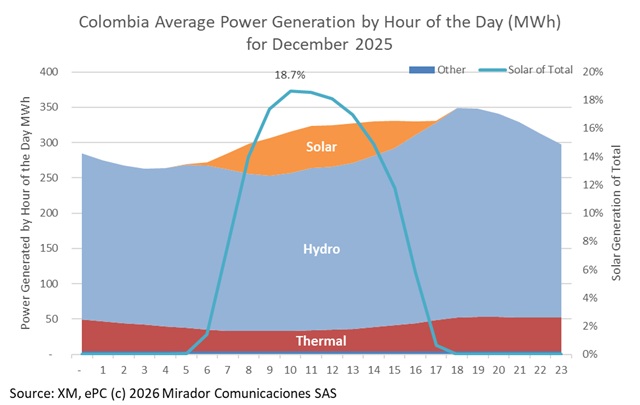
Colombia's energy transition is generating measurable momentum, with the government projecting that expanding renewable capacity could deliver cumulative tariff savings of up to CoP$7 trillion for electricity users over the next five years.
Read moreWith reservoirs across Colombia running at elevated levels amid heavy ongoing rainfall, the Ministry of Mines and Energy issued Circular 40008 on February 10, 2026, calling on wholesale electricity market participants—particularly hydroelectric and low-cost technology generators—to embrace the Energy Commission's (CREG) new Low Prices by Technology rules and translate hydrological conditions into lower tariffs for end users.
Read moreAfinia, the EPM Group subsidiary that took over power distribution on Colombia's Caribbean coast five years ago, has surpassed the milestone of 20,000 households enrolled in its prepaid electricity scheme — a model that is delivering savings of up to 35% on monthly bills.
Read moreColombia's overall inflation rate stood at 5.35% year-on-year in January 2026, remaining above the central bank's 5% threshold, but official data showed a notable divergence within the energy segment: electricity prices continued falling while natural gas costs kept rising.
Read more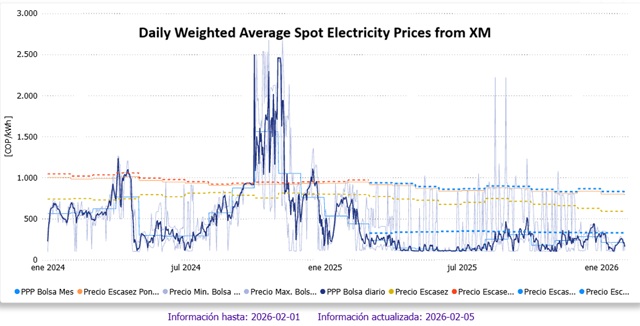
Colombia's wholesale electricity prices have fallen sharply in response to improved reservoir conditions, with spot market rates declining 26 percent year-over-year from CoP$797 per kilowatt-hour to CoP$590/kWh, according to XM, the country's electricity market administrator.
Read moreOn January 26, 2026, Ecuador increased Colombian oil transport costs through the Sistema de Oleoducto Transecuatoriano (SOTE) by 900%, from US$3 to US$30 per barrel, triggering Colombia's suspension of electricity exports.
Read moreThe Petro government created two new levies for energy generators under Legislative Decree 044 of 2026, which "adopts measures to ensure the provision of residential electricity public service" while acknowledging a liquidity crisis in the sector.
Read moreColombia's energy sector erupted in protest after the government issued Decree 044 of 2026 under economic emergency powers, imposing two new levies on power generators to address the liquidity crisis affecting intervened companies like Air-e.
Read moreColombia's Ministry of Mines and Energy issued a resolution convoking the country's first long-term electricity contracting mechanism, enabling contracts up to 15 years duration to secure energy supply, diversify the electrical matrix, and advance energy transition in compliance with Decree 1091 of 2025.
Read moreThe Ministry of Mines and Energy issued a draft decree modifying Decree 1073 of 2015 to strengthen natural gas supply and establish an enabling framework for biogas and biomethane integration into Colombia's energy system.
Read moreColombia's Producer Price Index (IPP) registered an annual decline of 2.63% in December 2025 compared to the same month in 2024, according to La República citing DANE data. The IPP measures price changes at the producer level before goods reach consumers, serving as "an early signal of what may happen later with inflation."
Read moreColombia's Ministry of Mines and Energy published a study examining energy distribution areas and potential alternatives to maximize efficiency and operability. These distribution areas define tariff rules across territories, meaning two users with identical energy consumption can pay different amounts depending on their location.
Read more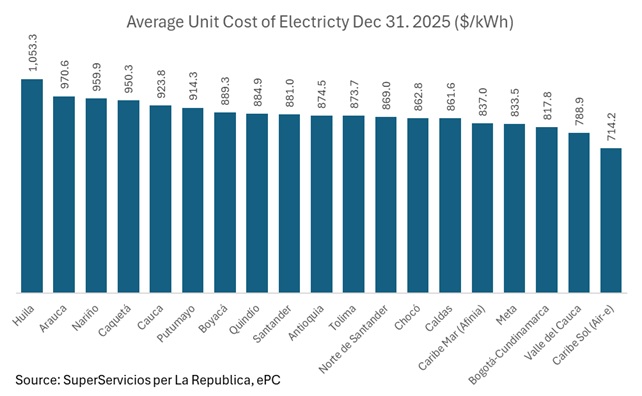
Huila and Arauca lead Colombia's departments with the most expensive electricity rates, a situation that could worsen with the Ministry of Mines and Energy's draft decree proposing a temporary CoP$8/kWh surcharge for National Interconnected System (SIN) users.
Read moreColombia's Ministry of Mines and Energy announced sustained electricity tariff reductions resulting from government measures to correct accelerated increases inherited at the beginning of President Gustavo Petro's administration.
Read more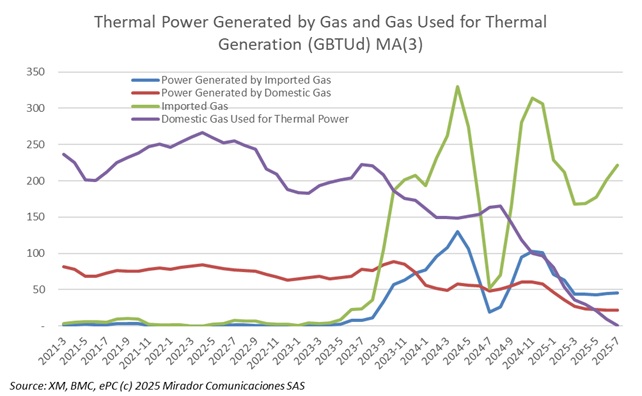
Colombia worries about importing gas because of its higher price. This obviously affects everyone using gas but there will also be an impact on electricity prices given the continuing importance of gas-powered thermogeneration to the matrix (to the chagrin of the “Illuminati”).
Read more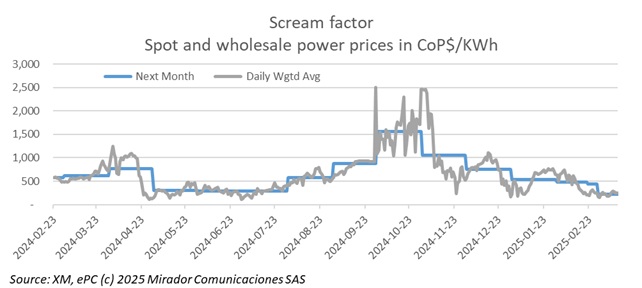
The good news is that wholesale electricity prices continue to fall. The bad news is that maybe it still isn’t raining enough. We can explain.
Read moreA recent study by BTG Pactual has shed light on the significant rise in energy prices in Colombia this year, primarily driven by the ongoing El Niño phenomenon, which has persisted longer than anticipated by IDEAM.
Read more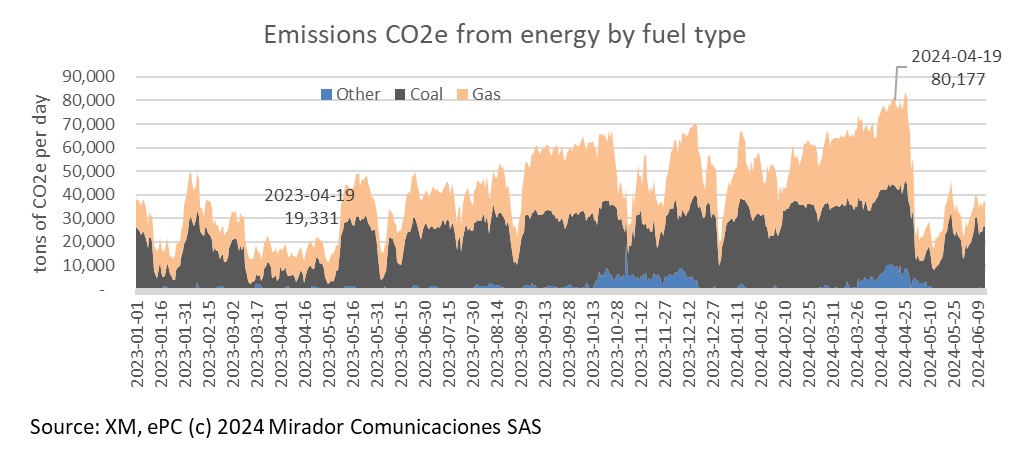
Colombia’s carbon tax is a mere US$6 per ton of CO2equivalent, perhaps a useful source revenue but hardly a disincentive. What would an effective tax look like?
Read more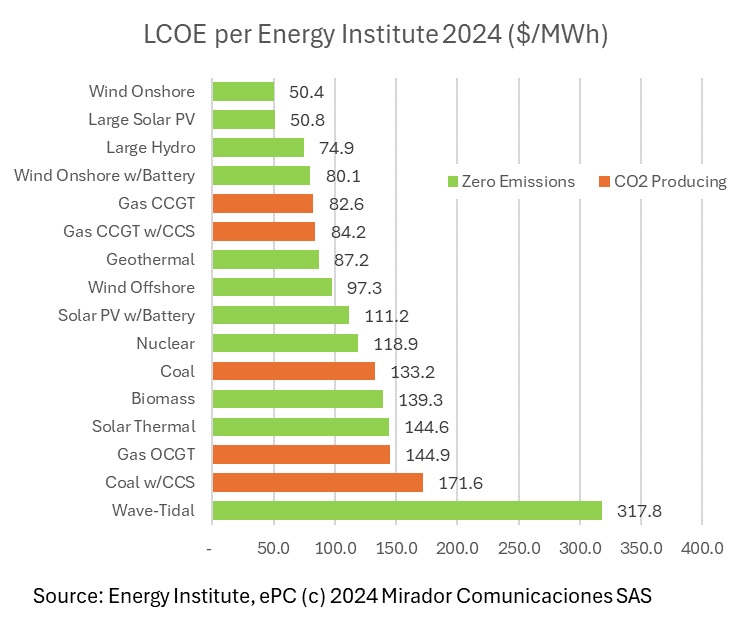
Our recent article about the viability of renewable energy investments leaned heavily on Levelized Cost of Energy or LCOE and, coincidentally, the Energy Institute (EI) updated its LCOE estimates for a range of technologies. For comparison and for local flavor, we found the UPME LCOE’s on the website (with some questions pending) and the International Energy Agency’s (IEA) estimates.
Read more
Continuing on from last week’s Thursday Thought we look at some of the relevant factors using disguised data from a member of the Colombian electricity sector.
Read moreEveryone can agree that tariffs should be fair. Who would agree they could be unfair? The Minister of Energy, Andrés Camacho, says “Our goal is to guarantee fair rates.” But what does that mean? Fair to whom? Everyone? Is that even possible? Are Colombian tariffs unfair and how do you make that determination in the first place?
Read moreThe Colombian Association of Engineers (ACIEM) presented comments on the proposed decree that sets policies and guidelines to promote efficiency and competitiveness in the national electricity service.
Read more
President Gustavo Petro has other problems this week so we have not heard much from his plan to set electricity rates PERSONALLY! Turns out European countries have the same problem of “too high” tariffs and are looking for better solutions than simply making arbitrary cuts. In the UK, some think that making public utilities into so-called “public benefit corporations” would solve the problem but I have my doubts.
Read moreColombians perceive they are still paying high energy prices, yet the country’s reservoirs are full, and the extended rainy season keeps them that way. Why?
Read morePresident Gustavo Petro spoke about energy prices in the country.
Read moreColombians have complained about alleged increases in their energy bills. The Ministry of Mines and Energy (MinEnergia) spoke on the matter.
Read more
The president of the Senate’s Fifth Commission (responsible for energy issues), Senator José David Name, questioned the regulations set by the Energy Regulatory Commission (CREG) for the country’s renewable energy auction.
Read moreThe Ministry of Mines and Energy (MinMinas) held a reliability auction to guarantee the energy supply in the coming years. This was a separate and distinct process from the long-term renewables auction held at the same time, which resulted in no transactions.
Read moreÁngela Montoya, president of the Colombian Association of Electric Power Generators (Acolgen) explained why ‘El Niño’ phenomenon will not affect energy tariffs this year.
Read moreThe National Department of Statistic (DANE) published figures for the variation of energy service tariffs. This is what industry experts have to say about it.
Read more