
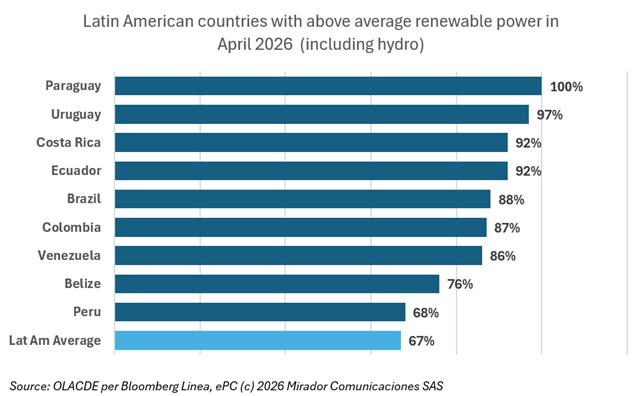
Nine of the 27 member countries tracked by the Organización Latinoamericana y Caribeña de Energía (Olacde) posted renewable (including hydro) shares above the regional average in April, as the region's overall electricity output climbed 4.5% year-on-year to 164 TWh.
Read moreGrupo Energía Bogotá president Juan Ricardo Ortega delivered his most detailed public assessment yet of Colombia's transmission crisis through two Valora Analitik pieces in consecutive days -- a letter to president-elect De la Espriella and a direct interview. Read together, they form a comprehensive indictment of four years of energy infrastructure paralysis and a precise warning about what comes next if it continues.
Read moreDelivered at the inauguration of a solar project in Manaure, La Guajira, Minister Edwin Palma's July 23rd call for telework and study-from-home schemes represents the most direct government intervention yet on the demand side of Colombia's El Niño preparedness.
Read moreThe resolution enabling private-sector electricity transactions between Colombia and Ecuador was confirmed legally on July 22, Minister Edwin Palma announced via X, clearing the way for the resumption of International Electricity Transactions (TIE) between the two countries in the coming days.
Read moreColombia's two most important La Guajira clean energy infrastructure announcements of the transition period arrived together on July 24: the Colectora 500 kV transmission line -- the dedicated highway for Guajira wind energy -- reaching 90% overall construction completion, and a draft regulatory resolution designed to prevent the wind projects that will connect to it from being cancelled due to the planning mismatches that have dogged Colombia's renewable buildout.
Read moreThe first invoices under the Colombia Solar program have arrived in the Villas de San Pablo neighborhood of Barranquilla -- and the numbers are striking.
Read moreColombia's Ministry of Mines and Energy hosted a two-week Regional Training Workshop for Front-Line Officers in Nuclear Physical Security Detection in Bogotá on July 25, organized jointly with the International Atomic Energy Agency (OIEA).
Read more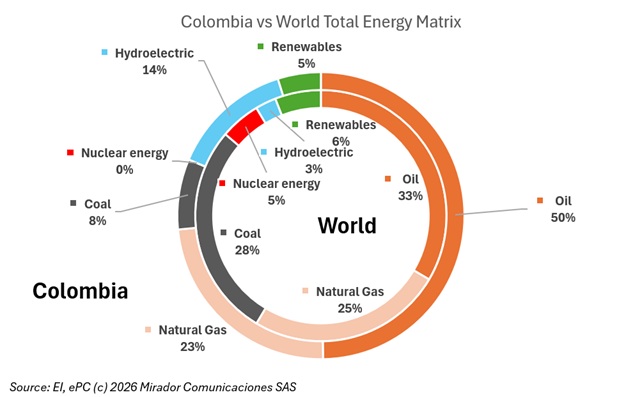
This morning I read a Bloomberg Energy newsletter piece about the growing disenchantment with LNG for Asian emerging markets importering countries and it got me thinking, again, about the long-term impact on the global energy matrix of the Iran War.
Read moreThe outgoing Petro government issued two related but distinct resolutions in the final weeks of its mandate that together address the structural problems most frequently cited for Colombia's electricity supply crisis: the chronic disconnect between generation and transmission project planning, and the grid's vulnerability to high-impact disruptions from extreme weather, equipment failure, and cyberattack.
Read moreThe outgoing Petro government recorded an important achievement: Colombia's installed capacity in solar and wind energy reached 4,626.73 MWp as of July 17th, 2026, surpassing the 4 GWp milestone of the administration's flagship 6GW+ program and representing a more than twenty-fold expansion from the approximately 200 MWp of non-conventional renewable capacity the government inherited in August 2022.
Read moreColombia's electricity system has crossed a threshold its operator XM had been warning about for years: available firm energy is no longer sufficient to cover projected demand under extreme drought scenarios, and the shortfalls are projected to persist across three consecutive reliability charge periods.
Read moreThe Comisión de Regulación de Energía y Gas (CREG) has named economist Adriana Jiménez Delgado as executive director for a 12-month term, formalized under Resolution CREG 105 015 of 2026.
Read moreWith fewer than two weeks left in his administration, President Gustavo Petro declared a national disaster for the El Niño phenomenon on July 23rd – Colombia's first such declaration linked explicitly to an electricity supply emergency – and simultaneously ordered a CoP$4T budget reallocation to the National Disaster Risk Management Unit (UNGRD), bringing its total El Niño resources to CoP$8T.
Read moreA comprehensive El Heraldo analysis published July 26th, based on interviews with six sector leaders, delivers the most structured account yet of the structural failures that have placed Colombia in its most vulnerable energy position since the 1992 blackout.
Read moreLa Guajira is the most electricity-poor department in Colombia's Caribbean region, with energy coverage reaching just 54.6% of its territory according to UPME, a figure that puts it well below the already inadequate national rural average of 75.9% that leaves 1.4 million homes across the country dependent on candles, kerosene, and other costly and polluting alternatives.
Read moreColombia's electricity system enters its most exposed five-day window of 2026 on Thursday, when SPEC shuts for scheduled maintenance through August 3rd .
Read moreThe clearest articulation yet of why El Niño is simultaneously a gas crisis and an electricity crisis came from Tomás González in a recent interview with El Tiempo, in which the former Mines and Energy Minister mapped the convergence of pressures the de la Espriella government will face from day one.
Read moreOutgoing Minister Edwin Palma disclosed on July 22nd, at a Colombia Solar ceremony in Barranquilla, that the transition team coordinating the sector handover for the incoming De la Espriella government had sent the ministry an official written request to abstain from continuing to execute and expand the Colombia Solar program during the transition period.
Read morePetro's outgoing government filed its final tax reform before the new Congress on July 21st, placing the mining and energy sector at the center of fiscal controversy for the second time in four years.
Read moreThe President's Legal Secretary had several decrees in process on July 17th accepting senior official resignations, El Tiempo's Investigative Unit reported, as the outgoing Petro government entered its final three weeks.
Read moreColombia's Ministry of Mines and Energy and the Colombian Agricultural and Livestock Research Corporation (AGROSAVIA) have formalized a bilateral cooperation agreement with Thailand to develop bioenergy from agricultural and livestock waste.
Read moreEPM issued an urgent public alert, warning that intelligence received from multiple sources indicated possible blockade actions in the North and Northeast subregions of Antioquia that could prevent operating personnel from accessing five of its hydroelectric generation facilities.
Read moreThe financial deterioration of Air-e has accelerated well beyond the figures that have circulated publicly.
Read more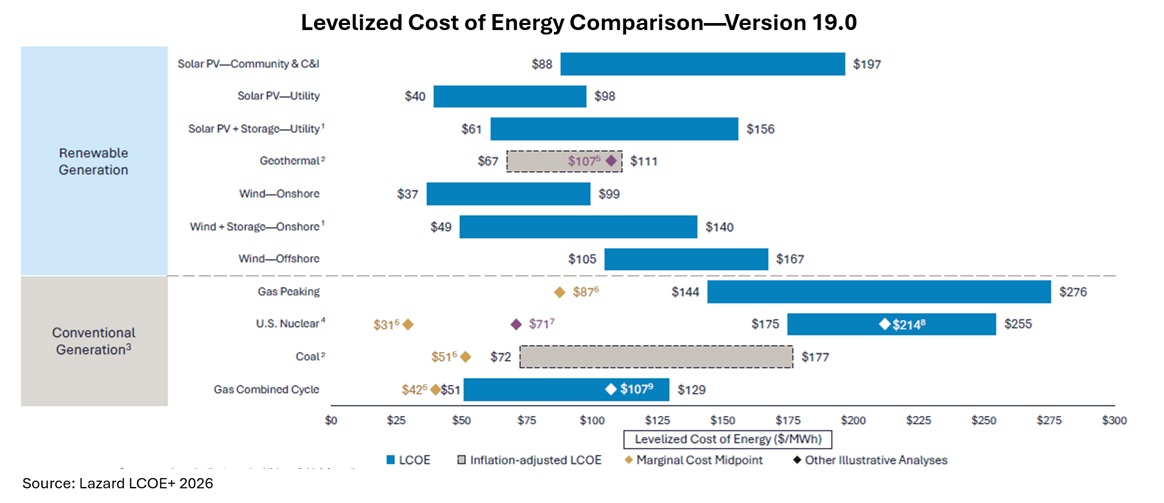
Lazard's 2026 LCOE+ benchmark says renewables remain the cheapest new-build despite rising costs across all technologies.
Read more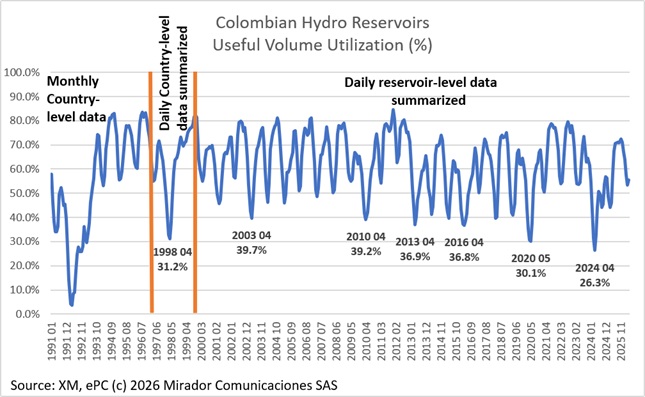
The Ministry of Mines and Energy used the final session of Colombia's National Risk Management Council on July 10th to deliver its most unambiguous public warning yet about the coming climate event: the approaching El Niño could be the most severe episode recorded in the last three decades.
Read moreTwo of Colombia's most prominent energy sector executives exited their roles in the week of July 14th, their departures overlapping with the broader institutional transition ahead of August 7th.
Read moreTwo El Tiempo investigations, eleven days apart, trace the arc of Colombia's hydroelectric maintenance crisis from internal CND recommendation to formal ministerial alert.
Read moreColombia's Ministry of Mines and Energy hosted a five-day Regional Training Course on energy demand modelling organized by the International Atomic Energy Agency (IAEA) in Bogotá in early July, bringing together specialists and representatives from 13 Latin American and Caribbean member states.
Read morePresident Gustavo Petro requested and received the resignation of Mines and Energy Minister Edwin Palma on July 17th, placing ANH president Pablo Yesid Fajardo in temporary charge of the ministry with just over three weeks left in the government.
Read moreThe day after Abelardo de la Espriella's June 21 election victory, Colombia's energy and mining sector moved quickly from congratulating the incoming president to handing him the bill.
Read moreMayor Alejandro Char inaugurated Las Gardenias Community Energy Project on July 9 -- the first of its kind in Barranquilla, marking a locally led step into distributed solar generation in a city that has served as the symbolic center of Colombia's Caribbean electricity crisis.
Read moreMinister Edwin Palma sent a formal letter to the CREG expert commissioners on July 8th, publicly rebuking the regulator for failing to implement the eight regulatory measures it committed to delivering in May to protect the national interconnected system during El Niño.
Read moreColombia's 2026 Multidimensional Energy Poverty Report (IPEM) confirmed on July 8 that the share of households in energy poverty fell from 22.3% in 2024 to 20.6% in 2025 – a 1.7 percentage point reduction equivalent to 227,532 households and 641,640 people exiting energy poverty in a single year.
Read moreWith the International Research Institute for Climate and Society placing the probability of El Niño at 80-90% for the second half of 2026 – and projections suggesting it could be among the most intense episodes of the past 30 years – Bancóldex, Colombia's business development bank, has launched a new phase of its "Energía Solar se Reactiva" program, making CoP$100B available to companies of all sizes for the installation of photovoltaic solar systems.
Read moreEcopetrol's July 9th El Niño contingency plan reveals a company that has quietly become a material contributor to Colombia's electricity system resilience – not as a customer of the grid but as an self-generator whose 1,863 MWp of installed capacity can operate independently of the national interconnected system and thereby reduce pressure on shared reservoir levels.
Read moreAs Colombia faces its most demanding El Niño season in years, a common thought has emerged in public debate: the idea that the country should simply turn on its entire thermal generation fleet to protect reservoir levels.
Read moreThe Ministry of Mines and Energy presented its final four-year electricity sector balance on July 9, framing the Petro government's legacy as a structural transformation of Colombia's generation matrix – and using the occasion to publicly condemn the de la Espriella transition team's suspension of the energy sector handover process as an act of institutional irresponsibility with direct consequences for El Niño preparedness.
Read moreColombia's Ministry of Environment and Sustainable Development issued Resolution 0808 on June 30th, establishing for the first time the environmental terms of reference that developers must follow when preparing Environmental Impact Studies for offshore wind energy projects.
Read moreColombia's Ministry of Transport published a draft resolution on July 7th establishing the country's first comprehensive national regulatory framework for light electric personal urban mobility vehicles – covering electric scooters, skateboards, monowheels, and electric bicycles – as a second public comment round under Law 2486 of 2025.
Read more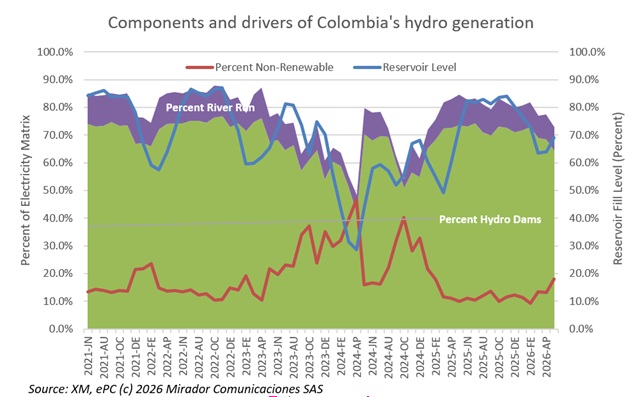
Colombia's reservoir system entered July in better shape than May but still short of where XM needs it to be and the improvement is almost certainly temporary.
Read moreThe designation of María Nohemí Arboleda as the incoming Mines and Energy Minister received an immediate institutional welcome from the Caribbean region on July 14, when the RAP Caribe – Colombia's Caribbean regional planning body – together with the Comités Intergremiales of Atlántico, Bolívar, Magdalena, Córdoba, Cesar, and Sucre jointly issued a statement of support and put forward a structured roadmap for the incoming minister to begin addressing the Caribbean energy crisis from day one.
Read moreThe Ministry of Mines and Energy published an updated regulatory framework for the Colombia Solar program on July 2, replacing the earlier 2026 resolution with a more detailed set of technical, financial, and operational rules governing how solar photovoltaic systems are installed in strata 1, 2, and 3 households connected to the national interconnected system.
Read moreVice president-elect José Manuel Restrepo made the economic cost of Colombia's energy crisis concrete on July 12th, posting on X after a meeting with sector leaders convened by El Tiempo that a blackout under current El Niño conditions would cost the country approximately CoP$204B per hour of lost supply.
Read moreColombia's electricity service quality improved measurably in 2025, with 74.6% of municipalities meeting the regulatory standard for interruption duration per user and 80.1% meeting the frequency standard, a meaningful step forward from 2024.
Read moreFor the electricity sector, the naming of María Nohemí Arboleda Arango as Minister of Mines and Energy is the most reassuring cabinet announcement of the transition period.
Read moreColombia's incoming government faces a climate scenario that has hardened since earlier in 2026.
Read moreColombia's Ministry of Mines and Energy and EPM are accelerating construction of the first prototype of the Cuadras Energéticas ("Energy Blocks") model – a community-scale distributed solar generation concept designed to bring shared clean energy to urban neighborhoods block by block.
Read moreA legal proceeding before the Administrative Tribunal of Cundinamarca has emerged as the sector's best near-term hope for unlocking the resources needed to keep Colombia's thermal generation fleet fueled through El Niño and Natalia Gutiérrez, president of the Consejo Gremial Nacional, used a detailed X thread on July 2 to call on the Tribunal to act urgently.
Read more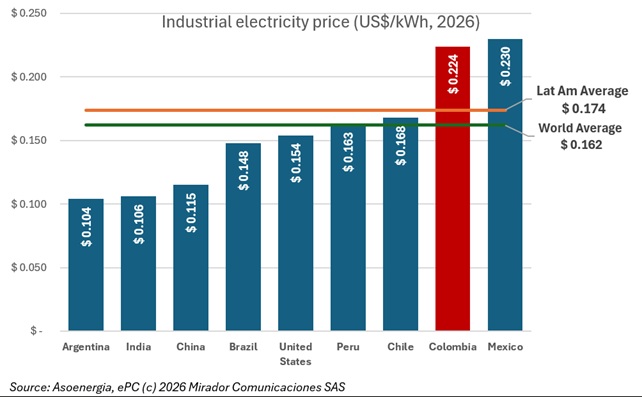
Colombia's industrial sector is paying the second-highest electricity tariff in Latin America, according to data from Asoenergía, the association representing Colombia's large industrial energy consumers.
Read moreThe Ministry of Mines and Energy has granted Colombia's first geothermal exploration permit under its new regulatory framework, authorizing a five-year program of subsurface investigation at El Barranquero, an area straddling the municipalities of Samaná in Caldas and Nariño in Antioquia.
Read moreAir-e Intervenida reported on July 8 that 106 people were captured for electricity theft across Atlántico, Magdalena, and La Guajira in the first half of 2026, as the result of 264 high-impact operations conducted jointly with the Attorney General's office and the National Police between January and June.
Read moreTwo earthquakes measuring magnitudes 7.2 and 7.5 that struck northern Venezuela in late June killed more than 3,800 people and caused widespread infrastructure damage -- but left the country's upstream oil production essentially unscathed.
Read more
Alejandro Arbeláez, general manager of Sociedad Hidroituango, used a July 5th interview with Valora Analitik to deliver the most operationally specific public warning yet about Colombia's blackout risk -- and to put two concrete proposals on the table for the incoming de la Espriella government: activate more thermal plants immediately, and advance the clock by one hour to optimize use of natural daylight.
Read moreAir-e Intervenida presented two strategic infrastructure projects to the UPME in early July, seeking financing from the Fondo de Apoyo Financiero para la Energización de Zonas Rurales (Finanical Support for Rural Electrification Fund, FAER) to strengthen electricity service in rural areas of Atlántico and Magdalena – the first time in a decade the Caribbean distributor had submitted projects to this fund.
Read moreColombia's energy and gas regulator CREG sent a delegation to Cartagena on July 6th for a two-day technical visit to Afinia and Grupo EPM, combining boardroom briefings with on-the-ground field tours through some of the city's most challenging electricity service zones.
Read more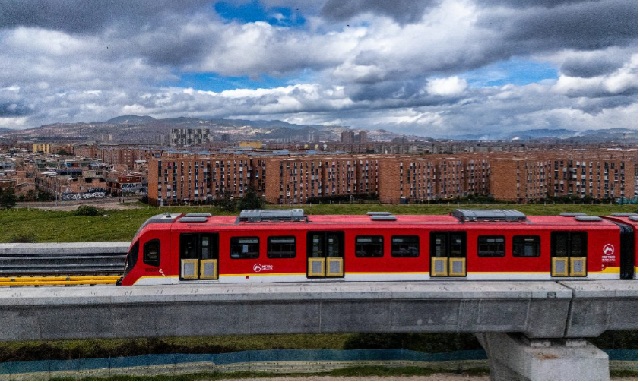
The defining moment of Colombia's 2Q26 transport transition came on May 29, when journalists, diplomats, and city officials boarded Bogotá Metro Line 1 trains for the first time as the system made its third and most significant test run, now on energized rail, from the Patio Taller to Station 2 in the Gibraltar neighborhood.
Read more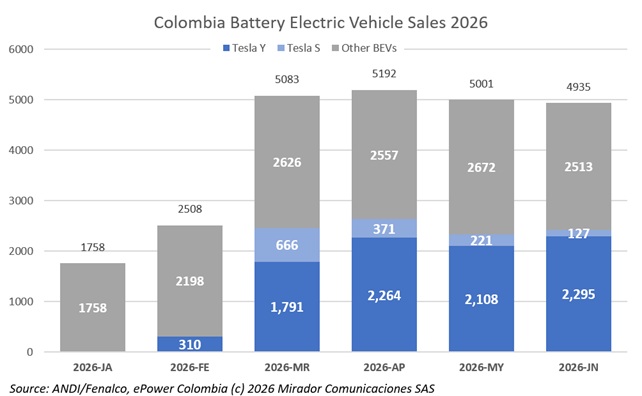
Tesla's arrival in Colombia has reshaped the country's automotive market faster than almost any observer anticipated.
Read morePuerta de Oro, Colombia's largest solar park, entered commercial operations on July 6th, an arrival that Valora Analitik noted comes at a strategically significant moment, with El Niño conditions confirmed and the national grid under pressure to build non-hydraulic generation capacity.
Read moreThe electricity sector's immediate response to president-elect Abelardo de la Espriella's June 30 social media broadcast – in which he warned of an imminent energy crisis inherited from the outgoing government and pledged his administration would honor the state's obligations to the sector – was unambiguous: industry association leaders called it a "positive signal" that restores confidence across the entire electricity supply chain at the most critical possible moment.
Read moreThe regulatory backstory behind the Caribbean energy tariff crisis became clearer when El Heraldo published a 22-page letter that CREG sent to President Gustavo Petro and Minister Edwin Palma on November 28, 2025 – a document that had been sitting undisclosed until the ombudsmen of Barranquilla and Santa Marta revealed its existence.
Read moreThe most underreported dimension of Colombia's El Niño crisis is not the reservoir levels: it is the simultaneous convergence of scheduled maintenance at the country's largest generation plants with the precise period when the system most needs them available.
Read moreThe Caribbean electricity crisis became the first substantive policy commitment of the de la Espriella presidency even before his August 7th inauguration.
Read moreThe rationale behind EPM's decision to spin off 35 municipalities from Afinia into a new subsidiary called Energía Atenea is essentially one of financial quarantine: separating a territory with energy loss rates of 40% and bill collection rates of just 60% from the rest of Afinia's more functional operation.
Read moreThe Superintendency of Public Services signed a Agreed Management Program (PGA) with Empresa de Energía Eléctrica de Vichada – Electrovichada – placing the isolated department's electricity provider under a structured corrective and preventive framework after regulatory inspections found a combination of technical, operational, and financial deficiencies serious enough to threaten service continuity.
Read more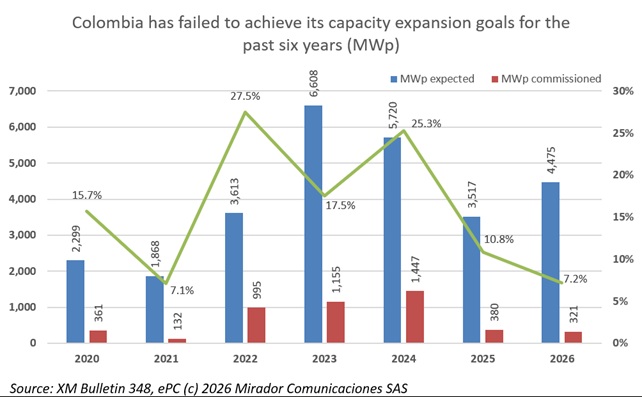
Colombia enters its seventh consecutive year of failing to commission the electricity generation capacity its own planning agency projected, according to XM data reported by Valora Analitik on June 27 -- and the timing could not be worse, with El Niño now confirmed and potentially extending into the first quarter of 2027.
Read moreColombia's incoming government faces an electricity system running a firm energy deficit that XM projects will widen every year through 2029.
Read moreJuan Ricardo Ortega, president of Grupo Energía Bogotá (GEB), issued one of the sharpest public warnings yet about Colombia's transmission infrastructure crisis in a conversation with ACIPET reported by Valora Analitik on June 26, framing Bogotá's energy restriction risk not as a future scenario but as a present reality already cutting off new industrial demand.
Read moreAir-e Intervenida issued a public statement seeking to calm the more than 1.3 million users in Atlántico, Magdalena, and La Guajira alarmed by President Petro's liquidation announcement, confirming that electricity service will continue with total normality and that Colombian public utility law prohibits liquidation from proceeding until a new operator has formally assumed service delivery.
Read more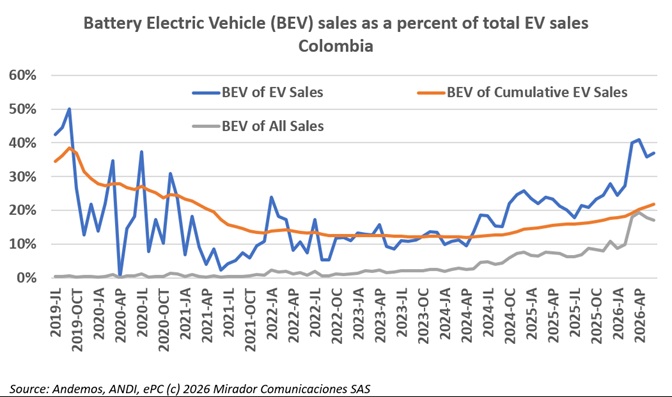
Colombia's automotive sector closed the first half of 2026 with 157,620 new vehicle registrations -- a 50.1% jump over the same period in 2025 -- and, more significantly, a structural shift in what Colombians are buying.
Read moreAcolgen president Natalia Gutiérrez used a Semana interview published June 24 to deliver the electricity generators' industry association's most direct warning yet to the incoming government: the El Niño response agenda is not a transition-period discussion: it begins on inauguration day.
Read moreThe Superintendency of Public Services issued Circular Externa 20261000000624 on June 30, ordering all electricity, gas, water, sewerage, and waste collection companies in Colombia to activate their contingency plans without delay ahead of an El Niño event that IDEAM projects will intensify significantly from September onward, with the Andean and Caribbean regions most exposed.
Read more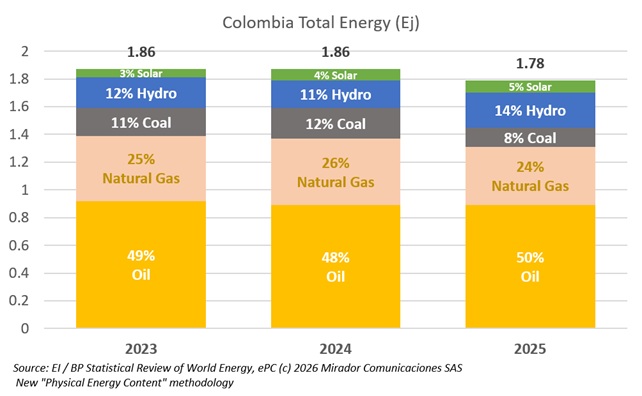
Energy Institute's 75th Statistical Review of World Energy 2026 confirms that the energy transition is accelerating in aggregate terms even as fossil fuels continue to expand in absolute volume -- a paradox that defines the current phase of the global system.
Read more