
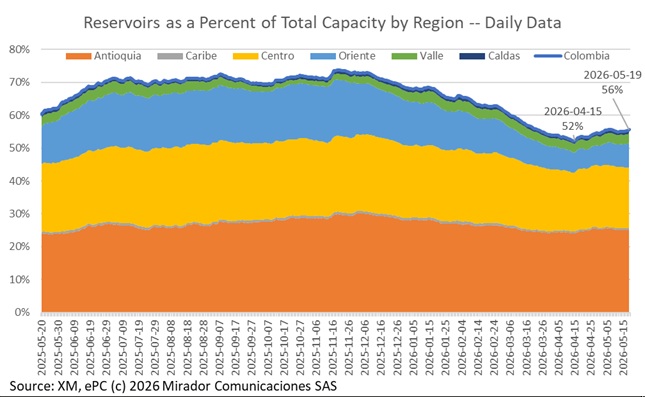
Several articles recently have noted the coming El Niño, perhaps “Super” El Niño and the need to ensure the hydro reservoirs are at their highest possible level.
Read moreWith El Niño conditions expected in the second half of 2026, the Ministry of Mines and Energy has issued Circular 40021 of 2026, directing all entities of the executive branch to establish measurable energy-saving targets, adopt clean energy where possible, and conduct periodic compliance evaluations.
Read moreColombia's central bank is sounding a clear warning about the inflationary consequences of an El Niño event that forecasters expect to arrive in the second half of 2026, intensifying toward a peak in September and potentially setting temperature records.
Read moreGrid operator XM has circulated an internal report, obtained by El Tiempo, laying out a detailed set of technical requirements for Colombia to navigate an anticipated strong El Niño event expected to develop toward the end of 2026 – a scenario the document warns could push the system "to operating levels that have never been seen before" and place reliable demand coverage at risk.
Read moreThree of Colombia's main electricity industry associations and the market manager have issued coordinated warnings about the structural fragility of the national grid as the probability of a strong El Niño phenomenon in the second half of 2026 rises – adding a climatic stress test to a system that analysts say is already operating with insufficient margin.
Read moreMinister of Mines and Energy Edwin Palma used an appearance at the ninth Encuentro y Feria de Renovables Latam, held at the Centro de Eventos Puerta de Oro in Barranquilla, to issue an unusually candid assessment of Colombia's energy security outlook, describing the convergence of climate risk and global geopolitical disruption as "quite a difficult cocktail."
Read moreColombia's Attorney General's Office is preparing to bring criminal charges against three senior engineers involved in the construction and oversight of the Hidroituango hydroelectric project, accusing them of causing an environmental catastrophe during the 2018 emergency that nearly destroyed the dam.
Read more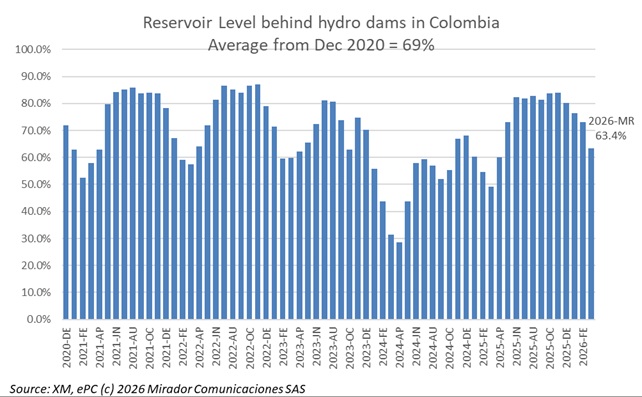
Colombia's national interconnected system reservoirs recovered to an average useful volume of 62.8% as of mid-April, driven by rainfall over the preceding days, according to the latest report from the Superintendency of Public Services (Superservicios).
Read moreSanta Marta hosted the First International Conference for the Transition Beyond Fossil Fuels from April 24–29, 2026, co-organized by Colombia and the Netherlands as a high-level platform for governments, academics, civil society, and industry representatives to map concrete pathways away from oil, gas, and coal.
Read moreColombia is heading into a potential El Niño episode with a structural shortfall in firm energy capacity that leaves the system dangerously exposed to a prolonged drought, according to Natalia Gutiérrez, president of the electricity generators industry association Acolgen and of the National Business Council.
Read moreEnlaza, the power transmission subsidiary of Grupo Energía Bogotá (GEB), has launched E-CoTigrillo, a formal conservation strategy for the woolly ocelot (tigrillo lanudo), a vulnerable feline species whose habitat overlaps with the company's Chivor II–Norte and Sogamoso transmission projects in Cundinamarca.
Read more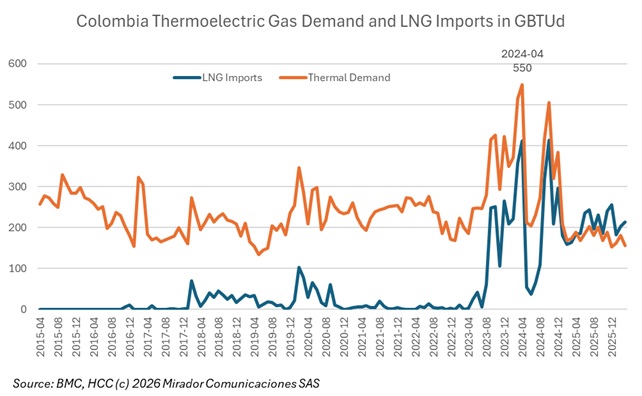
A Corficolombiana research report cited by Bloomberg Línea delivers the starkest assessment yet of Colombia's gas supply trajectory: production is in freefall, imports are surging to compensate, and the country is becoming dangerously dependent on infrastructure never designed for the role it is now playing.
Read moreSpeaking at the Naturgas industry association congress in Cartagena, Minister of Mines and Energy Edwin Palma issued a pointed warning to energy sector actors that climate experts have flagged a probable El Niño event — one that could develop into a severe episode — and that preparation cannot wait.
Read moreThe probability of El Niño conditions developing in Colombia has exceeded 60% in the near term and could reach 90% by September.
Read moreWith El Niño now forecast to arrive in September 2026, Colombia's thermal generation sector is navigating a dual challenge: securing sufficient fuel volumes while managing an increasingly stark price divergence between gas and coal that is already reshaping industrial consumption patterns.
Read moreWith the European Centre for Medium-Range Weather Forecasts projecting that the El Niño event expected to begin in September 2026 could rival the historically severe episodes of 1982, 1997 and 2015, Colombia's electricity generators are pushing back against expectations of a dramatic spike in consumer electricity bills — while acknowledging a more troubling underlying constraint.
Read more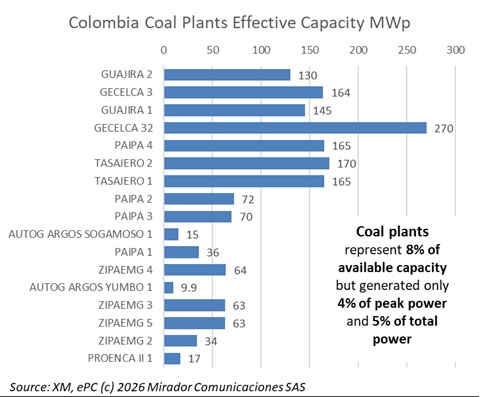
This week XM, the electricity market manager, highlighted that hydro reservoirs were not yet filled enough to withstand an El Niño event. It seemed to suggest using coal plants to let the reservoirs fill up a bit faster.
Read more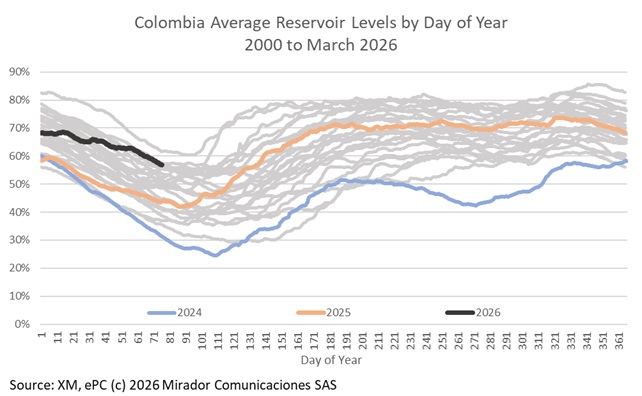
Colombia's wholesale electricity market administrator XM has issued a formal alert warning that the country will need to significantly expand its thermal generation capacity ahead of the El Niño phenomenon now forecast to begin in September 2026, with reservoir levels currently running well short of the target required to enter the dry season safely.
Read moreHidroItuango's reservoir has dipped back below maximum fill, recording 97.9% capacity according to the Superintendencia de Servicios Públicos Domiciliarios — a reading that could bring to a close more than 40 consecutive days of spillway releases driven by the heavy rainy season inflows to the Cauca River.
Read moreForecasters are increasingly confident, unfortunately, that a Super El Niño — one of the most powerful climate events on record — could develop in the second half of 2026, with potentially severe consequences for Colombia's already-stressed electricity system.
Read moreEcopetrol has obtained water use certification for five additional production fields, bringing the total number of certified assets to 23 — a roster that includes the Barrancabermeja and Cartagena refineries.
Read moreColombia became a member of the International Energy Agency (IEA) and one of the perks comes as technical assistance. Late last year, the country used that help to produce a roadmap to net zero.
Read moreEmpresas Públicas de Medellín (EPM) went on the offensive in late March 2026 following the Environment Ministry's announcement of a sanction process against Hidroituango, with General Manager Jhon Maya Salazar questioning both the basis and the scope of the investigation.
Read moreColombia's energy, agricultural, and macroeconomic outlook faces a new headwind: the Ministry of Environment, IDEAM, and the national disaster risk agency UNGRD have all confirmed an 80% probability of El Niño developing and consolidating in the second half of 2026, with a 13% chance of a "super El Niño" — defined as sea surface temperature warming above 2°C — toward year-end.
Read more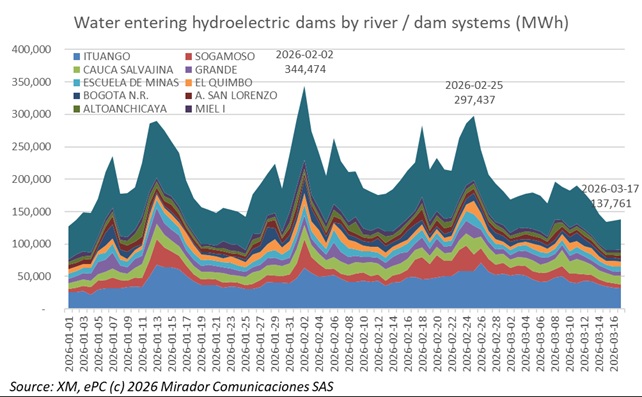
With other issues on their minds, President Gustavo Petro and MinEnergia Edwin Palma have stopped complaining about reservoir levels. We still thought we would update our principal charts concerning water levels in hydro dams, which we hadn’t looked at in six weeks or so.
Read moreEPM has launched a technical cooperation project with the South Korean government focused on developing circular economy solutions for the Hidroituango reservoir, the 78-kilometer impoundment on the Cauca River that houses Colombia's largest hydroelectric plant.
Read more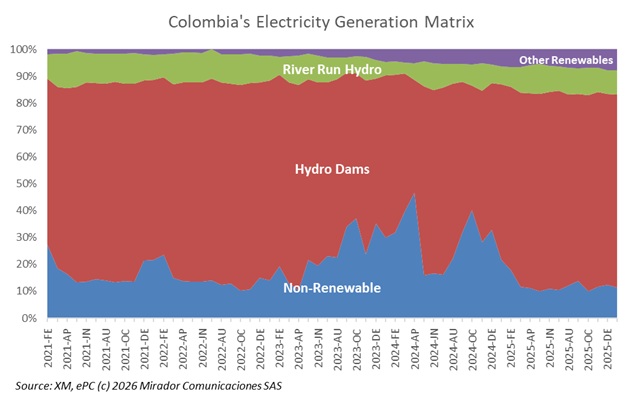
Colombia's Ministry of Environment and Sustainable Development and IDEAM issued an early warning on March 16, 2026 following detection of warming signals in the equatorial Pacific Ocean indicating possible El Niño development during the second half of the year, with potential implications for national water resources and agricultural sectors.
Read more