
Latin America's renewable energy endowment gives it a structural advantage in the global competition for artificial intelligence infrastructure investment, according to Steven Carlini, head of Data Centers and AI at French energy technology company Schneider Electric.
Read moreXM's Bulletin 348, published June 27, delivered the starkest available measure of Colombia's renewable energy buildout failure: of the 4,475 MW expected to enter the national interconnected system during 2026, only 321 MW -- just 7.2% of the annual target -- had actually connected as of the report date.
Read moreMines and Energy Minister Edwin Palma used a June 18 visit to Sincelejo – for the handover of solar projects to market traders and families in Sucre – to publicly endorse the creation of a majority state-owned electricity commercializer for the Colombian Caribbean, framing it as the structural solution the region needs after what he described as decades of private-sector failure.
Read moreUnder pressure from users and local media over rising electricity bills, Air-e – currently under government intervention through the Superintendency of Public Services – issued a public statement on June 24 explaining that the June tariff increase was driven by market conditions beyond its control rather than by any unilateral decision of the intervened company.
Read moreColombia dropped from 35th to 43rd place in the World Economic Forum's 2026 Energy Transition Index -- a ranking of 120 countries -- during the four years of a government that made decarbonization and the acceleration of the energy transition its defining political banner.
Read moreEl Niño was officially confirmed on June 11, three months ahead of the expected timeline, and NOAA's projections point to a potentially severe episode, possibly the worst since 1950.
Read moreColombia's energy regulator CREG has issued Resolution 101 113 of 2026, establishing for the first time a comprehensive regulatory framework for Battery Energy Storage Systems (SAEB -- Sistemas de Almacenamiento de Energía con Baterías) connected to the national interconnected grid.
Read moreColombia's energy and gas regulator CREG put a proposed demand-reduction incentive program out for public consultation on June 23, framing it explicitly as a pre-emptive El Niño measure following IDEAM's June 11 confirmation that El Niño conditions have arrived in the equatorial Pacific and are expected to intensify through the second half of 2026.
Read more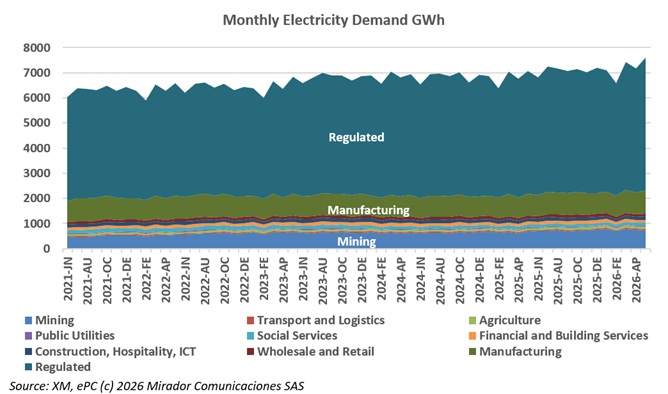
Colombia's electricity system is running a firm energy deficit that will widen every year through 2029, according to data from XM, the national electricity market operator, reported by Valora Analitik on June 22.
Read moreThe Petro government used the week of June 17-20, just before the final presidential vote, to announce a cluster of solar energy deliveries and regulatory changes spanning five different types of project, as it pushed to consolidate its Colombia Solar and Comunidades Energéticas programs before the August 7th transition
Read moreColombia's Ministry of Mines and Energy has designated Karen Schutt -- currently an expert commissioner at CREG and a former deputy energy minister -- as technical manager of the Sectoral Committee created under Resolution 40269 of 2026 to coordinate the government's response to El Niño and oversee strategic infrastructure milestones, including the scheduled maintenance at the SPEC regasification terminal in Cartagena.
Read moreThe Caribbean electricity crisis has become one of the most urgent files awaiting Abelardo de la Espriella on August 7, and it is a substantially worse problem than the one the Petro government inherited in 2024.
Read moreColombia's energy and gas regulator CREG has issued Resolution 101 114 of 2026, establishing a permanent regulatory framework for activating additional generation capacity and demand flexibility tools whenever the National Interconnected System (SIN) faces critical hydrology conditions.
Read moreColombia's main electricity and public services industry associations lined up on June 22 to congratulate president-elect Abelardo de la Espriella and put forward a shared framework for engagement with the incoming government, according to El Heraldo.
Read moreVenezuela has signed a memorandum of understanding with GE Vernova – the energy technology company responsible for generating approximately 25% of global electricity, spun off from General Electric – to develop projects aimed at improving the country's chronically deficient power supply.
Read moreLong-time readers will know that tariff-setting is an ongoing problem for Colombian regulators and politicians. Turns out the European Union has the same issues.
Read more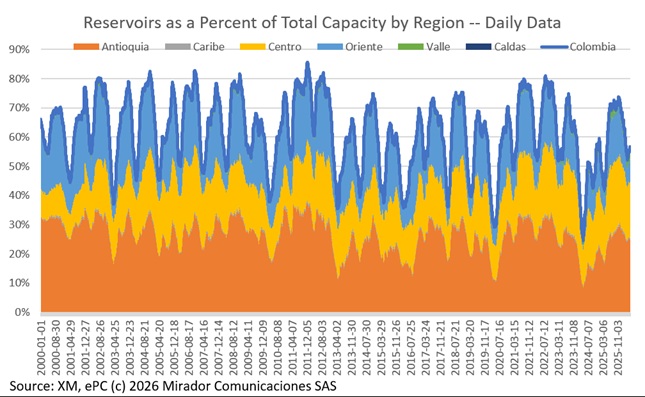
Colombia's El Niño weather event has arrived, and the country enters the dry season with reservoir levels already running roughly 10 percentage points below where they should be. XM, the electricity market operator and ISA subsidiary, warned as of June 17 that under scenarios resembling the driest episodes in the historical record, aggregate reservoir levels could descend to approximately 30% of useful capacity by the time the phenomenon peaks – far below the 80%-plus level that XM considers the minimum adequate entry point into the dry season.
Read moreEPM's Tepuy photovoltaic solar park in La Dorada, Caldas received ISO 9001:2015 certification from Colombia's national standards body Icontec on June 10, recognizing the quality of its operation and maintenance systems.
Read moreColombia's Ministry of Environment and Sustainable Development and Ministry of Mines and Energy signed a Memorandum of Understanding on June 17 with Iceland's Ministry of Environment, Energy and Climate, establishing a bilateral framework for cooperation in geothermal energy development.
Read moreSeven of Colombia's major energy sector industry associations – Andesco, Acolgen, Andeg, Asocodis, SER Colombia, Naturgas, and ACP – issued a joint public warning on June 18 against President Gustavo Petro's announcement that he intends to liquidate Air-e, the electricity distributor serving Atlántico, Magdalena, and La Guajira after 21 months of government intervention.
Read more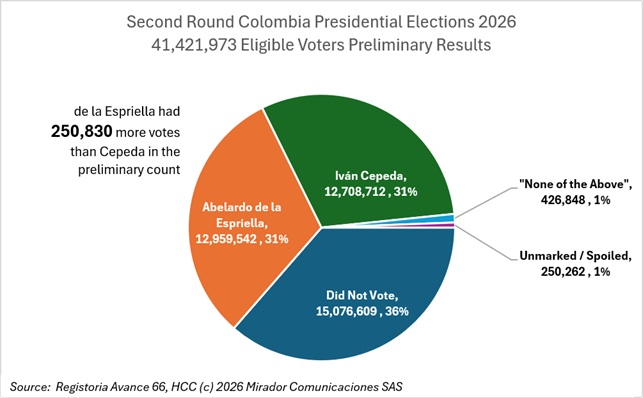
Yesterday’s presidential voting had a declared winner but the results are not definitive and the loser is contesting the result.
Read moreColombia has begun the largest distribution of individual solar solutions in the ministry's history, with the first 1,003 photovoltaic units handed over in Uribe, Meta on June 14 -- the opening act of a national program that will deploy more than 30,000 systems across non-interconnected zones and bring electricity for the first time to roughly 120,000 Colombians.
Read moreThe Colombian Institute of Petroleum and Energy Transition (ICPET), Ecopetrol's research arm, has launched an expanded operating model centered on decarbonization, circular economy applications, and nature-based solutions, deepening the institute's pivot toward energy transition technologies.
Read moreColombia's Ministry of Mines and Energy has issued Resolution 40267 of 2026, establishing the supply management framework to govern natural gas distribution during the scheduled maintenance of the SPEC regasification terminal in Cartagena, set for July 30 to August 3.
Read moreThe Ministry of Mines and Energy issued three press releases in the week of June 10--12 announcing a cluster of renewable energy deliveries and a high-profile project reactivation, presenting them collectively as evidence that the government's just energy transition is reaching remote and historically marginalized territories.
Read moreColombia's electricity generation buildout has fallen catastrophically behind schedule just as demand is hitting historic peaks, according to a detailed analysis by Valora Analitik drawing on data from grid operator XM, an ISA subsidiary.
Read moreFitch Ratings has warned that Colombia's electricity system will face heightened reliability pressure in the second half of 2026, with tightening supply-demand margins raising the risk of rationing if El Niño conditions materialize as projected.
Read moreThe governors of Córdoba, Atlántico, and Sucre signed the Plan Caribe Energético 2026-2030 on June 13, a regional energy roadmap developed through the Caribbean Regional Administrative Planning Body (RAP Caribe) in coordination with industry associations, energy companies, and technical experts.
Read more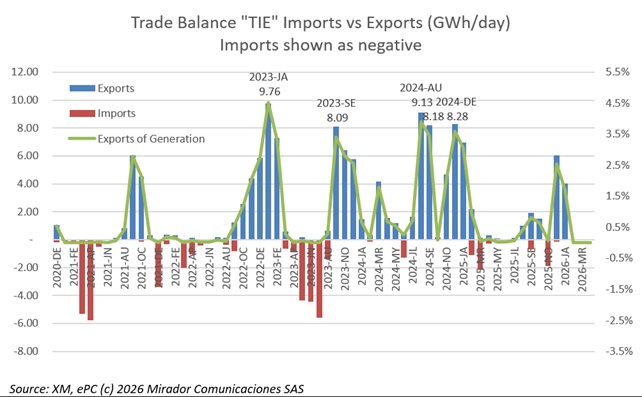
A diplomatic and commercial spat between Colombia and Ecuador spilled into the energy arena in late May, when President Gustavo Petro used his X account to signal that Colombia would be willing to resume electricity exports to its southern neighbor -- conditionally.
Read morePresident Gustavo Petro's flagship transoceanic railway project has seen its estimated cost nearly double from the CoP$54.6T figure cited by Transport Minister María Fernanda Rojas at a CAF forum last August, reaching CoP$92T according to prefeasibility studies obtained exclusively by Valora Analitik through a freedom-of-information request to the Infrastructure Planning Unit (UPIT).
Read moreEnergy Minister Edwin Palma traveled to Puerto Carreño on June 15 to announce a package of electricity investments for Vichada totaling CoP$89.9B, headlining a proposed bilateral power interconnection with Venezuela and a new 5-MWp solar plant for the departmental capital.
Read more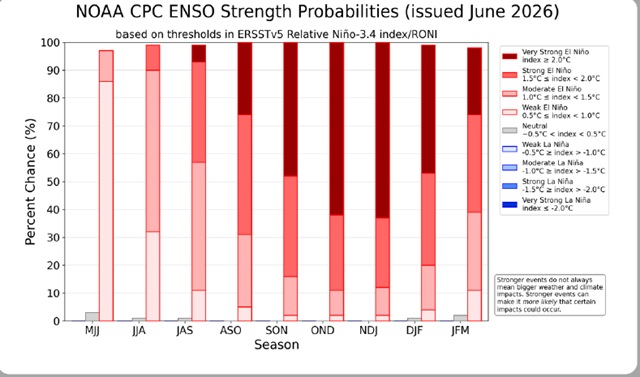
“El Nino has developed in the tropical Pacific,” says the latest report from the National Oceanographic and Atmospheric Administration (NOAA) and the forecasters expect it to “strengthen”.
Read moreColombia's Senate approved the so-called Ley Nuclear in its fourth and final legislative debate on June 11, sending the bill to the president for signature.
Read moreArgentine energy company Impsa is in advanced negotiations with Venezuelan state utility Corpoelec to revive a long-stalled hydroelectric contract that could add up to 672 MWp of generating capacity to Venezuela's chronically underpowered grid.
Read moreDeutsche Bank and Corficolombiana both published assessments on June 12 framing the same basic question ahead of Colombia's June 21 presidential runoff: what comes after the vote, and how durable will any initial market optimism prove to be?
Read moreThe Ministry of Mines and Energy announced on June 12 the creation of a Special Committee for the coordination and monitoring of El Niño response measures across the energy and mining sector, formalizing an institutional structure to manage the climatic risk the government has been tracking through 36 prior sessions of its CACSSE energy security committee.
Read moreThe May 22 reliability charge auction (OEF) awarded firm energy obligations to 15 new projects totaling 4,069 MW of capacity and 143 GWh per day, enough for the government to declare success, but not enough for industry bodies to agree with it.
Read moreFormer Minister of Mines and Energy Amylkar Acosta published a four-point demand-management plan on June 8, arguing that Colombia is already operating under conditions of "maximum hydrological and energy stress" even before El Niño has fully hit and that voluntary government appeals to save electricity are insufficient to manage what is coming.
Read moreColombia's residential electricity prices moved against the broader trend in May 2026: DANE data show a month-on-month variation of -1.93% for the electricity category, even as headline inflation climbed to 5.84%.
Read morePresident Gustavo Petro announced on June 13 via X that he had decided to liquidate Air-e, the electricity distribution company serving Atlántico, Magdalena, and La Guajira, after nearly 21 months of government intervention by the Superintendency of Public Services failed to stabilize the company.
Read moreAn ANIF report cited by Valora Analitik on May 22 puts hard historical numbers behind what Colombia's electricity sector is bracing for: every significant El Niño event of the past two decades has produced sharp spikes in residential electricity bills, driven by the system's structural dependence on hydroelectric generation (around 62% of effective installed capacity) and the much higher cost of the thermal backup that fills the gap when reservoirs run low.
Read moreAn El Tiempo investigation by Laura Lesmes Díaz offers the most comprehensive reconstruction to date of how Air-e arrived at its current crisis -- and makes a pointed argument that the distributor's collapse is not simply a legacy of private mismanagement but was significantly accelerated by the state's own handling of the intervention.
Read moreTwo opinion columns published in El Heraldo days apart arrive at the same place from opposite directions -- and together map the central contradiction of Colombia's Caribbean energy situation with unusual clarity.
Read moreWith El Niño already in a probability of 96% by year-end, Barranquilla's district administration has launched a two-track response combining immediate household demand-management guidance with longer-term urban climate adaptation investments.
Read moreWith climate models now placing the probability of a strong or very strong El Niño closing out 2026 at 96%, Colombia's association of capital cities, Asocapitales, has launched a coordinated national preparedness initiative that brings together the national disaster risk management agency (UNGRD), IDEAM, the Colombian Red Cross, and several ministries.
Read moreJuan Ricardo Ortega, CEO of Grupo Energía Bogotá (GEB), gave one of the most candid public assessments to date of Colombia's electricity and gas supply outlook in an interview covering El Niño preparedness, gas pricing dysfunction, reservoir management, the state of GEB's transmission projects, and the political environment surrounding the sector.
Read moreThe municipality of Galapa, in Atlántico department, has been subject to rolling power cuts for several weeks caused by overloading of the circuit serving the town, triggering community protests and blockades on the Cordialidad highway.
Read moreA May 13 commentary by IEA analysts Laura Cozzi, Marina Petrelli, and Arthur Roge documents how the 2026 Middle East conflict has produced an energy crisis with a dimension absent from previous shocks: the disruption of cooking fuel supplies for billions of people in emerging and developing economies, with consequences that extend from household food security to long-term clean energy transitions.
Read moreAtlas Renewable Energy is the latest international solar developer to join what El Tiempo calls Colombia's "1,000 MW club" -- a cohort of investors with announced targets at or above the gigawatt threshold.
Read moreThe Región Administrativa y de Planificación del Caribe (RAP Caribe) used its third Caribbean Energy Roundtable held in Barranquilla, to consolidate five months of technical work into a 49-measure action plan aimed squarely at the next national government.
Read moreColombia's Inspector General used a June 1 Asocapitales meeting on El Niño preparedness to deliver a pointed institutional message: the approaching climatic phenomenon cannot be managed as a water supply problem alone.
Read moreColombia's Comptroller General has issued a formal preventive fiscal control warning against the Superintendencia de Servicios Públicos Domiciliarios (Superservicios), its Fondo Empresarial, and the intervened Caribbean distributor Air-e, producing what is arguably the most damning institutional indictment of the intervention since it began in September 2024.
Read moreWith the June 21 presidential runoff looming, Colombia's energy sector is watching the electoral cycle with unusual intensity. Not because either candidate's platform is unclear, but because analysts say the first hundred days of the new administration will send market signals that reverberate for years.
Read moreThe Air-e crisis has crossed into international arbitration. On April 27, 2026, Termocandelaria -- parent company of two of Colombia's largest thermoelectric plants, Termocandelaria and Termobarranquilla -- filed a claim against the Colombian state before the International Centre for Settlement of Investment Disputes (ICSID), the World Bank's investment arbitration body.
Read moreGalapa, a municipality in Atlántico department, has become the first town in the department to face open, acknowledged electricity rationing by the government-intervened distributor Air-e and the editorial board of El Heraldo is not mincing words about what comes next.
Read moreRooftop solar is moving from environmental statement to household economics in Colombia, driven by a combination of falling equipment costs, grid-connected net metering rules, and a government program -- Colombia Solar -- explicitly designed to bring photovoltaic systems within reach of lower-income households.
Read moreThe Agencia Nacional de Hidrocarburos presented results from its 2024--2025 research program at the 5th International Natural Hydrogen Congress in May, confirming what the agency described as a significant step forward in understanding Colombia's geological potential for natural -- or "white" -- hydrogen.
Read moreColombia's Ministry of Environment issued a circular to all autonomous regional corporations, urban environmental authorities, and local governments on May 28, setting out ten operational directives for managing the El Niño phenomenon expected to consolidate in the second half of 2026 and potentially extend into early 2027.
Read moreJuan Ricardo Ortega, president of Grupo Energía Bogotá, told W Radio's 6AM program on May 28 that electricity tariffs in Colombia face an upward trajectory over the coming months, driven by three interlocking cost pressures that are coinciding at a moment of unusual vulnerability for the national energy system.
Read moreWhen the Superintendencia de Servicios Públicos intervened Air-e in September 2024, the Caribbean distributor's debt stood at approximately CoP$530B. By April 30, 2026 -- twenty months and five administrators later -- it had reached CoP$2.3T, an increase of more than 350%.
Read more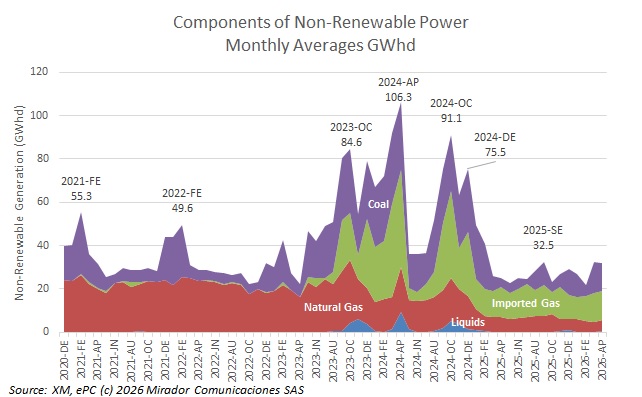
Colombia's thermal generation sector has been burning significantly more fuel since mid-May, with XM data showing coal consumption at thermal plants rising 47.9% between January and May 2026 -- from 132.7 to 196.3 GBTUd -- and gas consumption rising 65.1%, from 122.2 to 201.7 GBTUd.
Read moreNencol 5, the 2,240 MWp gas-fired thermal plant awarded a firm energy obligation in the May 22 reliability charge auction, is nominally the most consequential single result of that process -- representing 55% of the 4,069.7 MWp of new capacity assigned and 4.5% of all firm energy committed. However, El Tiempo's investigation into the project and the man behind it raises serious doubts about whether any of that will materialize.
Read moreThe Consejo Gremial Nacional issued an urgent public appeal on May 29 to the government, the Ministry of Mines and Energy, and CREG to act immediately on what it described as a real and imminent risk of both electricity and gas supply failure. Industry sources speaking anonymously to Portafolio were starker still: "we need a miracle to save ourselves from the blackout."
Read more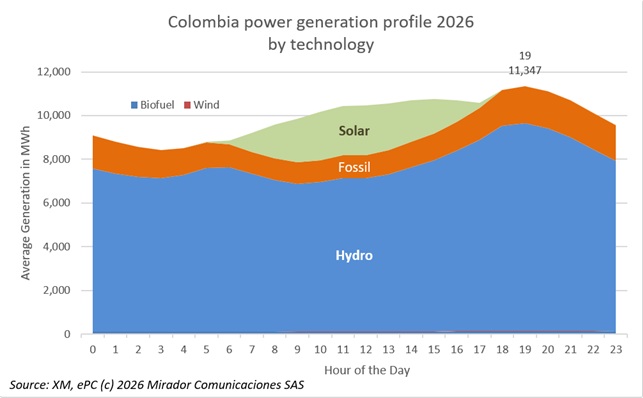
With El Niño rapidly approaching, planners are naturally concerned with the expected drop off in hydrogeneration and what they can use to replace it. Traditionally, it would be thermogeneration but, if the “Illuminati” still run the show after August 7th, they will want to use solar. We update our solar-related charts with five full months of 2026 in the books.
Read moreSimón Gaviria, writing in El Heraldo, argues that Colombia's energy debate is stuck in the wrong century.
Read moreThe Petro administration issued Decree 0526 on May 21, amending Decree 1073 of 2015 and fundamentally broadening the mandate of the Fondo de Energía Social (FOES) -- the fund that has historically financed electricity bill discounts for stratum 1 and 2 households.
Read moreColombia's 23 monitored hydroelectric reservoirs closed May at 66.38% of capacity -- a 2.35 percentage-point improvement over April's 64.03% but still well short of the 80% analysts consider the minimum safe level for withstanding a prolonged dry period.
Read morePromigas closed the acquisition of 100% of Zelestra Latam on May 28, adding a three-country renewable energy platform to its historically gas-focused portfolio and entering Chile as a new market for the first time.
Read more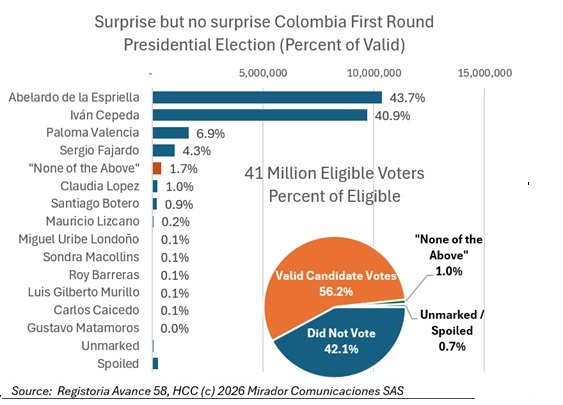
The expected candidates made it through to the second round and official government candidate Iván Cepeda got the approximately 40% of the vote that the polls said he would. But Abelardo de la Espriella surprised by getting over 43% and coming first.
Read moreThe Petro administration declared the May 22 reliability charge auction a resounding success, claiming it exceeded projected demand by 8%. Industry analysts, the power generators industry association Andeg, and the auction's most controversial winner all spent the following week telling a different story.
Read moreAlejandro Castañeda, president of the power generators industry association Andeg, declared on May 27 that Colombia faces a high probability of a blackout in March and April of next year, the product of three simultaneous failures: an undersized reliability charge auction, the financial collapse of Caribbean distributor Air-e, and the approaching El Niño phenomenon.
Read moreColombia's National Environmental Licensing Authority (ANLA) issued a public clarification on May 28 pushing back against media reports that implied the Hidroituango hydroelectric project required new regulatory approvals to raise its reservoir to 420 meters above sea level.
Read more