
Energía Atenea's subsidiary Energua (Energía del Guatapurí) has taken over as the new electricity operator for 35 municipalities across Cesar, Magdalena, and southern Bolívar, serving roughly 365,000 customers in territory carved out of Afinia's former market.
Read moreISA and its affiliated companies put personnel, technical equipment, and capabilities toward Colombia's earthquake emergency response following the August 10 event.
Read moreCarolina Escobar, who has served as president of Fiduciaria Central, will take over leadership of Hidroituango, Colombia's flagship hydroelectric project.
Read moreAtlántico governor and RAP Caribe president Eduardo Verano told the Inspector General’s newly installed technical roundtable in Bogotá that Colombia's electricity crisis won't be solved with temporary measures, arguing instead for a fundamental review of sector regulation and how the energy chain is currently organized.
Read moreXM's interim general manager Juan Carlos Morales said Colombia's electricity system remains far from the conditions that produced the 1992 blackout, even as the sector faces real El Niño-driven challenges.
Read moreThe Inspector General’s office will formally investigate former Minister of Mines and Energy Edwin Palma and former Superintendent of Public Services Elmer Felipe Durán over their alleged roles in worsening the crisis at intervened utility Air-e.
Read moreFormer Attorney General Francisco Barbosa writes in El Heraldo that Air-e's crisis illustrates a distinct kind of supply risk: a "financial blackout" that doesn't require empty reservoirs to disrupt service.
Read moreIn today’s lead story, XM's interim general manager Juan Carlos Morales said Colombia's electricity system remains far from the conditions that produced the 1992 blackout, though he didn't explain what specifically makes today's system more resilient. He was direct, instead, that "current uncertainty exceeds recent years'
Read moreGrupo Energía Bogotá posted CoP$702,000 million in net income for Q2 2026, up 15% year-on-year, driven primarily by strength in Enel Colombia's generation business and disciplined financial management.
Read moreSergio Arturo Piñeros Botero was sworn in August 13 as director of the Agencia Nacional de Licencias Ambientales (ANLA), the agency responsible for licensing hydrocarbons, electricity, and other infrastructure projects nationwide, succeeding Irene Vélez Torres.
Read moreInspector General Gregorio Eljach Pacheco installed a permanent technical roundtable on "paz energética" at his office this week, bringing together the government, regional authorities, sector agents, and control bodies to move from diagnosing Colombia's energy crisis toward folding solutions into the new 2026-2030 National Development Plan.
Read moreThe Inspector General's office is investigating a contract Air-e signed with China National Machinery Exports and Imports Corporation to finance up to CoP$1T in electrical infrastructure work, adding fresh alarm to a sector already watching the utility's finances closely.
Read moreColombia has designated 998,576 hectares of rural land as Areas Protected for the Production of Food (APPA) as of July, created under the Petro government's Agriculture Ministry to safeguard land for food production and security.
Read moreEcopetrol's Econova innovation center, in partnership with subsidiary Hocol and La Guajira's Chamber of Commerce, launched five open-innovation challenges aimed at solving strategic problems in energy transition, electrical reliability, risk management, and digital transformation.
Read moreColombia's Minister of Commerce, Industry and Tourism, Mauricio Gómez Amín, reported progress strengthening economic ties with Japan following strategic meetings in Tokyo, part of a government push to attract investment across agroindustry, technology, automotive manufacturing, and the transition to a sustainable economy.
Read moreSpeaking at Asobancaria's Banking Convention in Cartagena, Inspector General Gregorio Eljach warned that municipal governments and public entities need to get current on their electricity debts to relieve pressure on the sector's finances, confirming his office has opened disciplinary investigations over unpaid utility bills.
Read more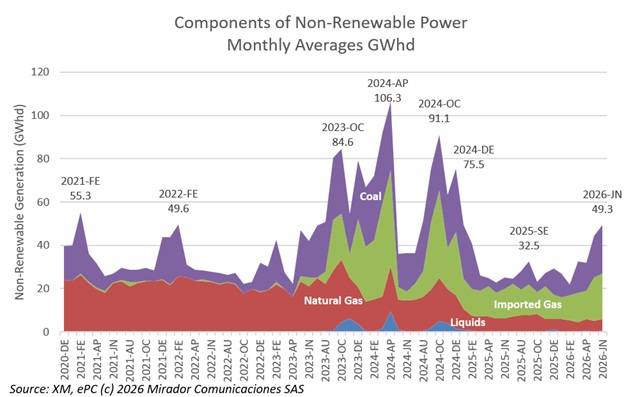
Colombia's electricity demand is projected to grow roughly 10% between 2026 and 2030, per UPME estimates cited at Andeg's 13th Energy Forum, straining a system already contending with delayed transmission projects.
Read moreAndeg president Alejandro Castañeda told the association's energy forum that despite tight physical supply and rising demand, the system's most immediate threat isn't a lack of energy but the financial state of the companies that generate it.
Read moreThe national government, through the Ministries of Finance and Mines and Energy, committed CoP$1.5T to Colombia's electricity sector under the newly named "Energy Plan NOW," aimed at protecting service continuity amid a payment-chain liquidity crisis affecting generators, transmitters, distributors, and commercializers.
Read moreFormer Minister Amylkar Acosta argues in this El Heraldo column that delays in building transmission lines and substations have stopped being a purely technical problem and become a direct cost passed to consumers – when the grid can't move power efficiently, the system falls back on more expensive generation, and that markup flows straight into household and business tariffs.
Read more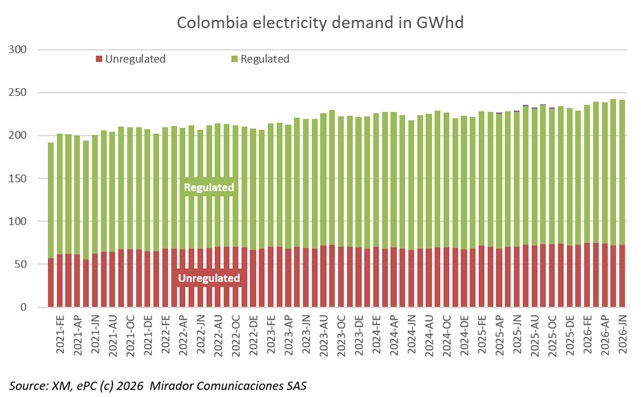
XM's wholesale market manager Jaime Alejandro Zapata told Andeg's 13th Energy Forum in Barranquilla that UPME projects Sistema Interconectado Nacional demand growing roughly 10% between 2026 and 2030, pressuring both system supply and the transmission network.
Read moreXM interim general manager Juan Carlos Morales laid out the electricity system's core vulnerability heading into El Niño: expected peak demand could exceed 265 GWh on some days, against roughly 118 GWh of thermal firm-energy obligations and around 20 GWh of daily solar – leaving hydro to cover the remaining 120-140 GWh, with no assurance about how long the dry period will last.
Read moreDeputy Minister of Energy Armando José Cuello said technical teams across the Ministry of Mines and Energy, CREG, and the Environment and Finance ministries are reviewing every available option to keep Colombia's electricity system stable through El Niño, though he stopped short of saying blackout risk is fully off the table.
Read more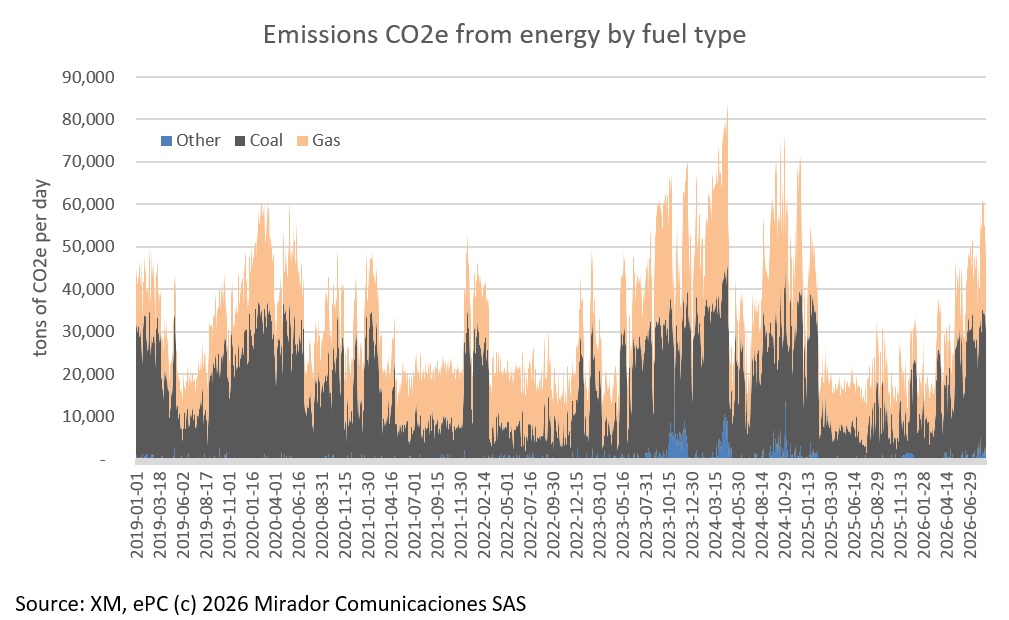
For some time, I had wanted to look at CO2e emissions from energy over the past eight years. With malice aforethought, I wanted to show were higher – or at least the same – when the “Illuminati” were running the show than during the previous administration. See graph.
Read more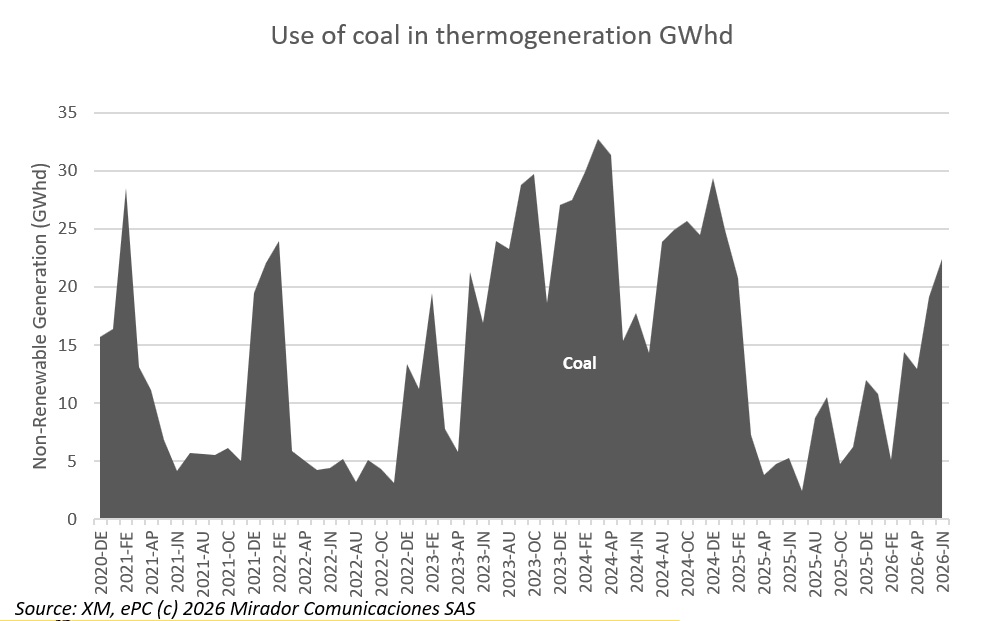
Minister of Mines and Energy María Nohemí Arboleda's administration reported a fast pivot from diagnosis to action in its first ten days, centered on institutional coordination to stabilize energy supply and tighten control over public resources.
Read moreGrupo EPM's electricity marketing companies in Colombia will implement a transitional incentive program for efficient electricity use, created by the CREG through Resolución CREG 101120 de 2026, aimed at reducing regulated demand during periods of energy scarcity, low rainfall, and supply reliability risk.
Read moreAndeg president Alejandro Castañeda struck an optimistic tone on the sector's relationship with the incoming government ahead of the association's 13th Energy Forum in Barranquilla.
Read more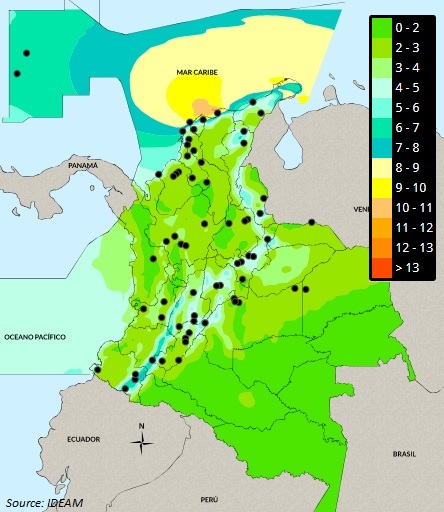
Barranquilla's district government signed a joint declaration with Copenhagen Infrastructure Partners (CIP) validating progress on "Winds of Barranquilla," (Vientos de Barranquilla) which will become Colombia's first offshore wind farm, positioned in Caribbean waters off the city's coast.
Read moreCREG executive director Adriana Jiménez said the sector's central challenge is coordinating simultaneous technological transitions across generation, grids, storage, and end users into a sustainable, integrated system, rather than regulating each shift separately.
Read moreAquiles Mercado's El Heraldo column frames global energy security as newly central to IMF and World Bank discourse, arguing that geopolitical instability – chiefly the Iran conflict and Strait of Hormuz risk – has pushed capital toward resource-rich, conflict-distant regions like Latin America, with Colombia positioned to benefit given its energy, mineral, and food resources.
Read moreColombia's electricity sector is navigating one of its most critical stretches since the 1992 blackout – tight supply-demand margins, delayed generation and transmission projects, gas supply strain, generator debt, and subsidy payment delays – with intervened utility Air-e's financial collapse now widely described as a systemic risk rather than a regional problem.
Read moreColombia's Ministry of Environment and Sustainable Development swore in its new leadership team on August 13, including Sergio Arturo Piñeros Botero as director of the Agencia Nacional de Licencias Ambientales (ANLA), the agency responsible for environmental licensing of major electricity infrastructure, from transmission lines to solar and wind farm development.
Read moreErco Energía announced the close of a US$129 million equity Series C round, funds the company said will strengthen its capacity to develop and build energy projects across Colombia.
Read moreAfinia called on authorities in Calamar, Bolívar, to guarantee the safety and mobility of its technical crews after several teams faced detentions and restrictions that have hampered maintenance and modernization work on the municipality's electrical infrastructure.
Read more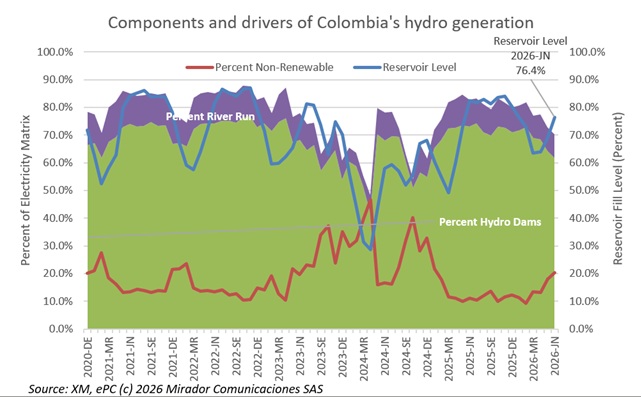
XM’s June report provides yet more graphic evidence that despite the rhetoric and ex-President Gustavo Petro’s visceral hatred of the thermogenerating industry, the matrix did indeed shift to protect the reservoirs. We also look at demand growth over the past four years.
Read moreConstruction is progressing on the APBAQ I solar farm in the Juan Mina district, one of Barranquilla's principal energy transition projects, aimed at generating clean power to support the city's public lighting system.
Read moreThe Ministry of Mines and Energy issued Circular 40034, requiring every ministry, decentralized entity, and other national-level government body to design and implement an Action Plan for energy savings and efficient use within 15 business days.
Read moreAir-e's August electricity rate rose to CoP$890.26/kWh, still below the national average of CoP$957.27/kWh among Colombia's main commercializers.
Read moreResidents of several Riohacha neighborhoods marched on Air-e's office on the Circunvalar avenue the night of August 4, blocking the road to Maicao and throwing stones at the building's façade, with some setting fires nearby.
Read moreThe previous government announced Colombia's most recent Reliability Charge auction, held May 22nd as a success – 15 new generation projects plus an existing plant's expansion, an estimated CoP$16T in investment, and 4,069.7 MW of new capacity assigned to meet demand for December 2029-November 2030. But …
Read moreColombia's El Niño phenomenon is expected to intensify in October and November, prompting think tanks and analysts to call for early-warning mechanisms to avoid any resort to energy rationing.
Read moreThe Ministry of Mines and Energy provided a full update on electricity restoration following the August 10 earthquake and its aftershocks, which knocked out power to more than 1.5 million users – concentrated in Chocó, Valle del Cauca, Risaralda, Caldas, Quindío, Cauca, and Nariño – and disconnected roughly 1,700 MW of demand, equivalent to 18% of national consumption at the time.
Read moreAir-e's intervening agent, Jaime Mesa Buitrago, detailed new tiered electricity tariffs at a Consejo Nacional de Operación de Gas (CNO Gas) meeting in Barranquilla led by then Minister Edwin Palma, under which consumers who reduce usage can earn discounts of up to 40%, while those exceeding set thresholds will pay progressively more.
Read moreColombia's electricity sector needs CoP$10-13T in annual generation investment to close firm-energy deficits, with grid infrastructure requiring a similar sum to keep pace with demand growth, figures that could rise further if Colombia pursues broader economy-wide electrification and its 2050 emissions targets, according to Raúl Lancheros, Acolgen's director of sectoral affairs and regulation.
Read moreColombia's National Council for Economic and Social Policy (CONPES) approved the country's first National Hydrogen Policy document, with then-MinEnergia Edwin Palma casting a favorable vote in the non-in-person session, establishing an intersectoral roadmap to develop hydrogen as a strategic sector through 2031.
Read moreColombia's electric vehicle boom has shifted the industry's central challenge from selling cars to building the network that keeps them moving.
Read moreThe Colombian Geothermal Association (AGEOCOL) will hold the 8th National Geothermal Meeting (RENAG 2026) October 27-30 at the SENA Industry and Services Center in Villavicencio, Meta, organized alongside SENA and with support from Germany's GIZ.
Read moreThe national government approved a modification to SPEC LNG's environmental license in Cartagena, adding 58 million cubic feet per day of natural gas capacity to strengthen the country's supply.
Read moreColombia's August 10th magnitude-7.4 earthquake knocked out roughly 18% of national electricity demand, with the heaviest impact concentrated in Chocó, Valle del Cauca, Quindío, Caldas, and Risaralda, according to preliminary information from MinEnergia María Nohemí Arboleda and system operator XM.
Read moreMaría Nohemí Arboleda, sworn in as Colombia's new Minister of Mines and Energy under President Abelardo De la Espriella, summarized the state of the sector bluntly in her first hours in office: "the situation is critical, but not lost."
Read moreThe Asociación Nacional de Empresas de Servicios Públicos y Comunicaciones (Andesco) delivered a "critical" balance of the Petro government's energy record as it left office, warning the incoming administration faces financial, regulatory, and supply risks despite genuine transition-era progress over the past decade.
Read moreColombia's average wholesale spot price reached CoP$562.1/kWh in June 2026, up 395.7% from CoP$113.4/kWh in June 2025 and 8.9% from May, driven by increased thermal generation's share of the mix.
Read moreAn El Espectador retrospective on the Petro government's energy record found sharp disagreement on the electricity side, where genuine renewable-capacity gains sit alongside execution delays and a financial crisis at one of the Caribbean's main distributors.
Read moreThe Household Public Services User League (Liga Nacional de Usuarios de los Servicios Públicos Domiciliarios) pushed back against former Minister Edwin Palma's plan to penalize energy waste during the current drought.
Read moreOn Friday, August 7th Abelardo de la Espriella was sworn in as Colombia’s President for 2026 to 2030, a critical period for the county’s energy sector.
Read more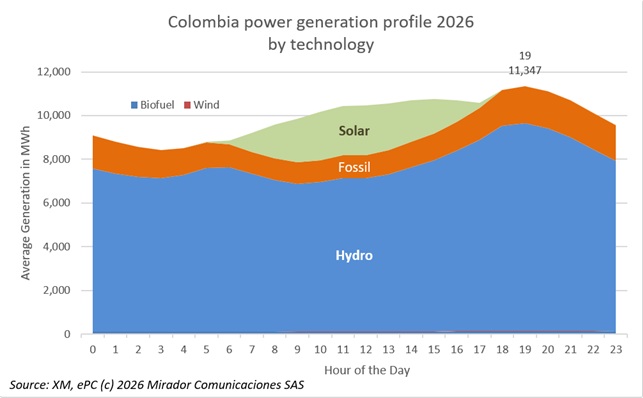
The outgoing Petro government has celebrated surpassing 4.6 GWp of installed solar and wind capacity, exceeding its 4 GWp target under the 6GW+ program and putting clean sources at 74.16% of the national grid’s installed capacity.
Read moreVice President José Manuel Restrepo presented findings from 62 technical transition meetings held with the General Controller, a process he called "historic" in the country's democratic life.
Read moreThe Superintendencia de Industria y Comercio (SIC) formally charged Enel Colombia, AES Colombia, and Celsia Colombia, finding preliminary evidence suggesting conduct that may have affected free economic competition in the Mercado de Energía Mayorista (MEM).
Read moreThe Inspector General’s First Delegate for State Contracting suspended Brayan Giraldo Ruiz, executive director of the Fondo de Energías No Convencionales y Gestión Eficiente de la Energía (Fenoge), for three months and opened a disciplinary investigation over alleged irregularities in a contracting process worth more than CoP$164,000 million
Read moreArmando Cuello Navarro, tapped as Vice Minister of Energy under incoming Minister María Nohemí Arboleda, arrives with direct electricity-sector operating experience: he most recently served as general manager of CEO (Compañía Energética de Occidente), the Cauca electricity distributor and Promigas subsidiary, where he led initiatives on innovation, operational efficiency, and sustainability.
Read moreThe Global Environment Facility (GEF) Council announced the selection of Diego Mesa Puyo, Colombia's former Minister of Energy and Mines, as the fund family's next CEO and Chairperson, for an initial four-year term aligned with the GEF-9 funding period.
Read moreFormer Minister of Mines and Energy Amylkar Acosta argues in this El Heraldo opinion column that the risk of simultaneous electricity and natural gas rationing in Colombia is real, not alarmism, though whether it materializes depends on rainfall, thermal-fuel availability, and how quickly contingency measures are adopted.
Read moreThe Comisión de Regulación de Energía y Gas (CREG) announced progress on the long-running Colombia-Panama electricity interconnection project, publishing a Complementary Agreement with Panama's Autoridad Nacional de los Servicios Públicos (ASEP) that establishes the remuneration scheme for the interconnection
Read moreGrupo EPM reported consolidated Q2 2026 revenue of CoP$19.5T, EBITDA of CoP$5T, and net income of CoP$3.2T, attributing the results to "solid operations, efficient use of resources, and a diversified business portfolio."
Read moreThe Ministry of Mines and Energy ordered every network operator in the country to mandatorily report information on connection points for generation, cogeneration, self-generation, distributed generation, and energy community projects currently in process, pending approval, awaiting energization, or rejected over the past twelve months,
Read moreThe Superintendencia de Servicios Públicos Domiciliarios published "Generación Eléctrica en Colombia 2026: Concentración, Riesgos y Transición Energética," the first study from its new Observatorio de Servicios Públicos Domiciliarios, identifying structural vulnerabilities in the national generation fleet even as the country advances on renewables.
Read moreThe Ministry of Mines and Energy is setting up a dedicated cybersecurity monitoring center (CMS) providing continuous monitoring, early threat detection, and coordinated incident response across the sector's technology infrastructure.
Read moreThe Ministry of Mines and Energy issued Resolución 40334, simplifying the connection process for public electric vehicle and plug-in hybrid charging stations to the electrical grid, aiming to accelerate deployment of what it called strategic infrastructure for the country's clean mobility transition.
Read moreThe Comisión de Regulación de Energía y Gas (CREG) formally approved a measure offering discounts of up to 40% on electricity bills for households that cut consumption by up to 30%, with surcharges applied to users who exceed reference consumption levels.
Read moreInterconexión Eléctrica S.A. (ISA), Ecopetrol's transmission and infrastructure subsidiary, reported operating revenue of CoP$8.6T for the first half of 2026, up 17% year-on-year, with EBITDA reaching CoP$4.9T (+20%) and net income of CoP$1.3T (+9%).
Read more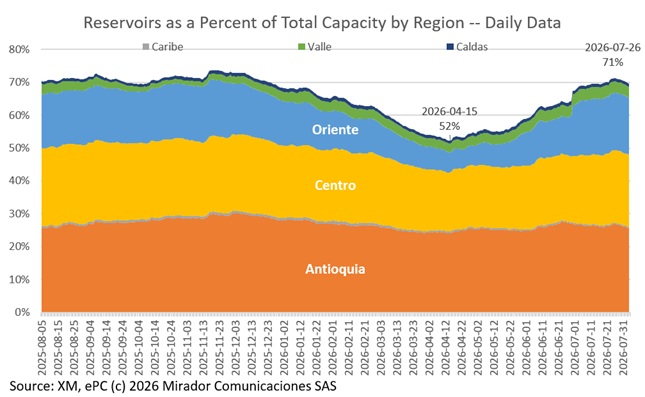
Colombia's hydroelectric reservoirs closed July above 80% of capacity nationally, according to XM data -- the level the system operator considers the minimum threshold needed to withstand a drought, and the highest reading recorded so far in 2026.
Read moreThe Ministry of Mines and Energy formally acknowledged that Colombia needs to incorporate more firm energy to guarantee electricity supply in coming years, asking the Comisión de Regulación de Energía y Gas (CREG) to advance new Firm Energy Obligations (OEF) assignments and hold whatever reconfiguration auctions are needed to strengthen the national grid (SIN).
Read moreSpeculation about a potential sale of Ecopetrol's controlling stake in ISA to Grupo Energía Bogotá (GEB) moved through three distinct stages over three days in late July, ending where it started: interest without a deal.
Read moreA fast-developing El Niño episode -- potentially among the six most intense since 1870 -- has Deutsche Bank warning of inflationary pressure, economic disruption, and possible monetary policy effects across Latin America, with Colombia identified as the region's most exposed economy.
Read moreA public dispute broke out over Air-e's financial trajectory nearly two years into its government intervention, with Caribbean Region Users League coordinator Norman Alarcón directly challenging claims from SuperServicios Felipe Durán that more than 20 actions have been taken to stabilize the utility.
Read moreThe Ministry of Mines and Energy closed its Clean Energy Contracting Auction with what it framed as a turning point for the country's power system: the first long-term contracting mechanism to incorporate battery energy storage systems (BESS) alongside solar generation, multiplying the country's contracted storage capacity by a factor of ten.
Read moreEmpresas Públicas de Medellín issued a broad appeal tied to El Niño risk this week, notable less for its urgency than for its scope: rather than the single-service warnings that have dominated recent coverage, EPM is flagging conservation needs across water, electricity, and gas simultaneously – a reflection of just how much of Colombia's utility infrastructure runs through the company.
Read moreColombia's National Interconnected System came through the five-day SPEC regasification maintenance window without disruption to grid reliability, and the terminal itself confirmed a clean finish.
Read moreColombia's Constitutional Court reviewed three decrees issued under the Economic Emergency declared by Decreto 150 de 2026 in response to the extreme weather event of early 2026, upholding most measures while striking some provisions and conditioning others to the actually affected areas.
Read more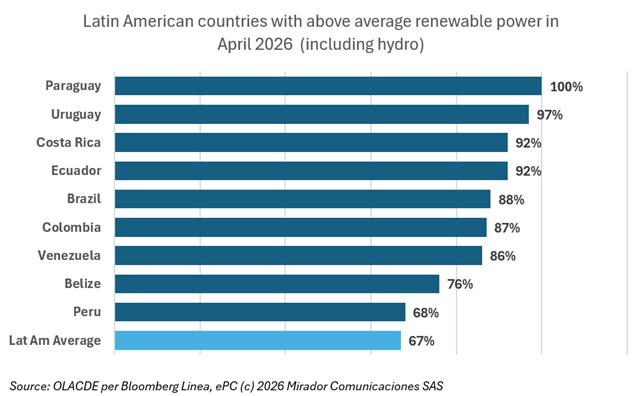
Nine of the 27 member countries tracked by the Organización Latinoamericana y Caribeña de Energía (Olacde) posted renewable (including hydro) shares above the regional average in April, as the region's overall electricity output climbed 4.5% year-on-year to 164 TWh.
Read moreGrupo Energía Bogotá president Juan Ricardo Ortega delivered his most detailed public assessment yet of Colombia's transmission crisis through two Valora Analitik pieces in consecutive days -- a letter to president-elect De la Espriella and a direct interview. Read together, they form a comprehensive indictment of four years of energy infrastructure paralysis and a precise warning about what comes next if it continues.
Read moreDelivered at the inauguration of a solar project in Manaure, La Guajira, Minister Edwin Palma's July 23rd call for telework and study-from-home schemes represents the most direct government intervention yet on the demand side of Colombia's El Niño preparedness.
Read moreThe resolution enabling private-sector electricity transactions between Colombia and Ecuador was confirmed legally on July 22, Minister Edwin Palma announced via X, clearing the way for the resumption of International Electricity Transactions (TIE) between the two countries in the coming days.
Read moreColombia's two most important La Guajira clean energy infrastructure announcements of the transition period arrived together on July 24: the Colectora 500 kV transmission line -- the dedicated highway for Guajira wind energy -- reaching 90% overall construction completion, and a draft regulatory resolution designed to prevent the wind projects that will connect to it from being cancelled due to the planning mismatches that have dogged Colombia's renewable buildout.
Read moreThe first invoices under the Colombia Solar program have arrived in the Villas de San Pablo neighborhood of Barranquilla -- and the numbers are striking.
Read moreColombia's Ministry of Mines and Energy hosted a two-week Regional Training Workshop for Front-Line Officers in Nuclear Physical Security Detection in Bogotá on July 25, organized jointly with the International Atomic Energy Agency (OIEA).
Read more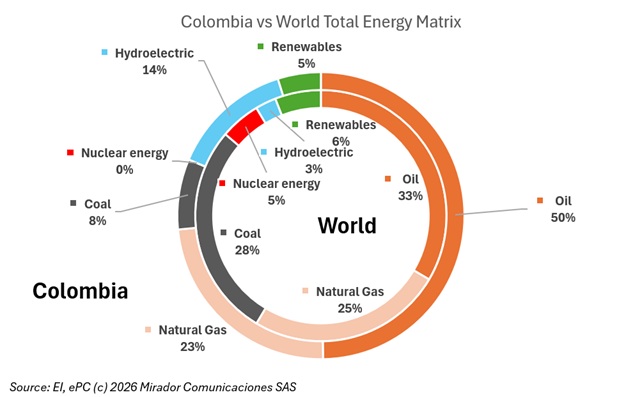
This morning I read a Bloomberg Energy newsletter piece about the growing disenchantment with LNG for Asian emerging markets importering countries and it got me thinking, again, about the long-term impact on the global energy matrix of the Iran War.
Read moreThe outgoing Petro government issued two related but distinct resolutions in the final weeks of its mandate that together address the structural problems most frequently cited for Colombia's electricity supply crisis: the chronic disconnect between generation and transmission project planning, and the grid's vulnerability to high-impact disruptions from extreme weather, equipment failure, and cyberattack.
Read moreThe outgoing Petro government recorded an important achievement: Colombia's installed capacity in solar and wind energy reached 4,626.73 MWp as of July 17th, 2026, surpassing the 4 GWp milestone of the administration's flagship 6GW+ program and representing a more than twenty-fold expansion from the approximately 200 MWp of non-conventional renewable capacity the government inherited in August 2022.
Read moreColombia's electricity system has crossed a threshold its operator XM had been warning about for years: available firm energy is no longer sufficient to cover projected demand under extreme drought scenarios, and the shortfalls are projected to persist across three consecutive reliability charge periods.
Read moreThe Comisión de Regulación de Energía y Gas (CREG) has named economist Adriana Jiménez Delgado as executive director for a 12-month term, formalized under Resolution CREG 105 015 of 2026.
Read moreWith fewer than two weeks left in his administration, President Gustavo Petro declared a national disaster for the El Niño phenomenon on July 23rd – Colombia's first such declaration linked explicitly to an electricity supply emergency – and simultaneously ordered a CoP$4T budget reallocation to the National Disaster Risk Management Unit (UNGRD), bringing its total El Niño resources to CoP$8T.
Read moreA comprehensive El Heraldo analysis published July 26th, based on interviews with six sector leaders, delivers the most structured account yet of the structural failures that have placed Colombia in its most vulnerable energy position since the 1992 blackout.
Read moreLa Guajira is the most electricity-poor department in Colombia's Caribbean region, with energy coverage reaching just 54.6% of its territory according to UPME, a figure that puts it well below the already inadequate national rural average of 75.9% that leaves 1.4 million homes across the country dependent on candles, kerosene, and other costly and polluting alternatives.
Read moreColombia's electricity system enters its most exposed five-day window of 2026 on Thursday, when SPEC shuts for scheduled maintenance through August 3rd .
Read moreThe clearest articulation yet of why El Niño is simultaneously a gas crisis and an electricity crisis came from Tomás González in a recent interview with El Tiempo, in which the former Mines and Energy Minister mapped the convergence of pressures the de la Espriella government will face from day one.
Read moreOutgoing Minister Edwin Palma disclosed on July 22nd, at a Colombia Solar ceremony in Barranquilla, that the transition team coordinating the sector handover for the incoming De la Espriella government had sent the ministry an official written request to abstain from continuing to execute and expand the Colombia Solar program during the transition period.
Read morePetro's outgoing government filed its final tax reform before the new Congress on July 21st, placing the mining and energy sector at the center of fiscal controversy for the second time in four years.
Read moreThe President's Legal Secretary had several decrees in process on July 17th accepting senior official resignations, El Tiempo's Investigative Unit reported, as the outgoing Petro government entered its final three weeks.
Read more